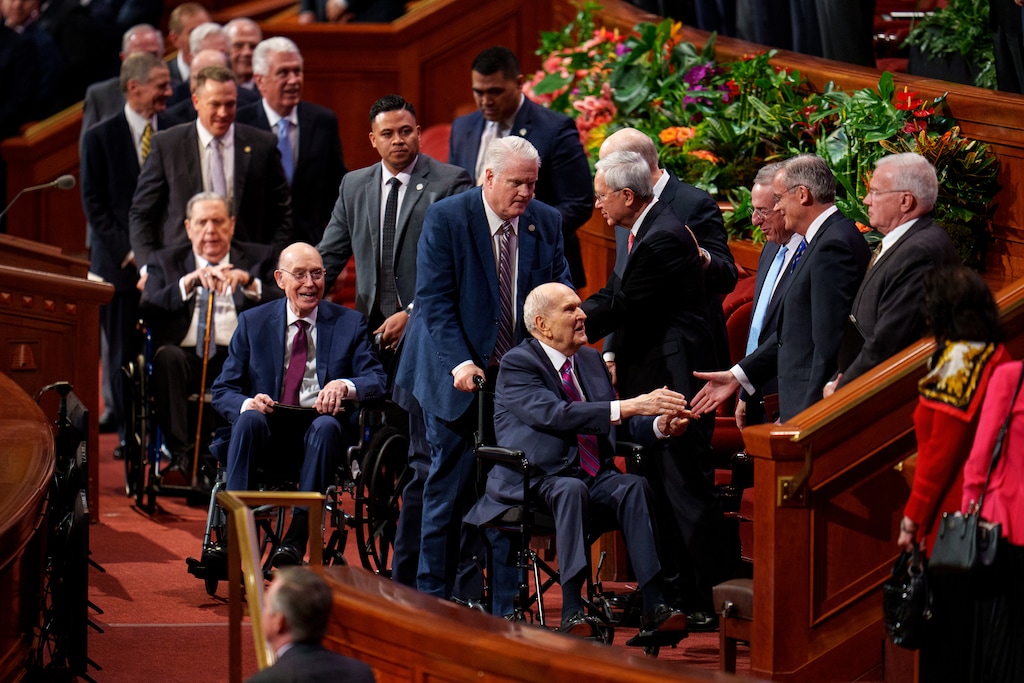
The precedent for the most senior apostle in The Church of Jesus Christ of Latter-day Saints to preside over the faith was firmly fixed by the late 19th century. Yet church leader Hugh B. Brown never liked the way the faith chose its president. Rather than being selected on their fitness to lead, church presidents were picked based solely on their seniority as an apostle. Brown also disliked that the First Presidency and the Quorum of the Twelve Apostles — the church’s top two governing bodies — were occupied by old men, most of whom were in their 70s and 80s.
Never one to keep his opinions to himself, Brown told First Presidency counselor J. Reuben Clark in 1945 what he thought of the church’s aging leadership. Clark recorded in his diary:
“Hugh B. Brown — Quite a long talk with him. He says a very great deal of frank talk and dissatisfaction in the church. Dissatisfaction seemed to be over the fact that so many of the general authorities were getting old.”
There was irony about Brown expressing himself so bluntly about aging leaders; he was one of them. Brown was called as an apostle in 1958 at age 74 and into the First Presidency at age 77. He frequently joked about his age. “Brothers and Sisters, you’re looking at an antique,” he once began a talk. But underlying that humor was Brown’s deep concern that the gerontocracy wasn’t serving the church well. No example better illustrated this than when he worked closely with nonagenarian church President David O. McKay. Brown noted that the president frequently missed meetings due to frail health. He also observed that McKay had trouble remembering and deciding things.
(The Church of Jesus Christ of Latter-day Saints) From left, N. Eldon Tanner, David O. McKay and Hugh B. Brown served together in a First Presidency.
“President McKay cannot make decisions and is not capable of running the church,” Brown confided to friends. When word got back to McKay’s secretary, Clare Middlemiss, about what Brown had been whispering in private, she noted sharply, “President Brown is telling everybody that President McKay cannot run the church.” Brown also told his friends that 93-year-old apostle Joseph Fielding Smith, who was next in line for the church presidency, wasn’t fit to lead either.
In October 1969, when McKay fell into a coma and was nearing the end of his life, Brown became even more emphatic in his views, urging the apostles to leapfrog over Smith when McKay died and appoint 70-year-old apostle Harold B. Lee as McKay’s successor.
Brown told the apostles that “President Smith could not possibly assume this position. He sleeps now through most of the meetings and is too old.” He then added, “The matter of the president of the Quorum of the Twelve becoming the president is after all simply a tradition and need not be followed.”
(The Church of Jesus Christ of Latter-day Saints) President David O. McKay with U.S. President John F. Kennedy in the Tabernacle in September 1963. McKay died in 1970 at age 96.
(The Church of Jesus Christ of Latter-day Saints) Behind the scenes, apostle Hugh B. Brown argued that Joseph Fielding Smith, pictured here, wasn't healthy enough to lead the church.
(The Church of Jesus Christ of Latter-day Saints) Harold B. Lee eventually did become church president, though his tenure was short.
Pushing and pushback
It’s tempting to think that Brown was going rogue when he made this proposal, but he wasn’t. Former church President Heber J. Grant, who was Brown’s mentor and his mission president, taught him that there was nothing sacred or doctrinal about the most senior apostle becoming the president, nor was there justification for it in scripture. It was simply a tradition.
The apostles knew that there would be significant risks having the ailing Joseph Fielding Smith as the church president. They worried that he would stumble over his words in General Conference, and embarrass himself and the church. They had good reason to worry. Smith was dozing through meetings, couldn’t remember things, and often repeated himself to friends and family. They also knew of Grant’s strong views about presidential succession because they had heard them, too. Nevertheless, they feared change; they didn’t want to alter “the proper order of things,” as then-apostle Spencer W. Kimball put it. They asserted that it would take a divine revelation to change the practice of presidential succession.
And yet, Brown pushed for change. That, of course, didn’t endear him to his colleagues. In January 1970, he was dropped from the First Presidency shortly after McKay died. Even so, Brown continued expressing his opinions about the church’s gerontocracy problem. After witnessing Smith sit through a series of meetings with the apostles “for seven hours without saying a word,” Brown made his most radical proposal yet to overhaul how the church chooses its president.
Emeritus status proposed
(Vatican Media via AP) Apostle Hugh B. Brown favored a system for selecting the Latter-day Saint president more akin to how the College of Cardinals picks a Catholic pope. Here, the cardinals sit inside the Sistine Chapel at the Vatican at the start of the conclave to elect a successor in Pope Francis in 2025.
Borrowing ideas from his friends Marion Hanks and Paul Dunn, also high-ranking church leaders, Brown proposed that all general authorities, including the Quorum of the Twelve and the First Presidency, be given emeritus status at age 70. He proposed that apostles select the church president in a private meeting, in much the same way the College of Cardinals picks the pope in the Catholic Church. There wouldn’t be smoke wafting out of the Salt Lake Temple to signal that a new leader had been selected. The new president, rather, would be announced at General Conference, and he would be selected based on his health, vigor and fitness to lead — not on his seniority among the apostles.
If Brown’s proposal had passed, it would have been the most consequential policy change in the 20th-century church, second perhaps to lifting the priesthood and temple ban on Black members in 1978. His proposal would have shattered the church’s succession tradition. Most of the apostles would have been emeritized immediately, including Brown, because they were over 70. Still, they rejected it — even though they knew there was precedent for releasing general authorities for “age and infirmity.” At least one apostle, Charles C. Rich, was released for ill health during church President John Taylor’s administration in the 1880s, and several other lower-ranking general authorities were released as well.
For Brown, knowing that there was precedent for releasing infirm leaders emboldened him, but he also believed that it was the right thing to do. The apostles could retire with their dignity intact.
Even though the apostles didn’t accept Brown’s proposal, his efforts did not go unheeded. In 1978, N. Eldon Tanner of the governing First Presidency announced in General Conference that members of the First Quorum of Seventy — which ranked just below the Quorum of the Twelve and the First Presidency — would achieve emeritus status at age 70.
Tanner didn’t explain why the Quorum of the Twelve and the First Presidency exempted themselves from emeritus status, and Brown wasn’t around to influence them. He had died in 1975 at age 92, unaware that the seeds he planted years earlier had borne partial fruit.
Brown’s extraordinary proposal is worth remembering today for two reasons: First, it demonstrates his humility in recognizing that younger and more vigorous men could be better equipped to lead the church. And, second, it recognizes the fragile distinction between policy and doctrine and what could be changed through executive decision or divine revelation.
(Courtesy) Historian Matthew Harris is the author of this book about the former priesthood/temple ban against Black members of The Church of Jesus Christ of Latter-day Saints.
Note to readers • Matthew L. Harris is a professor of history at Colorado State University-Pueblo and author of the acclaimed book “Second-Class Saints: Black Mormons and the Struggle for Racial Equality.” He is currently writing a biography of Hugh B. Brown. This column is available to Salt Lake Tribune subscribers only. Thank you for supporting local journalism.