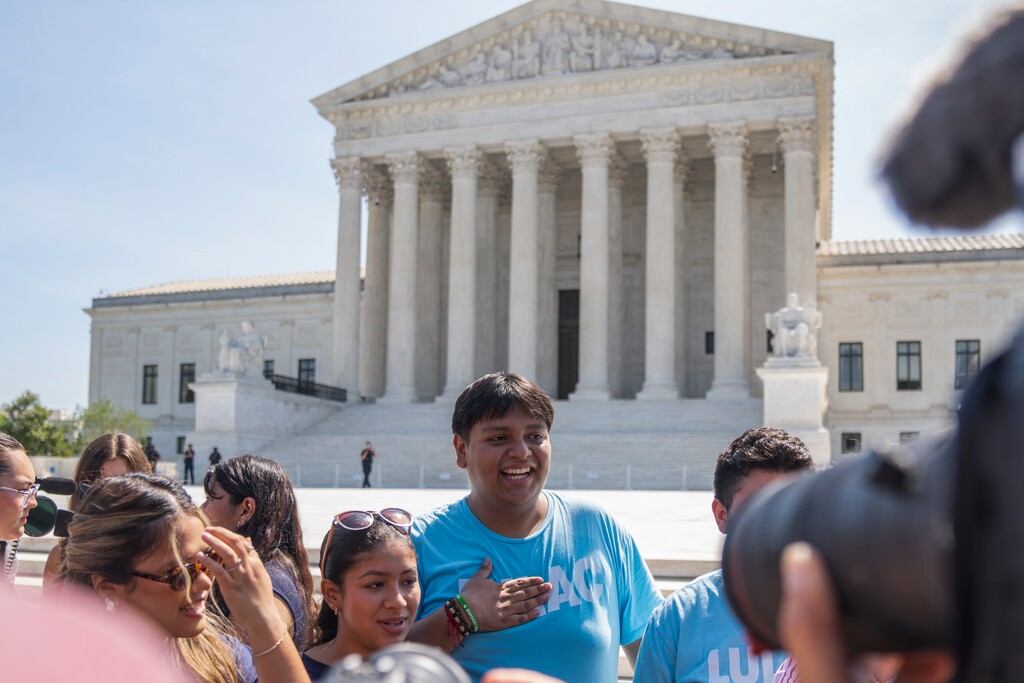
The Supreme Court of the United States Tuesday upheld the plain language of the 14th Amendment to the U.S. Constitution. It ruled, 6-3, that anyone born in the United States is automatically a citizen of this great nation — a principle that is a big part of what makes this nation great.
Too many Utah politicians are upset by that outcome. Utahns who remember their history, and their humanity, should not be. And they should tell their politicians to accept and honor this ruling.
Utah Attorney General Derek Brown had signed onto a brief urging the court to uphold Donald Trump’s unconscionable and unconstitutional executive order giving him the power to set the constitutional provision aside. Utah Sen. Mike Lee quickly launched a social media tantrum calling for a constitutional amendment to gut the birthright citizenship provision.
The history and the principles of Utah hold otherwise.
Settled by refugees, founded by a global religious order that welcomes all nationalities, and led — until recently, anyway — by people who signed onto the 2010 Utah Compact, Utah has a proud tradition as a welcoming culture. The Utah Compact is a declaration calling for compassion, support for families and a recognition of the economic and social contributions made by immigrants and refugees.
Having nothing constructive to offer our nation, Trump, Lee and too many others, mostly Republicans, seek, win and hold power by instilling fear of the other. Lee’s new campaign to eliminate the 14th Amendment will no doubt keep him busy and energized, filling his X feed and his fundraising appeals. But, quite rightly, it stands no chance of becoming law.
The historically grounded and well-reasoned opinion from Chief Justice John Roberts recalls exactly what everyone thought the amendment, and laws passed by Congress since it was adopted 168 years ago, meant. Until Donald Trump, as part of his campaign of fear and xenophobia, started spreading the lie that birthright citizenship is a bad idea that he had the power to sweep aside.
The idea of birthright citizenship, Roberts writes, harkens back to English common law and easily crossed the Atlantic to become embedded in American law. Individual states, as well as the nation, took the idea for granted.
The idea that birthright citizenship had to be encoded in our written laws only arose during and after the Civil War, when apologists for slavery argued that slaves, and former slaves, didn’t deserve the protections of American citizenship. The 14th Amendment, other acts of Congress, and the Supreme Court’s ruling in 1898 holding that a child born in the U.S. to Chinese immigrants was automatically a citizen, all united to destroy any doubt.
Beyond the principle involved, the fact is that if birthright citizenship isn’t a given, the political and bureaucratic mess that will necessarily follow, sorting the worth from the unworthy, will leave far too much to the whims of successive administrations, endangering millions and turning American against American in a way that will be destructive of the very core of our nation.
The justices of our highest court on Tuesday upheld what we are as a nation.
Editorials represent the opinions of The Salt Lake Tribune editorial board, which operates independently from the newsroom.