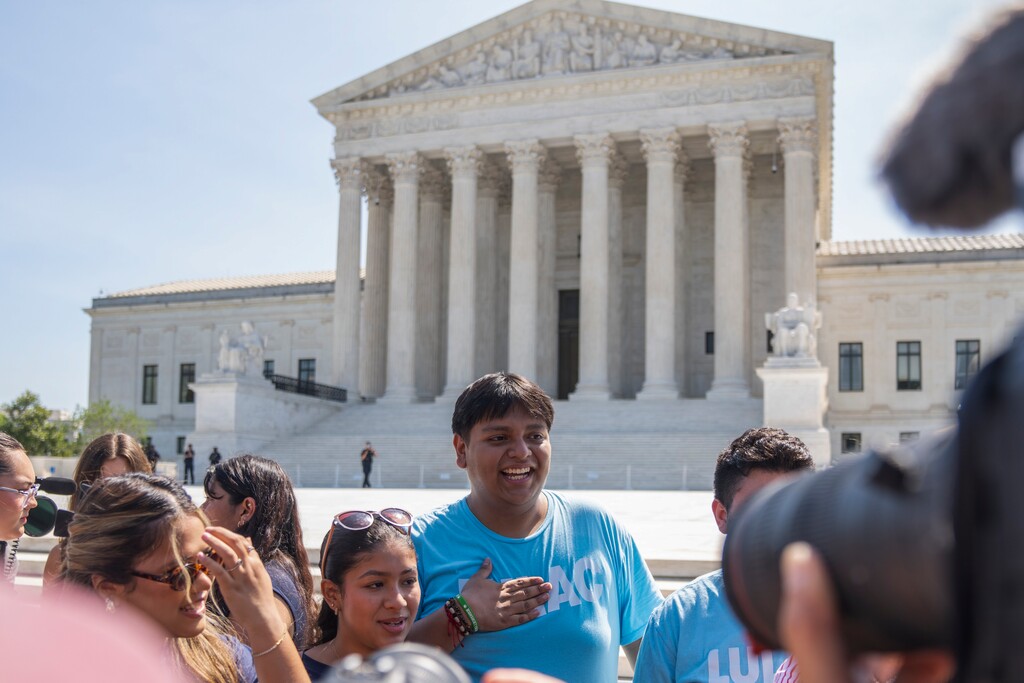
Washington • The Supreme Court on Tuesday struck down President Donald Trump’s executive order limiting birthright citizenship, reaffirming the long-held principle that the Constitution guarantees that nearly all children born on U.S. soil are citizens.
The ruling, which was 6-3 to strike down the president’s executive order, was a blow to a policy long pursued by Trump to prevent babies born to immigrants lacking permanent legal status and temporary foreign residents from automatically becoming Americans.
Chief Justice John Roberts, writing for the majority, explained that Trump’s executive order violated the 14th Amendment of the Constitution. Children born in the United States to undocumented parents or to parents temporarily in the country, he wrote, are citizens at birth.
“Citizenship, then and now, was the right to have rights — to freely participate in our political community,” Roberts wrote. “The framers of the 14th Amendment extended that promise to ‘every free-born person in this land.’”
He added: “We keep that promise today.”
The chief justice was joined in upholding birthright citizenship by the court’s three liberal justices, along with fellow conservatives Justices Amy Coney Barrett and Brett Kavanaugh, although Kavanaugh wrote that he would strike down the executive order based on federal law, not the Constitution.
Justice Clarence Thomas dissented, joined by two of the court’s conservatives, Justices Samuel Alito and Neil Gorsuch. Neither Alito nor Gorsuch was on the bench Tuesday, the court’s final opinion day of the term.
A court spokesperson did not immediately respond to a request for information about their absences.
In his 91-page dissent, Thomas said that the 14th Amendment was designed to enshrine citizenship for formerly enslaved people and their descendants, a repudiation of the court’s infamous Dred Scott case that had denied citizenship to Black people.
“Blacks were entitled to citizenship because they were Americans,” Thomas wrote. “They had no other homeland, owed no allegiance to any foreign power, and were subject to no other authority.”
He added that, in his view, “the same could not be said for the children of foreign temporary visitors,” who he described as “attached to their home country” and who he characterized as lacking “similar bonds to this country” and who “would not be called upon in time of war.”
The legal battle over birthright citizenship began on the first day of Trump’s second term, when he announced an executive order titled “Protecting the Meaning and Value of American Citizenship.”
In the order, he declared that citizenship would no longer be automatically granted to babies born on U.S. soil. In particular, children born to immigrants who entered the country illegally would no longer be citizens, nor would those born to parents here on a lawful but temporary basis, such as those on student, work or tourist visas.
The president’s order faced immediate legal challenges, as civil rights organizations, immigrant advocacy groups and expectant parents sued, successfully winning in court to block the order while lawsuits unfolded.
It never went into effect, and there were few signs the administration had been preparing the dramatic overhaul of the citizenship system that would have been necessary were it allowed.
The challengers pointed to the text of the 14th Amendment, which reads: “All persons born or naturalized in the United States, and subject to the jurisdiction thereof, are citizens of the United States and of the state wherein they reside.”
(Minh Connors | The New York Times) Siblings Sandra Wong and Norman Wong, whose grandfather was the plaintiff in the Supreme Court case affirming birthright citizenship, at his home in Brentwood, Calif., on March 29, 2026. The descendants of Wong Kim Ark, the Chinatown cook whose 1898 victory at the Supreme Court secured birthright citizenship for all Americans and set the precedent for the ruling on June 30, said in interviews that they were elated — and relieved. “You’re born here, you belong here,” said Sandra Wong. “We have had that for 150 years.”
That language dating to the 1860s has long been understood to grant birthright citizenship. The challengers also cited a landmark 1898 decision by the Supreme Court, U.S. v. Wong Kim Ark, in which the court, relying on the 14th Amendment, ruled that a man born in San Francisco to Chinese immigrant parents was a citizen.
The challengers also said the order violated federal statutes from 1940 and 1952, when Congress codified the language of the citizenship clause into law.
The case heard by the Supreme Court was filed in New Hampshire on behalf of two babies subject to the president’s executive order, their parents and a pregnant woman.
The Trump administration asserted that the 14th Amendment, adopted after the Civil War, had been intended to guarantee citizenship for the children of formerly enslaved people and that the president’s executive order “restores the original meaning of the citizenship clause.” Lawyers for the administration also said the order would affect only babies born after the order went into effect, trying to assuage concerns of millions of Americans who feared the order could cause them to lose their national identity.
Trump also drew attention to babies born through what he has called “birth tourism,” when wealthy foreigners visit the United States intending to give birth while in the country so their babies are citizens.
Lawyers for the American Civil Liberties Union, which represented the challengers, argued that the order purported “to strip birthright citizenship from persons born in the United States to parents who lack permanent immigration status” and that it was “squarely contrary to the constitutional text” as well as counter to “well over a century of our nation’s everyday practice.”
After Tuesday’s ruling, Cecillia Wang, the national legal director for the ACLU, celebrated the ruling, writing that the decision “reaffirms a fundamental American promise — if you are born here, you are a citizen.”
“A president cannot change the Constitution by executive fiat,” she wrote in an emailed statement, adding: “The Constitution’s guarantee of birthright citizenship stands strong.”
This article originally appeared in The New York Times.
(Allison Robbert/The New York Times) The Supreme Court on Tuesday struck down President Trump’s executive order limiting birthright citizenship, reaffirming the long-held principle that the Constitution guarantees that nearly all children born on U.S. soil are citizens.