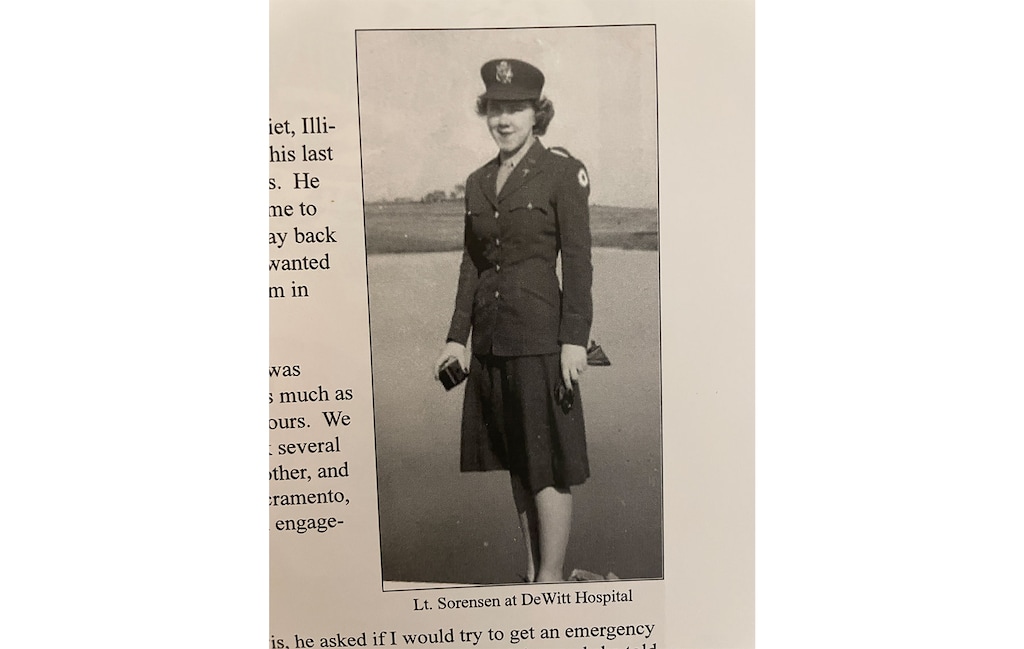
It was a scorching July day in Utah when I arrived at Pleasant Grove to meet the children and brother of an unsung American hero, Second Lieutenant Ora Mae Sorensen Hyatt; she was a nurse during World War II in a place that became known to all who served there as “Bloody Okinawa.”
I was there to gather material for my new book, “The Flight Nurses War: The American Women Who Saved Thousands of Lives in Iwo Jima and Okinawa.” As we sat in her daughter Carol’s cozy living room drinking punch, Ora Mae’s family told me stories about their courageous, humble, deeply religious and brilliant mother.
As we celebrate Veteran’s Day, one of the many extraordinary — and largely unknown stories — is the central role that American nurses played in the war in the Pacific. Incredible women such as Ora Mae Sorensen Hyatt ended up saving tens of thousands of lives. They did their work without complaint and with deep patriotism and there are countless Americans alive today due to the extraordinary care delivered by these women in the most brutal of circumstances.
Ora Mae had been deployed to Okinawa just a few weeks after marrying Army Corps Engineer Lieutenant Edmond Preston “Pres” Hyatt at The Salt Lake Temple. Arriving on Okinawa on July 2, 1945, she was there to help treat some of the thousands of men still in the hospitals recovering from the battle with the highest casualties in all of the Pacific theater.
Ora Mae and her fellow Army and Navy nurses worked 12-hour shifts in hospital wards treating Marines and soldiers who were too seriously injured to be transported back to the United States. The men in their care had been fighting in close combat in the mud and torrential rain where advances were measured in yards, sometimes feet and even inches. And the wounds were like nothing Ora Mae had prepared for in nursing school: shrapnel, violent amputations, flame thrower burns, shell shock. These were the men who had taken Naha Airfield and Hacksaw Ridge and Shuri Castle. Treating them was hard, rewarding and indeed dangerous work as active Japanese snipers and saboteurs were still in the area. Ora Mae relied heavily on her faith as she delivered compassionate professional care to broken men and boys who often called her “mom.”
When the war formally ended on Sept. 2, 1945, with the Japanese surrender on the deck of the USS Missouri in Tokyo Bay, Ora Mae and the other nurses knew that their job was not yet done. She and her unit remained in the Pacific to take care of American and Allied POWs who had somehow survived years of starvation, torture and the denial of basic medical care by the Japanese. As she later recounted of treating these POWs, “I remember especially the look in their eyes when meals were brought to their beds. They cleaned up every crumb — practically licked the trays. One evening while on duty I found some sugar, canned milk and cocoa in our nurses’ station. I used the electric hot-plate and made a batch of fudge for all the patients who loved the unexpected treat.”
Finally, in late October 1945, Ora Mae was discharged. As her flight descended at night to Hamilton Field outside of San Francisco, she saw lights along the coast spelling out the words “WELCOME HOME. WELL-DONE.” As Ora Mae later recalled, “When I saw those words and realized I was really home, I couldn’t stop the tears rolling down my cheeks. As long as I live, I’ll never forget the joy of landing in the United States of America and the pride I felt in the country to which I belonged!”
Ora Mae and Pres eventually settled in Salt Lake City to raise their 10 children after she used the GI Bill to complete a bachelor’s degree in nursing at BYU in 1952, graduating cum laude. Ora Mae’s kids told me about a warm, loving home filled with music, prayer and love. Feeding a family of 12 three times a day on a limited income required creativity and management skills and, as one of her children explained to me, “Her specialty was making something out of nothing — casseroles, Mulligan stew, baking.”
In 2007, Ora Mae Sorensen Hyatt was honored on Veterans Day at the University of Utah. She wore her uniform and found this acknowledgment “truly thrilling.” When she turned 90, her family arranged a massive reunion, with more than 200 children, grandchildren, great-grandchildren and relatives in attendance.
Ora Mae died of natural causes at home in Orem in 2017 at the age of 94. Her beloved Pres passed away two years later, also at home in Orem.
A huge photo of Ora Mae Sorensen Hyatt on her Honor Flight is on the wall of the Salt Lake City International Airport. It does not include her name, but it is my hope that we all remember this remarkable servicewoman.
(Leah Garrett) Leah Garrett is an award-winning historian, author and professor whose work focuses on hidden histories of World War II.
Leah Garrett is an award-winning historian, author and professor whose work focuses on hidden histories of World War II. She is the author of multiple critically acclaimed books exploring war, identity and resilience, including the bestselling “X Troop: The Secret Jewish Commandos Who Helped Defeat the Nazis.” Her forthcoming book is entitled “The Flight Nurses War: The American Women Who Saved Thousands of Lives at Iwo Jima and Okinawa.”
The Salt Lake Tribune is committed to creating a space where Utahns can share ideas, perspectives and solutions that move our state forward. We rely on your insight to do this. Find out how to share your opinion here, and email us at voices@sltrib.com.