 Jessica Schreifels
Provo • A Utah County prosecutor told a judge this summer that DNA testing would settle the case against Douglas Carter, a former death row inmate convicted of killing a woman in 1985. In September, the results excluded Carter as the source of blood found at the crime scene — but prosecutors aren’t ready to drop the charges.
Deputy Utah County Attorney Stephen Jones said during a Tuesday hearing that prosecutors are still considering moving towards trial next summer, despite the earlier assurance from another prosecutor that the results would be “dispositive.”
“We expected this to be over today,” defense attorney Neal Hamilton told reporters after the Tuesday hearing. “The signaling we were getting was that today was going to be the end of the case. It’s not … It’s disappointing.”
(Trent Nelson | The Salt Lake Tribune) Attorney Neal Hamilton speaks to media after a hearing for Douglas Carter, a former death row inmate who was recently released from jail after crime scene DNA doesn't match his, in Provo on Tuesday, Nov. 10, 2026.
Jones indicated that prosecutors are waiting for 4th District Judge Derek Pullan to rule on whether Carter’s purported confession will be suppressed. He also said prosecutors now support the defense’s efforts to seek another type of DNA testing that could determine who Eva Olesen’s killer was.
Prosecutors initially opposed Carter’s motion for this type of DNA testing, saying it was the police’s job to investigate Olesen’s death — not Carter’s.
Carter was convicted in 1985 of murdering Olesen, a Provo woman who was the aunt of the city’s police chief at the time. Revelations about police misconduct later unraveled his conviction. In September, prosecutors dropped their pursuit of the death penalty after crime scene DNA did not match Carter’s.
Pullan allowed Carter’s release from jail on Sept. 28, but he still faces an aggravated murder charge, and a lengthy trial next summer. The 71-year-old has maintained his innocence.
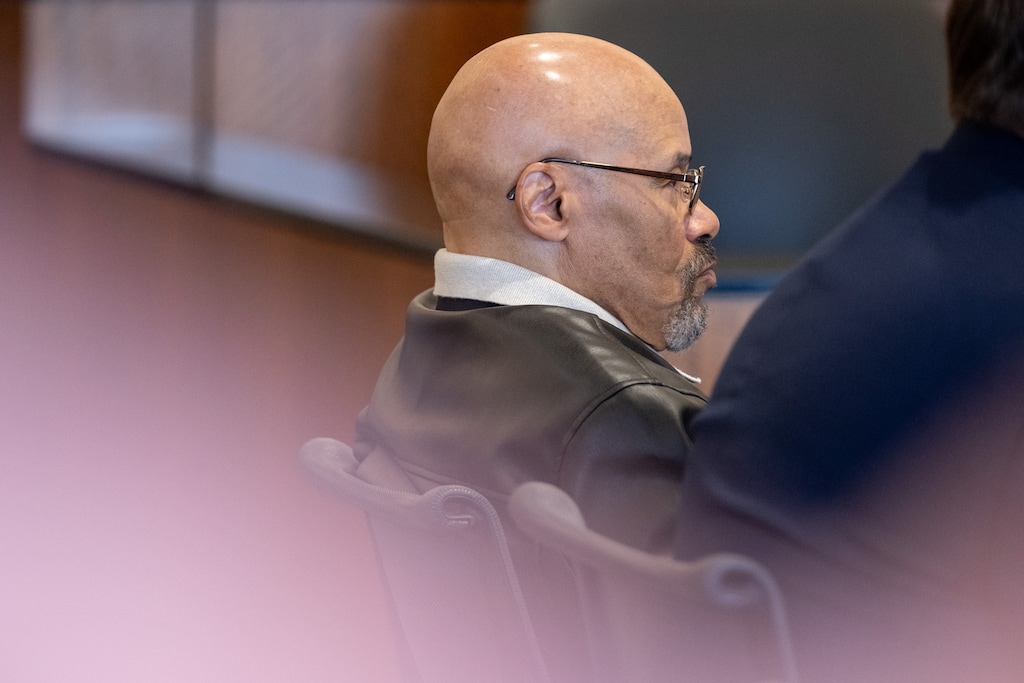
(Trent Nelson | The Salt Lake Tribune) Douglas Carter, a former death row inmate, speaks with his appellate attorney Eric Zuckerman before his court hearing Tuesday.
While Jones, the prosecutor, mentioned at one point in the Tuesday hearing that the urgency in the case has decreased with Carter out of jail, Hamilton took issue with that characterization.
“He’s not free,” he said after the hearing. “He has charges pending. He has an ankle monitor. He can’t do anything outside of the state of Utah without written permission before. That is not freedom.”
Carter’s defense team has asked Pullan to order the crime lab to provide them with DNA extracts so that an expert can conduct their own testing.
That expert plans to use a genetic genealogy method to try to find the killer, Carter’s defense attorneys wrote in a motion. This typically involves using public genealogy websites populated with profiles from at–home DNA testing kits, where a researcher traces a DNA profile through someone’s family tree.
This method was famously used by police to identify the Golden State Killer.
The DNA samples that Carter wants access to came from blood found in an alleyway near Olesen’s home, as well as blood on the knife authorities say was used to kill her. In a previous hearing, a defense expert testified that the killer likely cut himself on the knife while stabbing Olesen and left blood behind — an opinion that prosecutors have not tried to publicly dispute.
Utah’s crime lab didn’t oppose the request, and an attorney for the Utah Bureau of Forensic Services described in a court filing that the amount of DNA in one remaining extract as “large.”
Carter is expected to be in court next week where Pullan will make a decision on the new DNA testing.