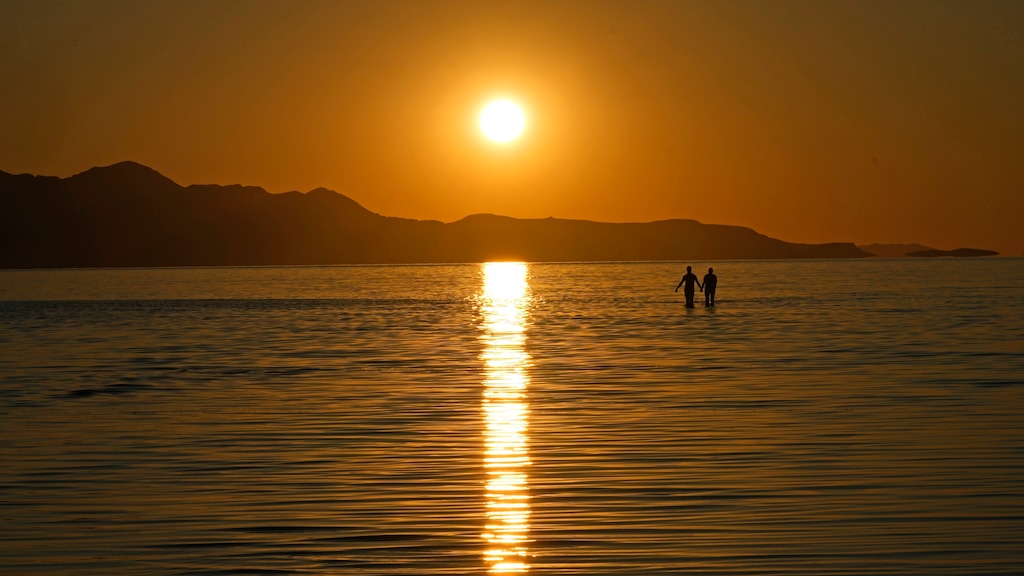
I grew up in the town of Magna, in the shadow of the Oquirrh Mountains and along the shores of the Great Salt Lake. Like so many who grew up here, some of my favorite memories were made at the lake: prom at the Saltair, afternoons spent at “Black Rock” and sunsets over the water.
Those experiences feel increasingly distant as the shore continues to recede, year after year. The lake is disappearing. And every Utahn, whether they’ve ever set foot on its shore or not, should be worried about what that means for all of us.
I’ve watched this crisis up close for most of my life. Magna sits at the base of the Oquirrhs, where Rio Tinto/Kennecott has mined and refined for 120 years. On windy days, you can watch dust lift off the tailings ponds near my home and drift into the neighborhoods — schools where kids play, backyards where families spend quality time together, park pavilions where communities gather. I’ve watched people I love get sick. A friend of mine has been treated for cancer more than once and, after she lost her husband to cancer as well, their doctor told her he believed environmental pollutants played a role.
Now imagine that same toxic residue, decades of it, settled at the bottom of a shrinking lake, lifting into the air across the whole Wasatch Front. This is not a hypothetical; it’s a real fear I know many of us share. Scientists have warned for years that an exposed lakebed would send arsenic-laced dust over homes, schools and playgrounds from Ogden to Provo. This isn’t just a west-side problem; it’s a Utah problem, and none of us can outrun it.
A few years ago, frustrated that our mountains kept getting fenced off, mined and polluted with almost no public accountability, I joined the board of the Oquirrh Foundation, a small nonprofit working to preserve what open space we have left in the Oquirrhs. We’ve shown up at zoning meetings and town council meetings. We’ve organized cleanups in Butterfield Canyon and Yellow Fork Canyon. It is slow, unglamorous work, and it’s taught me how difficult it is for ordinary residents to be heard over industries with vast amounts of money and influence.
I see that same imbalance playing out with the Great Salt Lake. We know what it needs: more water. What we haven’t seen is the political will to treat this like the emergency it is. Every year we delay, the lakebed grows, the dust grows more dangerous and the cost of fixing it grows further out of reach.
Utah’s leaders have taken some real steps; I won’t pretend otherwise. But incremental progress isn’t the same as a plan sized to meet the actual crisis. We need sustained, binding commitments to get water to the lake, not just optional conservation programs. We need real accountability for the industries, including the one operating in my own backyard, whose pollution will end up in that lakebed dust. And we need to treat a shrinking Great Salt Lake with the same urgency we’d give any other public health emergency, because that is exactly what this is.
I think about the prom I had on that lakeshore, and I think about my own kids, whose children may not ever see the Great Salt Lake at all if we don’t change course soon, and who won’t have their chance to raise their families in the community we love. That’s not a legacy any of us should be willing to accept. It’s part of why, this year, I decided to stop waiting for someone else to fix it and run for the Utah House of Representatives myself.
I’m not a typical politician, not a developer or attorney, and certainly not independently wealthy. I’ve spent my career showing up for people during the hardest moments of their lives: as a nurse’s aide, a funeral director, and now a health insurance case manager. None of that work taught me to look away from a hard problem because it was inconvenient to solve. It taught me that the people who need you most are usually the easiest to ignore, right up until you can’t ignore them anymore. If elected, I’ll bring that experience to the Capitol.
We need sustained funding to get water to the lake, real accountability for the industries polluting it, and a refusal to let this crisis continue to worsen.
The west side needs a real voice at the Capitol, and that’s why I’m running for House District 27.
(Liz Oates) Liz Oates is a lifelong resident of Magna, a licensed funeral director, a health insurance case manager and a board member of the Oquirrh Foundation.
Liz Oates is a lifelong resident of Magna, a licensed funeral director, a health insurance case manager and a board member of the Oquirrh Foundation. She is the Democratic candidate for Utah House District 27.
The Salt Lake Tribune is committed to creating a space where Utahns can share ideas, perspectives and solutions that move our state forward. We rely on your insight to do this. Find out how to share your opinion here, and email us at voices@sltrib.com.