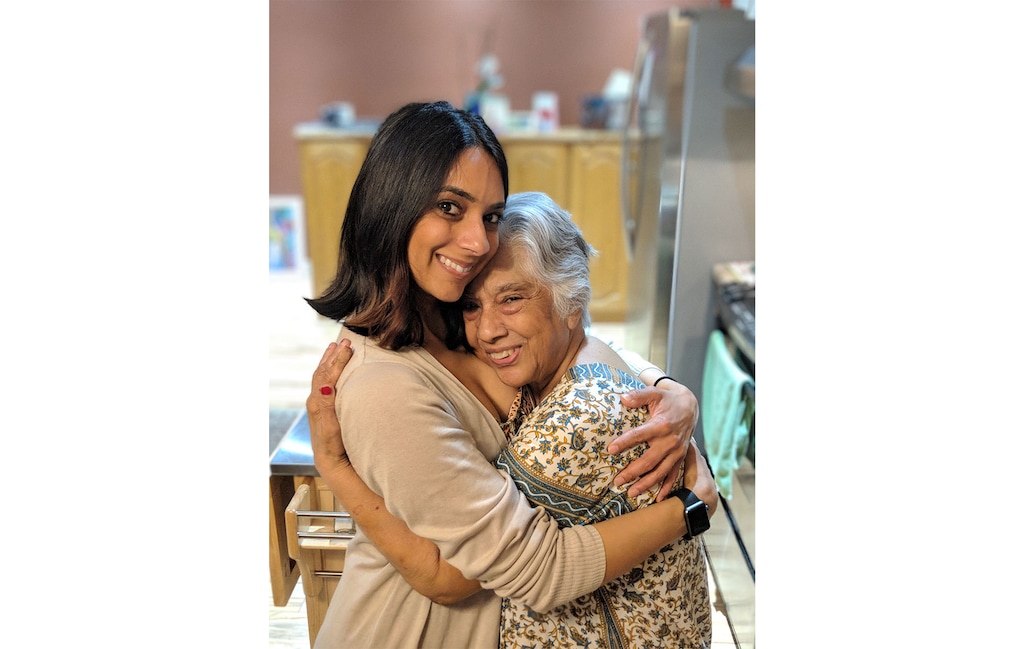
“She’s leaving us, come say your goodbyes,” my cousin texted in the family thread.
My mousi — or aunt — the matriarch of our family, had a fall a week before that escalated quickly into hospice. I didn’t think she would fade away so fast.
I laid next to her in her bed. She was in a deep sleep, taking deep breaths, and I found myself counting the seconds in between. I could hear the death rattle. I thought, “This is the only moment I get with her, this woman who was like a mother to me, peppy and pretty powerful, lying there lifeless, unable to comfort me like she always had.”
I knew she would take a part of me with her, and I wouldn’t be the same after.
But that’s the thing. After a loved one dies, we’re expected to go back to normal. Back to work, back to being productive, back to life as if it never happened. In America, we strangely decide how much time someone deserves to grieve based on how closely they were related to the person. It’s absurd that someone else can determine who you grieve and for how long.
For an immigrant family like mine, our mousis are our mothers. They raise us. Our cousins are our siblings. Our best friends and neighbors are part of our family system. It takes days, weeks, months, years to grapple with that kind of loss. Researchers have a name for what happens when your grief doesn’t fit society’s approved list of relationships: disenfranchised grief, the loss that goes unrecognized and unsupported because it doesn’t look like the grief we’ve agreed matters most.
But Utah believes it only takes three days, in writing.
Utah Administrative Code R477-7-9 defines “close enough to grieve” narrowly: spouse, parents, siblings, children and grandparents or grandchildren of any level. No mousis, uncles, or cousins, no matter how close. The rule lets a manager approve leave for what it calls “other unique family relationships,” but only if they feel like it. And there’s no guarantee you’re covered, because it only applies to public employees. Private employers usually allow three days, and if generous, maybe five or six. There’s no federal law requiring bereavement leave anywhere in the country, and Utah is one of the 45 states that hasn’t passed one of its own, so even that “generous” five or six days is entirely up to a company’s discretion.
The days allotted also say something about how we look at death, dying and grief as a society. Psychiatrists don’t even start evaluating whether someone’s grief has become abnormally prolonged until they’ve been grieving for six months. We’ve built policy around three days for something that isn’t even considered unusual at six.
So, no, three days doesn’t come close to covering how long grief actually takes. But it does reinforce our obsession with productivity.
The good news is this can change, because Utah has already changed it once. In 2022, it passed SB63, adding miscarriage and stillbirth to what counts as a covered loss, another case where grief once fell outside “immediate family.” California is pushing this further with SB1149, which would let employees name who counts as family to them instead of a legislature deciding for them. It hasn’t passed, and wouldn’t help Utah today, but it shows what this could look like: an mousi who raised you, a cousin who was closer than a sibling, or a family you chose instead of family into which you were born.
Here’s what I think Utah should do: Let people decide who counts as family when they grieve, and give them the time they actually need, because grief looks different for everyone. Yes, employers will want consistency — that’s fair enough. I’d argue a designated-person model is still consistent. But the person grieving gets to make the decision instead of a lawmaker.
I don’t think this should sit on individual employers to fix, either. R477-7-9 governs the state’s own employees, which makes Utah the largest employer already setting the norm for what counts as reasonable. If the state builds flexibility into its own policy, private companies that look to the state as a baseline would follow suit.
October will mark exactly one year since I was by my mousi’s side, listening to her slow, deep breaths, and I still can’t seem to go back to normal.
(Neelam Chand) Neelam Chand is a Utahn, mother of a vibrant 6-year-old and founder of Shift SLC, a culture and belonging consulting firm.
Neelam Chand is a Utahn, mother of a vibrant 6-year-old and founder of Shift SLC, a culture and belonging consulting firm. She hosts the podcast “Are We Well,” covering topics from mental health to social justice, and is a newly trained death doula. She previously served as a Senior Vice President at Zions Bank and is currently pursuing a Master of Social Work at the University of Utah.
The Salt Lake Tribune is committed to creating a space where Utahns can share ideas, perspectives and solutions that move our state forward. We rely on your insight to do this. Find out how to share your opinion here, and email us at voices@sltrib.com.