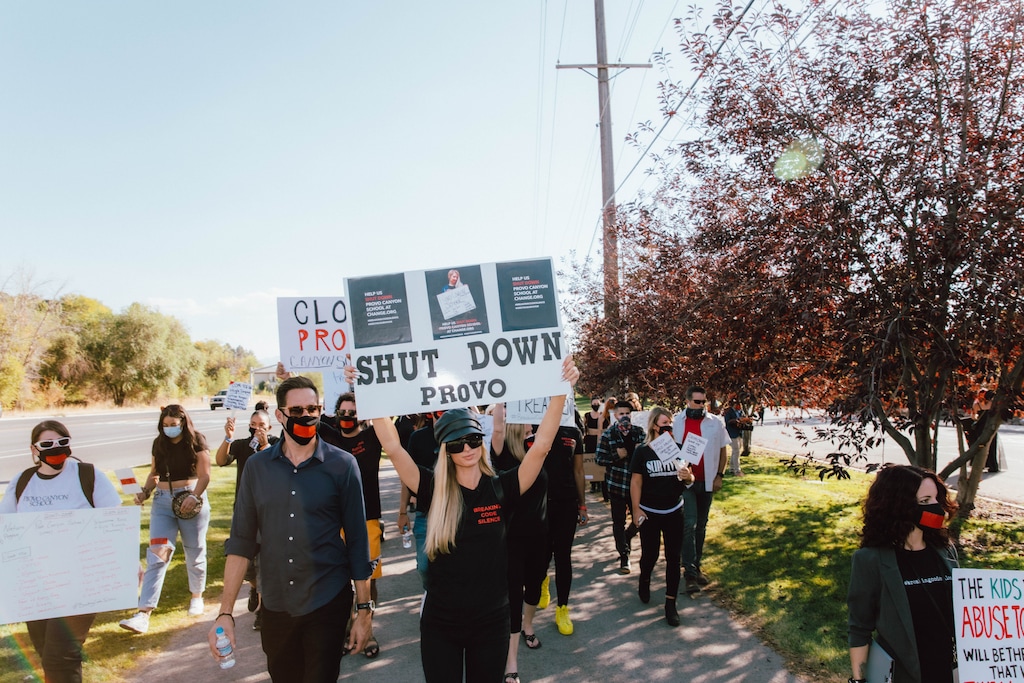
For more than 50 years, children were sent to Provo Canyon School with promises of treatment, healing and safety. Instead, the facility became synonymous with allegations of abuse, neglect and mistreatment.
After decades of survivors fighting to expose what happened behind its walls, Utah has finally revoked the licenses of both Provo Canyon School campuses. It is something many of us never believed we would live to see.
But Universal Health Services, the corporation that owns the facility, has appealed the decision. Now comes the real test. Will Utah stand by its own findings, or will this facility once again use the legal process to avoid accountability for the children it failed to protect?
In 2021, I came to Utah to tell my story of abuse at Provo Canyon School and to ask lawmakers to pass Senate Bill 127, the state’s first meaningful reform of the youth residential treatment industry in more than 15 years. One by one, lawmakers apologized to survivors. One senator told us, “Frankly, we failed to protect you. And I’m sorry about that.” For the first time, it felt like Utah was listening.
But even then, the industry fought to preserve the status quo. On the House floor, lawmakers proposed changes that would have allowed staff to intentionally inflict pain on children in order to get them to comply. One legislator argued that twisting a child’s thumb wasn’t unusual. The amendment ultimately failed, but the debate revealed something deeper. While survivors were asking how to better protect children, some facilities were asking for legal permission to keep hurting them.
That resistance has continued every time meaningful accountability has come within reach. When Maple Lake Academy lost its license in 2024 after a girl’s death, it appealed the decision and a judge let it stay open — though it voluntarily closed a month later. After three children died at Diamond Ranch Academy, the program sought to rebrand and reopen under a different name. Discovery Ranch remained open after the death of 17-year-old Biruk Silvers, returning to admissions within weeks of being placed on a conditional license.
Again and again, we’ve watched facilities respond to tragedy not with reform, but with appeals, rebranding and delay. That’s why we need to pay attention to what happened at Provo Canyon School.
This spring, a 13-year-old boy at Provo Canyon School was beaten unconscious. Staff failed to call 911, waiting more than an hour before seeking emergency medical care for a child suffering life-threatening head injuries.
When investigators finally looked closely, what they found was horrifying. At the Springville girls campus, the state cited years of chronic noncompliance and failures to provide basic health and safety services. The campus was cited for failing to protect children from harm and neglect, failing to maintain safe staffing, failing to report critical incidents, and compromising the integrity of the state’s investigation. The Disability Law Center called the conditions “shocking.”
At the Provo campus for boys, the findings were just as disturbing. The state found that children were not protected from harm, abuse or mistreatment, and that staff used cruel and unnecessary pain-compliance techniques and discipline meant to frighten or humiliate. Boys in a stabilization unit were reportedly not allowed to speak and could only use the bathroom or get water at the top of the hour. Children were also intentionally humiliated, including being ordered onto their hands and knees to bark like dogs for snacks.
This is the culture survivors have been describing for decades. It is the same culture I experienced as a teenager in the 1990s, and one that has persisted for far too long inside the for-profit youth residential treatment industry.
For years, I have watched this industry treat every death as an isolated incident, every abuse allegation as a public relations problem and every attempt at accountability as something to litigate, delay or simply rebrand away.
Utah finally has the opportunity to break that cycle. As the state’s licensing director said when announcing the closures, “No child should be hurt in a program that is meant to protect them.”
Those words now need to be matched with sustained action.
The appeals have already begun. The lobbying will come next. There will be pressure to reconsider, to compromise, to give Provo Canyon School yet another chance.
Utah must resist it.
Because this decision is about far more than one school. It is about whether children matter more than corporate interests. Whether accountability is real, or simply another hurdle powerful institutions know how to outlast.
Utah has the chance to make sure no child ever has to survive Provo Canyon School again. Now comes the real test: standing by that decision.
(11:11 Media) Paris Hilton photographed in front of Provo Canyon School.
Paris Hilton is a survivor of institutional child abuse and the founder of 11:11 Media Impact, an organization advocating for reform of the youth residential treatment industry.
The Salt Lake Tribune is committed to creating a space where Utahns can share ideas, perspectives and solutions that move our state forward. We rely on your insight to do this. Find out how to share your opinion here, and email us at voices@sltrib.com.