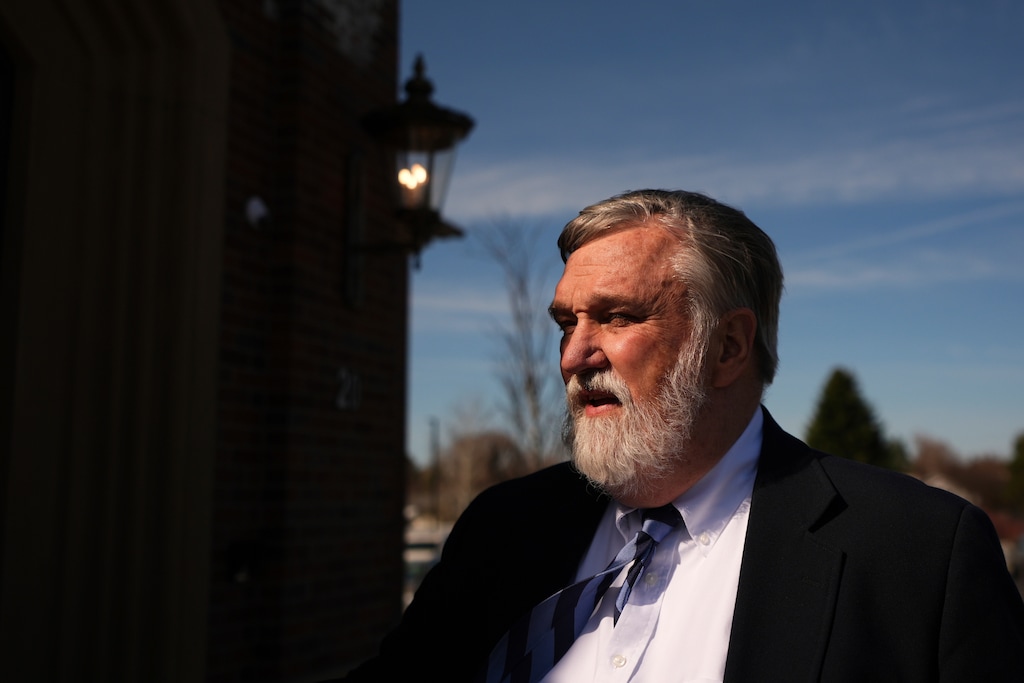
Forty years ago, Doug Wilson was a young assistant pastor at his father’s fundamentalist church in Pullman, Washington. He later broke from his dad’s congregation and built a religious empire in the adjacent twin city of Moscow, Idaho, which includes an expanded church, a liberal arts college with a theological doctrine mainlined into the classic curriculum, a private elementary and high school, a publishing house, and a chunk of downtown Moscow’s real estate.
He is the co-founder and de facto force behind the Communion of Reformed Evangelical Churches, currently numbering about 170 congregations nationwide.
I may have had an unwitting, albeit embryonic, role in Wilson’s rise.
That was then. He now has new enablers in high places, such as Defense Secretary Pete Hegseth.
Hegseth’s eschewing of women in military leadership, in combat roles, or who push back is hardly an original philosophy. Neither is Hegseth’s of-God-wills-it philosophy in global conflicts, which he embraces with a doctrinal adherence worthy of an Iranian ayatollah. He got much of this from his “theo-bro,” the Rev. Doug Wilson.
Wilson has long held that women ought not vote or hold public office. Their place is raising children and running households. Wilson would amend the 19th Amendment to limit vote casting to one ballot per household, the husband making the final electoral decision, much as it was for the first 150 years of this nation’s history.
Silencing women is far from the only showstopper in the Gospel According to Doug. He longs for a Christian theocracy for America with only Christian males holding office and voting. (Spoiler alert: He doesn’t see Latter-day Saints as Christian.)
America has long been a harbor for religious wing nuts. What makes Wilson worrisome is that he is neither a crackpot nor loathsome to challenge. He is articulate, civilly candid, rolls with counterpunches, keeps his cool and doesn’t tailor messages to what people want to hear. What you see is what you get.
What you get, however, is a suffocating embrace of gender inequity and accompanying masculinism as ageless religious and cultural tenets, mostly culled from select biblical passages, historical precedents and one-time societal prescriptions. For much of his life, it made him a political and religious outcast. His recent role as “theology whisperer” to Hegseth and other acolytes in President Donald Trump’s circles makes him dangerous.
In the mid-1980s, I gave Wilson a bullhorn that transcended a hundred people in the pews. I was editor of the daily newspaper that called the college towns of Moscow and Pullman home. I was searching for a conservative columnist to balance my other writers. Whoever took up this pen would have a target on his back in the progressive — and not always open-minded — university towns. Spoiling their breakfasts, as liberal columnists did to conservatives, would make for lively food fights.
Wilson fit the bill: a moral conservative who could make his point succinctly, take the heat from readers, and loved to rattle cages of the comfortable.
I gave him the same four ground rules in place for the other columnists: Issue no calls to violence or blatant discrimination, adhere to deadlines, don’t take reader pushback personally, and serve at my pleasure.
For about a year, it unfolded as I had hoped. He embraced divisive positions and easily was the most talked about columnist in circulation. People subscribed and canceled subscriptions with equal ferocity based on his weekly utterances. He pushed the envelope. I agreed with little of what he wrote, but that’s why I recruited him. I abhor culture cancelers — be they on the right or the left.
Then he crossed a line. Wilson said homosexuality ought to be made a capital offense and people found to have engaged in such behavior should be executed.
Whoa! The collective minds of Moscow and Pullman blew up. As did mine. We parted ways. He may proclaim that sort of thinking on the streets of Moscow and Pullman but not from my watchtower. He didn’t urge people to go forth and kill gays, as my first rule forbade. Rather, he ran head-on into Rule 4: He no longer pleased the editor.
I think of myself as an absolutist when it comes to the First Amendment. You are free to say what you wish. The First Amendment guarantees that one can offer opinions even if the establishment considers them offensive. There can be no prior restraint.
I don’t regret giving him a chance to articulate his thoughts or helping him launch his public persona. He grabbed the ball and ran with it. I am certain he would tell you that with or without the newspaper column, he would have gotten where he is. That’s likely true.
Would I give him a column today? No. These days he is quite capable of providing his own mega soapbox.
(Francisco Kjolseth | The Salt Lake Tribune) Jay Shelledy
James Shelledy is a member of The Salt Lake Tribune’s board of directors and currently is serving a rotating term on the newspaper’s editorial board. He is a former editor of this newspaper, the Lewiston (Idaho) Morning Tribune and the Moscow (Idaho; Pullman, Washington) Daily News.
The Salt Lake Tribune is committed to creating a space where Utahns can share ideas, perspectives and solutions that move our state forward. We rely on your insight to do this. Find out how to share your opinion here, and email us at voices@sltrib.com.