The news of Sharon McMahon’s canceled appearance at Utah Valley University’s (UVU) 2026 commencement has not gone away quietly.
What started nearly two months ago as a commencement speaker announcement has become a rolling controversy: criticism of McMahon’s selection, the decision to proceed without a speaker, billboards along Interstate 15 and McMahon’s own account that Utah politicians pressured the university to withdraw the invitation.
The story lingers because it is not only about one speaker. It is about what Utah campuses do when safety concerns, political pressure, public perception and, in some cases, legal uncertainty collide. It is a cautionary tale about what happens when colleges and universities are left guessing how to operate. In this vacuum, self-censorship begins to look like compliance, and viewpoint diversity becomes a stated value that institutions are expected to prove and perform but are not always equipped to practice.
UVU had invited McMahon, a New York Times-bestselling author known for her work on civics and government literacy, in alignment with its university framework meant to restore “a safe and supportive environment for dialogue” following the September 2025 campus shooting death of conservative activist and political commentator Charlie Kirk. UVU likely hoped that a keynote-free ceremony would redirect public attention elsewhere. Instead, the empty stage became part of the story.
The impact of the UVU shooting reached Westminster University, where I serve as chief diversity officer, almost immediately. Our 150th anniversary keynote speaker was scheduled to arrive the next day, while the shooter remained at large and the shock of the shooting was still unfolding. Amid nonstop breaking news coverage, the speaker began to reconsider whether coming to Utah felt physically and rhetorically safe. The speaker ultimately chose to make the trip only after we shortened the campus visit and arranged for a police escort to remain with them throughout their time on campus.
Just two months later at Weber State University, the pressure around campus speech took a different form. Before its November 2025 Native American Heritage Month symposium, the university sent award-winning Lipan Apache author Darcie Little Badger and her co-presenters a list of prohibited words and concepts. The list included “equity, diversity and inclusion,” “oppression” and “critical race theory.” In response, Little Badger withdrew from the event, noting that “the list…was so broad that there was no way we could talk about what we could talk about … without touching upon these concepts. And personally, I will not censor myself. That’s not who I am as a storyteller and editor.”
Weber State pointed to Utah House Bill 261 as the basis for the list. The legislation, which went into effect in July 2024, restricted how Utah’s public colleges and universities could name, organize and practice diversity, equity and inclusion-related work. The university later said it was reviewing its speaker guidance and revising its approach to ensure compliance with the law. Meanwhile, state and higher education leaders said HB 261 was not intended to restrict guest speakers or academic dialogue. Utah Senate Bill 295 was subsequently introduced to clarify that distinction.
SB 295 calls for evidence of viewpoint diversity programming, but offers limited guidance on how institutions are supposed to prove they have met the requirement. Institutions are left trying to satisfy the law without overcorrecting, promote intellectual diversity without narrowing speech and avoid becoming the next public or political flashpoint.
Utah’s legislation grew out of real local and national debates about how diversity, equity and inclusion programs were being implemented. Both UVU and Weber State appeared to be trying to honor their values under pressure. UVU connected a campus speaker to healing after crisis. Weber State tried to interpret a new legal environment. In both cases, the promise of viewpoint diversity was compromised: the very value Utah’s legislation says it aims to protect.
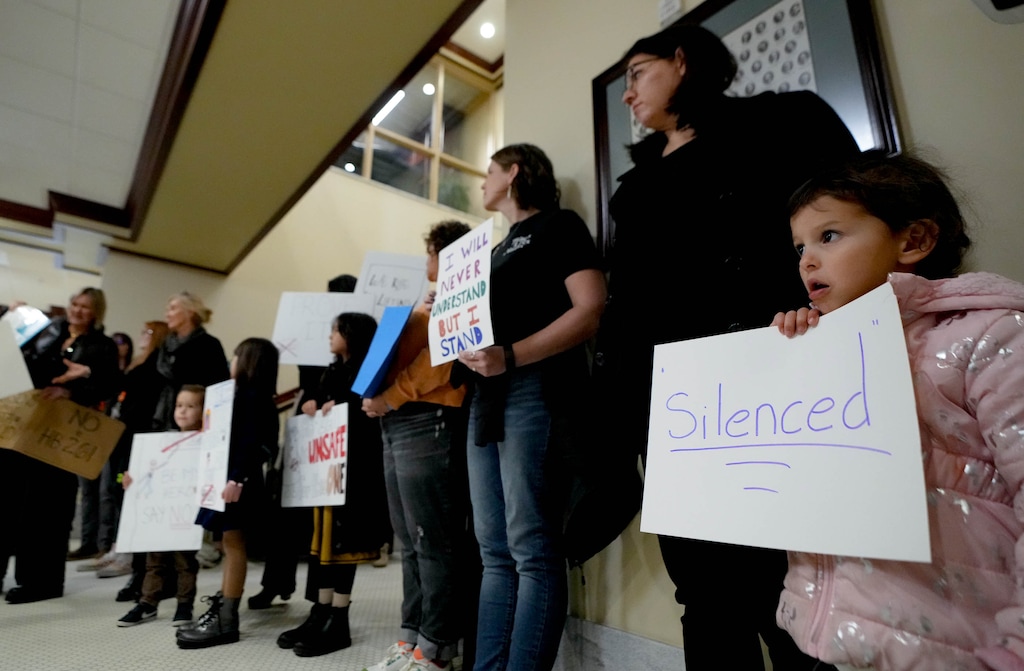
Three incidents. One school year. One pattern: a chilling effect. Utah and other states with similar laws set out to protect viewpoint diversity. What’s filling that space now isn’t neutrality. It’s silence. And silence doesn’t announce itself as censorship. It looks like an empty stage, a police-escorted visit and a list of prohibited words.
(Tamara N. Stevenson) Tamara N. Stevenson, Ed.D., is vice president for diversity, equity, and inclusion and chief diversity officer at Westminster University.
Tamara N. Stevenson, Ed.D., is vice president for diversity, equity and inclusion and chief diversity officer at Westminster University. A 2025–26 American Council on Education Fellow, she writes and speaks at the intersection of organizational leadership, policy equity, and futures thinking.
The Salt Lake Tribune is committed to creating a space where Utahns can share ideas, perspectives and solutions that move our state forward. We rely on your insight to do this. Find out how to share your opinion here, and email us at voices@sltrib.com.