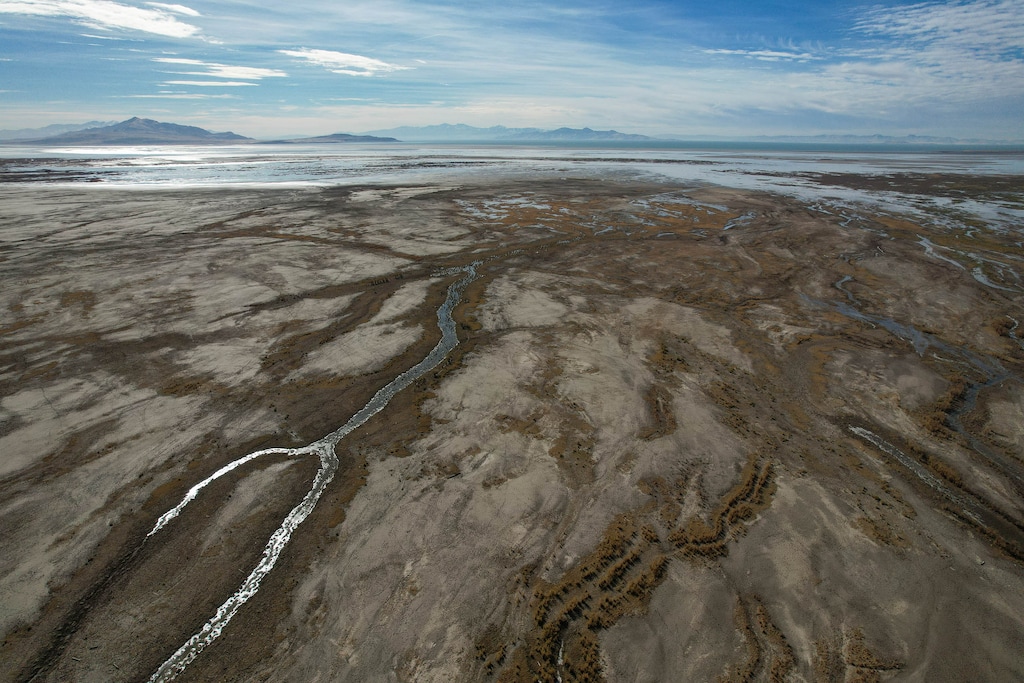
Following the announcement from President Donald Trump committing to save Great Salt Lake, Gov. Spencer Cox indicated that this support was a response to a $1 billion dollar ask.
Water is what Utah’s iconic salty lake needs, so how do you turn money into water?
The federal government has sent money our way in the past few years, including tens of millions of dollars from the Inflation Reduction Act and the Saline Lake Ecosystems Act. The state of Utah has contributed tens of millions of dollars, as well. This money pays for water leasing, upgrading infrastructure, ecosystem monitoring and purchasing water rights. These investments are coupled with action from Utah including the development of the Great Salt Lake Commissioner’s office, the Watershed Enhancement Trust and the Basin Integrated Plan.
My perspective is that of a lake lover. I’ve researched Great Salt Lake for the better part of three decades, and as a professor, have mentored many students in doing the same. I serve on state committees that manage the lake, and I’m an author of many scientific articles and books on this important ecosystem.
There are so many smart people working with this government money to determine how to save Great Salt Lake and what strategies are most effective to get water to the lake. New water rights have been committed to the lake, but the pressures of persistent drought and climbing temperature continue.
Will another $1 billion dollars be used to further invest in these well-researched paths to buy more water rights or better optimize agriculture equipment? Maybe not. Gov. Cox and legislators indicate that this money could do bigger things, such as fund pipeline projects and desalination plants.
Is it possible to move water through pipelines to Great Salt Lake? Because we move liquid petroleum across our nation, it is possible, and it is an idea we should consider. A team of engineers at BYU did just that. Calculating the costs and energy requirements to complete the simplest pipeline option from the Pacific Ocean, they estimated that per year, the energy needed would be equivalent to 11% of Utah’s current electricity demand, the cost over $300 million per year, and the greenhouse gas emissions would equate to 200,000 cars. In addition, we would need to remove the salt, and desalinization is terribly expensive and energy consuming.
Maybe we could trade water. Other ideas our legislators have considered are paying other states to desalinize ocean water, then Utah could trade with those states, keeping more fresh water from rivers. This idea has gotten pushback from environmental groups, and Utahns may be wary of spending our tax dollars in other states, but the conversations that surround this idea are good ones to have with our neighbors. We do live in a shared watershed and managing this resource together is always a good idea. However, the impasse in negotiations regarding the Colorado River Compact indicate that we likely are not ready to share water, and the costs may well exceed what Utah can afford, even with federal assistance.
If more federal funds are directed at Utah, these ambitious strategies are tempting. After all, investing in such expensive infrastructure would be difficult to achieve with the state budget. But the ongoing costs should give us pause because those will come from Utah’s purse.
Another consideration is time. How much time would be needed to secure the funds then build the infrastructure of pipelines and desalinization plants? How much time would be required to complete western state negotiations over water?
Great Salt Lake does not have time for large infrastructure projects. The evaporative season of the summer and fall will take precious feet from the lake elevation, and our inflows this year are well below average. We are dreadfully close to meeting our historic low and perhaps besting it.
I am grateful for the national attention on Great Salt Lake that validates the environmental and economic emergency we are facing in Utah. The cheapest and fastest way to solve the problem of a shrinking lake may not be to invest new funds on elaborate infrastructure, but instead to support policies and investments that reduce water consumption, improve watershed management and address climate-driven impacts. This may be the best way to turn money into water.
(Bonnie K. Baxter) Bonnie K. Baxter, Ph.D., is a professor of biology and Director of Great Salt Lake Institute at Westminster University.
Bonnie K. Baxter, Ph.D., is a professor of biology and the Director of the Great Salt Lake Institute at Westminster University. Her research focuses on the extreme biology of Great Salt Lake. She is a professor, an author and a spokes-scientist.
The Salt Lake Tribune is committed to creating a space where Utahns can share ideas, perspectives and solutions that move our state forward. We rely on your insight to do this. Find out how to share your opinion here, and email us at voices@sltrib.com.