 Addy Baird
 Brooke Larsen
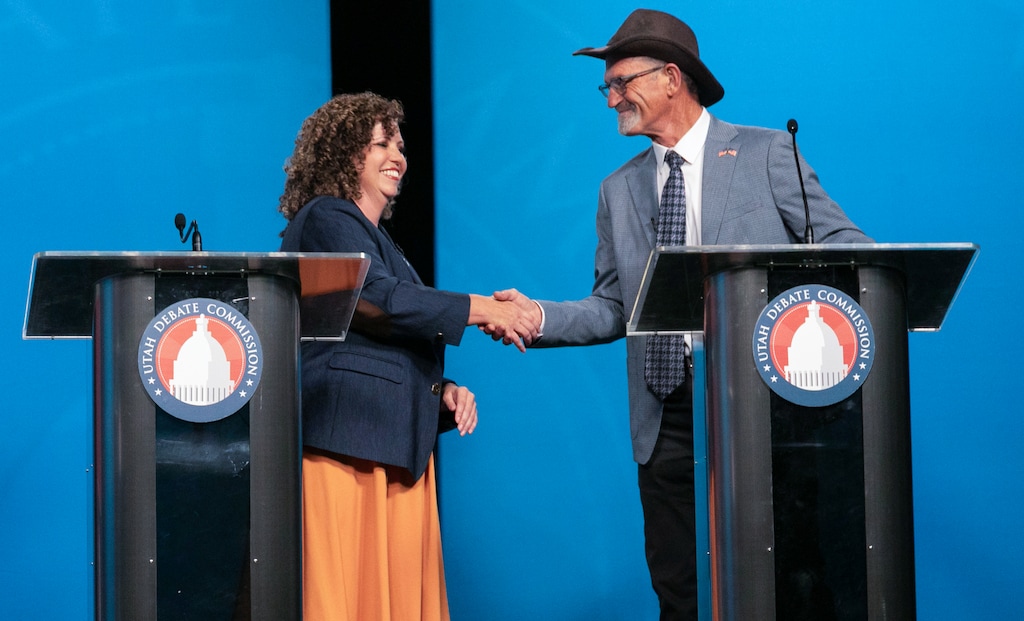
The top contenders in Utah’s newly drawn 3rd Congressional District debated artificial intelligence and data center regulations, water, the boundaries national monuments and of the district itself in their first pre-election matchup Friday evening.
U.S. Rep. Celeste Maloy, the Republican nominee, currently represents the state’s 2nd Congressional District, but she is running for reelection in the 3rd District after new maps were put in place ahead of the 2026 midterms.
Early in the debate, Maloy and Democratic nominee Kent Udell split over the boundaries set in the maps, which came as the result of a yearslong court fight over who gets to draw the state’s congressional districts.
“I think we could have gotten a better outcome if we’d have followed the process that we’re supposed to follow when we get new maps,” she said, arguing that the state Legislature has the right to draw Congressional boundaries.
“I, however, do not get a say in that process,” she said. “So I am running in the district I live in, based on the boundaries that are law right now.”
Earlier this year, Maloy joined with another member of the state’s federal delegation to sue over the maps. Udell hit her for the suit in his response Friday, arguing she wanted to keep the old boundaries because they were safer for Republicans.
(Jud Burkett | Special to The Tribune) Kent Udell answers a question during a 3rd Congressional District debate at Utah Tech University in St. George, Friday, Oct. 2, 2026.
“When I saw this first district, I fell in love. This is my land. These are my people. These are the lands I love. These are the waters I love. These are the people I grew up with,” Udell said. “What did my opponent do? She sued so that she could keep the boundaries as they were before so she keeps her seat.”
Her lawsuit, Maloy responded, was part of an effort to ensure Utahns could weigh in on the map, which was chosen by a judge.
“This is a cool district,” she added “It’s got all five of the ‘Mighty Five’ national parks, it’s got most of the energy production in Utah, all of Lake Powell, and I’m excited to represent the new third district.”
(Jud Burkett | Special to The Tribune) Celeste Maloy answers a question during a 3rd Congressional District debate at Utah Tech University in St. George, Friday, Oct. 2, 2026.
Though voters in the 3rd District will have six candidates to choose from on their ballot, the debate at Utah Tech University featured only Maloy and Udell. Constitution Party candidate Cassie Easley, Libertarian Michael Stoddard and unaffiliated candidates Adonis Hooslyn and Ayden Scott did not qualify, based on a poll conducted on behalf of the organizer, the Utah Debate Commission.
Friday’s event was the second of four sessions — one for each congressional district — scheduled by the commission. Ben McAdams and Riley Owen debated earlier this week, and District 4 candidates Republican Mike Kennedy and Democrat Jonny Larsen will debate Oct. 8.
Monument downsizing
Though Maloy and Udell’s comments Friday were largely diplomatic and civil, their exchanges were tense when they discussed the new boundaries of both the district and a pair of national monuments within it: Bears Ears and Grand Staircase-Escalante, which were recently — and once again — downsized by President Donald Trump.
Udell promised that if he is elected to Congress, he will work to have the boundaries of both monuments restored and established under federal law, rather than determined by “willy-nilly executive decisions.”
Maloy, on the other hand, said she stands firmly behind Trump on the downsizing — literally.
“I was standing in the Oval Office when the announcement was made about reducing the monument boundaries, so obviously I support that decision,” Maloy said. “It was made by listening to elected officials from Utah. That’s why I support the decision.”
(Julia Demaree Nikhinson | AP) President Donald Trump holds a signed executive order in the Oval Office of the White House, Monday, July 13, 2026, in Washington. His signed orders modified the Bears Ears and Grand Staircase-Escalante National Monuments. Behind Trump, from left: U.S. Reps. Celeste Maloy and Mike Kennedy; U.S. Sens. John Curtis and Mike Lee; Gov. Spencer Cox; and House Speaker Mike Schultz.
She agreed, however, that the monuments need to be defined by law, and has sponsored legislation to remove a president’s authority to designate national monuments in Congress. Udell was unsatisfied with the lawmaker’s answer.
“You stood behind President Trump as he was saying, ‘You can’t hike on these lands, you can’t camp on these lands, you can’t fish on these lands,’ and that was a lie. And you knew that, and you stood there and smiled,” he said.
“I have worked on the Grand Staircase Escalante National Monument and its management for over 20 years,” Maloy responded. “When President Clinton stood on the north end of the Grand Canyon and created a monument in Utah, he promised that all the traditional uses would continue, but through management decisions over time, they have been restricted.”
Colorado River
The candidates also weighed in on the drought in the Colorado River Basin and other water shortages in the state.
(Jud Burkett | Special to The Tribune) Republican Rep. Celeste Maloy and Democratic challnger Kent Udell, right, listen as debate moderator Bob Evans asks a question during a 3rd Congressional District debate at Utah Tech University in St. George, Friday, Oct. 2, 2026.
“We need to make sure that the farmers get the water that they need, and we need to make sure that the homes get the clean water that they deserve,” Udell said.
He called for an analysis of groundwater supplies and the retrofitting of Glen Canyon Dam as Lake Powell drops. Climate change and overallocation of water are at the root of the decline, he said.
Maloy took a more optimistic tone. “We need to get out of the scarcity mindset when it comes to water,” she said. “It’s time to start looking at new technologies, new innovations.”
Utah and the six other states that share the Colorado River have tensely negotiated the future of the waterway. With the lack of an agreement among the states, the federal government finalized a new near-term plan for how to manage the dams and reservoirs under its authority.
Maloy said states should always be in charge of their water. “For every drop that goes to one state, another state feels robbed, and that’s why I think it’s time to innovate with technology,” she said.
AI and the economy
A significant portion of Friday’s hour-long debate was focused on artificial intelligence and the economy. Asked by a Utah student what policies they would support in Congress to address concerns many young voters have about their job prospects amid the rise of AI, neither provided a direct answer.
(Jud Burkett | Special to The Tribune) Democratic challenger Kent Udell, right, and Republican Rep. Celeste Maloy during a 3rd Congressional District debate at Utah Tech University in St. George, Friday, Oct. 2, 2026.
“I have faith in your generation that you’re going to learn to use AI, to harness the power of AI, and turn that into family-sustaining jobs for yourselves,” Maloy said. “You might be doing less busy work because AI is doing some of that, but you’re going to be the human intelligence behind the machines, and you’re going to have a bright and beautiful future in this country.”
She added: “Don’t believe all the doom and gloom.”
Maloy told reporters she’d be digging into potential AI policies later this month at her regulatory reform summit.
“I actually really like the Utah model of not regulating the underlying technology, letting the technology race continue, but regulating how it’s deployed and the rollout,” she said.
Udell said Utah students need real world experiences in order to be the “wisdom” behind AI’s knowledge.
“Keep focused on the experience and the wisdom, get the experiences that allow you to be able to make the right decisions in this AI world,” he said.
After the debate, Udell told reporters that he’s interested in regulations that require labels on all AI-generated content.
“I don’t think that an AI bot should ever be in a position of making the decisions that only humans should be making,” he added. “They should not be able to open a bank account. They should not be able to be put in a weapon to make a decision to kill or not. Those are human decisions.”
Udell is also interested in launching a new youth jobs corps to create opportunities for young people, he said.
Asked later in the debate about data centers, both Maloy and Udell said they believe data center decision-making belongs at the local, not the congressional, level.
“It’s clearly a local issue,” Udell said — but, he added, he wants a moratorium on new data centers in Utah.
(Jud Burkett | Special to The Tribune) Democratic nominee Kent Udell, right, listens as Republican Rep. Celeste Maloy answers a question during a 3rd Congressional District debate at Utah Tech University in St. George, Friday, Oct. 2, 2026.
Maloy did not go so far, saying only that the issue should be in the hands of local officials.
“If we came in from the federal government and said this is the regulation that will solve this problem for everybody in the country, that might not fit Utah,” she said. “Sometimes one-size-fits-all doesn’t actually fit anybody, but our state Legislature and our county commissioners and our city councils are best suited to know what resources match their needs in their area.”
Data center proposals are also popping up on federal land, though. Valor Atomics is proposing a project that would include data centers and small nuclear reactors on 9,000 acres of public land near Price, Utah, as NPR reported earlier this week.
“The [federal] resource management plans say where things can and cannot happen,” Maloy told reporters after the debate. “That part has been taken care of. Then I think the locals should have a say in whether they want this on their local grid.”
Maloy also said she supported investing in nuclear power, in large part because she believes it’s the best way to address massive AI energy requirements.
“It’s going to be the energy source of the future that doesn’t disappear — that isn’t controversial,” she said. “It’s going to power the AI future that we are going to have.”
Udell isn’t so sold on the idea, comparing the state’s nuclear push to “sitting in a timeshare presentation.”
“We have not shown that they’re safe, and it has not [been] shown that it’s economical,” he said. “And I don’t want you to be holding the bill on a boondoggle on the nuclear power plant.”