 Emily R. Anderson
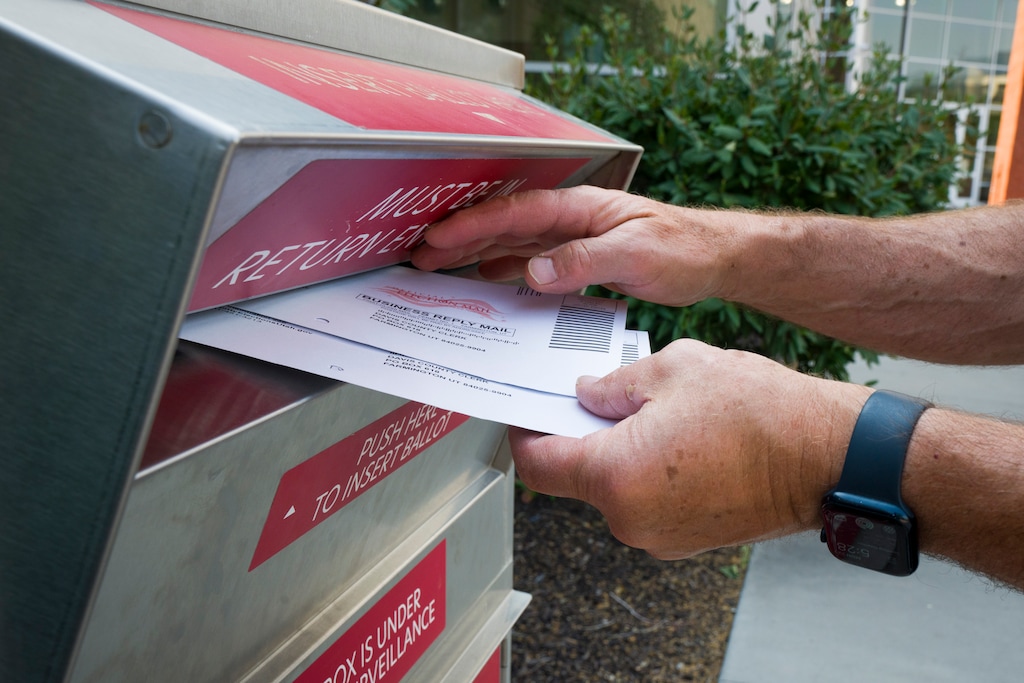
Just seven weeks before Utah’s counties are scheduled to mail ballots to every active, registered voter in the state, the U.S. Supreme Court ruled in one case Monday that restrictions on mail voting ordered by President Donald Trump can move forward ahead of November.
The order, however, will not impact Utah’s elections yet, top election official Lt. Gov. Deidre Henderson said in a statement.
“Today’s SCOTUS decision has no effect on Utah,” she wrote. “A nationwide injunction against the [U.S. Postal Service] mail ballot rule stemming from a different lawsuit remains in place for now. We expect an updated ruling in that lawsuit on Wednesday.”
That decision will come from a Boston federal district court in League of Women Voters of Massachusetts v. Trump.
In their Monday ruling, justices did not address the underlying legality of the executive order.
“In the meantime,” Henderson, a Republican, continued, “Attorney General [Derek] Brown and I are in close communication as his office works through all our legal options. I assure all Utah voters that they will be defended. We will run a secure election in accordance with state and federal law.”
As Utah’s elections chief, Henderson has previously said the state was readying to sue the USPS in anticipation of the courts ruling in Trump’s favor.
In July, after a dozen GOP-led states urged the high court to let mail-in voting restrictions take effect, Henderson wrote on social media: “I expect the catastrophic USPS rule to be rightfully quashed, but we are preparing a lawsuit against the postal service and will be ready to file it if needed. We will stand up for Utah voters.”
The order would present massive difficulties for running elections in red Utah, where The Salt Lake Tribune found approximately 95% of voters cast the ballot they received in the mail, rather than voting in person, in June’s primary election.
Utah is one of several states that allow counties to conduct elections entirely by mail — and since 2019, all 29 of its counties have sent ballots to every active, registered voter. It is the only state in the group where Republicans control both the executive and legislative branches.
A spokesperson for the USPS’ regional and Washington offices did not immediately respond to a request for comment.
Trump’s executive order seeks to restrict which people — based on lists of eligible voters that would be drafted by the U.S. Department of Homeland Security — postal workers can deliver ballots to.
County clerks are scheduled to begin mailing ballots to Utah voters on Oct. 13, according to the state’s elections website.
The number of Utah voters who could be impacted by the order’s implementation is also uncertain.
The Trump administration has said the order is meant to address false claims it has made of widespread voter fraud by noncitizens, which it alleges is facilitated, in part, by mail-in voting.
In a comprehensive audit of Utah’s voter rolls earlier this year, Henderson’s office said it found 27 noncitizens and 25 “probable noncitizens” — less than a hundredth of a percentage point of the more than 2 million voter records it reviewed. Officials immediately canceled noncitizens’ registrations and gave probable noncitizens 30 days to prove their citizenship.
Trump’s Justice Department is currently suing Utah in an effort to obtain those voter rolls. Henderson has resisted the DOJ’s requests to hand the entirety of the state’s database over, arguing there is no federal legal basis for the petition and that her compliance would violate state privacy laws.
The information sought by the DOJ would include voters’ sensitive personal information, such as their full name, date of birth, residential address, and their state driver license number or the last four digits of their Social Security number.
The administration has filed similar lawsuits against 30 other states and Washington, D.C., according to a database maintained by the University of Wisconsin Law School’s State Democracy Research Initiative.
So far, federal judges have dismissed 23 of those cases. The judge overseeing Utah’s case has not yet scheduled a hearing.
Note to readers, Aug. 25, 11:10 a.m. • This story has been updated to clarify the percentage of voter records that Utah found were alleged noncitizens.