 Emily Anderson Stern
Following Donald Trump’s lead, Republican state lawmakers have tried — unsuccessfully — in back-to-back legislative sessions to dismantle Utah’s vote-by-mail election system.
But in the first federal electoral contest since Trump retook the White House and vowed to “get rid of MAIL-IN BALLOTS,” Utahns signaled the president’s ongoing attacks had little influence on the voting method’s popularity in the Beehive State.
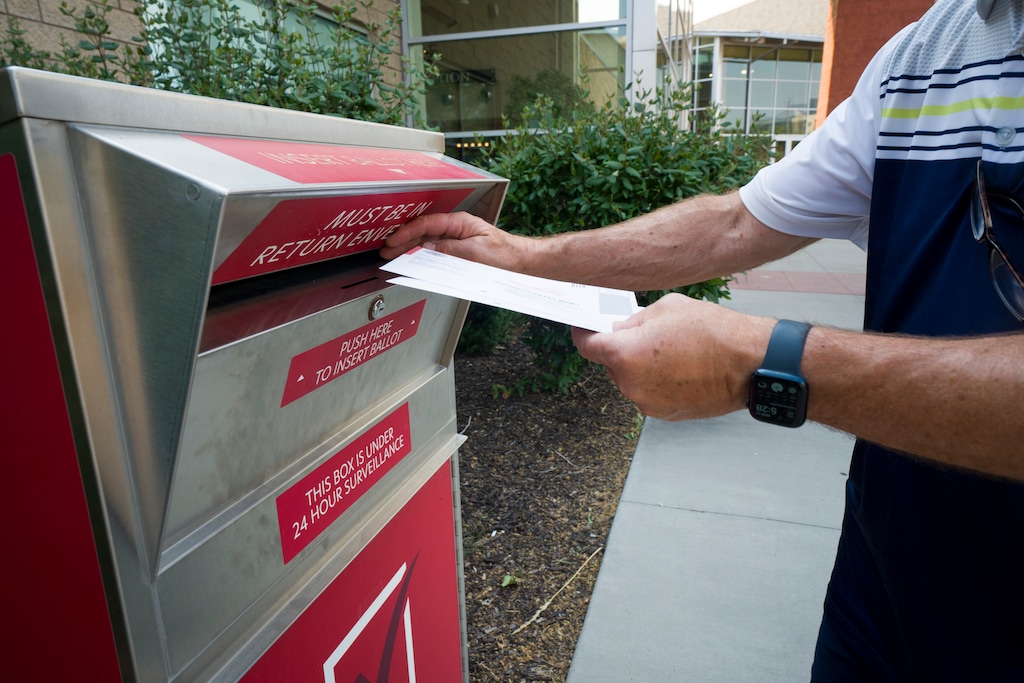
Nearly 95% of votes counted in Utah’s June primary elections were either delivered through the postal service or left in a drop box, The Salt Lake Tribune found in an analysis of election data. Over 334,000 Utahns used the ballot that arrived in their mailbox.
While that’s proportionally a slight decrease from the 96.5% of voters who used the ballot they received in the mail to participate in the 2024 primary, the vast majority of active Utah voters continue to rely on the postal service to take part in elections.
In two of Utah’s most sparsely populated counties, Emery and Garfield, every vote came via post or was left in a drop box.
Utah is one of several states that allow counties to conduct elections entirely by mail — and since 2019, all 29 of its counties have sent ballots to every active, registered voter.
The majority of those states are in the expansive American West, where some voters would have to drive hours to vote at a polling place on Election Day. Utah is the only state in the group where Republicans control both the executive and legislative branches.
Starting in 2029, under a law the Utah Legislature passed last year, voters will have to opt in to receive their ballot in the mail. Voting rights advocates argue the move will likely drive down turnout.
That policy change came after some Republican lawmakers, backed by the conservative Heritage Foundation, sought to eliminate vote by mail entirely. The organization is most well-known for its controversial Project 2025 playbook compiled in anticipation of Trump in 2024.
In that playbook, the Heritage Foundation urged a future Trump administration to assert more control over elections after years of the president falsely claiming they are rife with fraud. The president has heeded many of its recommendations.
Earlier this year, Trump signed an executive order seeking to restrict which individuals the U.S. Postal Service can deliver ballots to based on lists of eligible voters that would be drafted by the U.S. Department of Homeland Security.
The order has repeatedly failed when challenged in federal court, but last week the Department of Justice asked the U.S. Supreme Court to step in and allow the federal government to change mail-in voting rules before November.
Utah’s election chief, Republican Lt. Gov. Deidre Henderson, criticized the order as “nonsensical dialogue” and has consistently resisted the Trump administration’s efforts to control how elections are administered.
Late last month, Henderson wrote on social media: “I expect the catastrophic USPS rule to be rightfully quashed, but we are preparing a lawsuit against the postal service and will be ready to file it if needed. We will stand up for Utah voters.”
Numerous legislative audits of Utah’s elections have found no evidence of widespread fraud.
After a group of GOP lawmakers tried again this year to drastically restrict voting by mail in Utah and were blocked, they settled on a compromise requiring a taxpayer-funded study on “the security of ... voting by mail” by Utah Valley University.
Researchers must present their findings during — or prior to — the Legislature’s October meetings.
Emily is a statewatch reporter at The Salt Lake Tribune, where she has worked since 2022. She received her master's degree in journalism from Northwestern University. There, she worked on investigative projects for The Washington Post and ProPublica. While writing, she's probably spinning something from her ever-expanding shelf of punk records.