 Robert Gehrke
After promising to put a proposed constitutional amendment on the ballot in November that would restore the Legislature’s power to draw political boundaries to favor Republicans, leaders say they are shelving the idea to let the redistricting case work its way through the courts.
Missing the 2026 election means new congressional boundaries creating a new, blue-leaning district would remain in place for 2028 elections — unless the recently expanded Utah Supreme Court, with five new justices who were not part of the 2024 gerrymandering decision, reverses the court’s earlier ruling and allows the Legislature to redraw the maps.
And a recent polling by proponents of 2018’s Proposition 4, which prohibited gerrymandering in Utah, shows that had the proposed amendment gone to voters, its passage would basically have been a coin toss.
The poll, conducted for Better Boundaries, the group that led the fight to pass Proposition 4, showed voters were basically split — within the margin of error — on whether to support or oppose an amendment giving lawmakers the ability to repeal voter-passed ballot initiatives.
Less than half the 1,010 likely voters who responded to the poll, 42%, supported giving legislators more power to repeal or amend ballot initiatives, while 40% opposed the idea. The poll’s margin of error is 3.5 percentage points.
When voters were told about what passing the amendment would mean, more were likely to oppose it.
Ahead of the 2024 election, Republican legislators attempted to rush an amendment to the ballot that would have undone a Utah Supreme Court ruling and given the Legislature the power to undo citizen-passed initiatives.
If the amendment had passed, the Legislature could have repealed the voter-approved Proposition 4 and redrawn the state’s congressional boundaries to benefit Republicans.
The court, however, disqualified the amendment from the election because, the justices said, the language on the ballot was deceptive, asking voters if they wanted to strengthen the initiative process when, in fact, it would have weakened it. Lawmakers also failed to comply with a constitutional requirement that the amendment language be published in newspapers across the state at least 60 days prior to the election.
During the past legislative session, Senate President J. Stuart Adams, R-Layton, and House Speaker Mike Schultz, R-Hooper, had vowed there would be a new amendment on the ballot, but the language of the constitutional change was still being hammered out and was never made public.
In February, Adams said the aim was to “make sure that initiatives and statutes are on a level playing field, that we don’t destroy our republic.” And Schultz told attendees at the Davis County Republican Convention in April that lawmakers were “likely to come to you this fall, in November, with a constitutional amendment to help us get our judiciary back in line.”
Now legislative leaders say they want to wait and see how the litigation over the congressional districts plays out before moving forward with the amendment effort.
“We believe it’s appropriate to allow the litigation to continue through the courts before considering whether any further action is necessary,” Schultz told The Salt Lake Tribune in a statement. “Our focus remains on defending the Legislature’s constitutional authority through the judicial process.”
Currently, the next hearing in yearslong litigation over Proposition 4 is an argument before the Utah Supreme Court in September over whether the Republican Legislature’s creation of a three-judge panel to hear the gerrymandering lawsuit and other challenges to state law is unconstitutional.
It will likely take several months for the justices to issue a ruling, and, no matter how the court rules, the case would then return to the lower court.
Adams, who lost his Republican primary election last month, was a driving force behind the amendment push. But Senate Majority Leader Kirk Cullimore, R-Cottonwood Heights, said in an interview that the decision to push pause was not influenced by Adams’ defeat.
“President Adams has obviously been a staunch supporter of some sort of a constitutional amendment to try to bring propositions back to how they were understood prior to the Supreme Court decision,” Cullimore said. “But even prior to President Adams’ [loss], there have been some discussions about maybe this year is not the right year to consider that.”
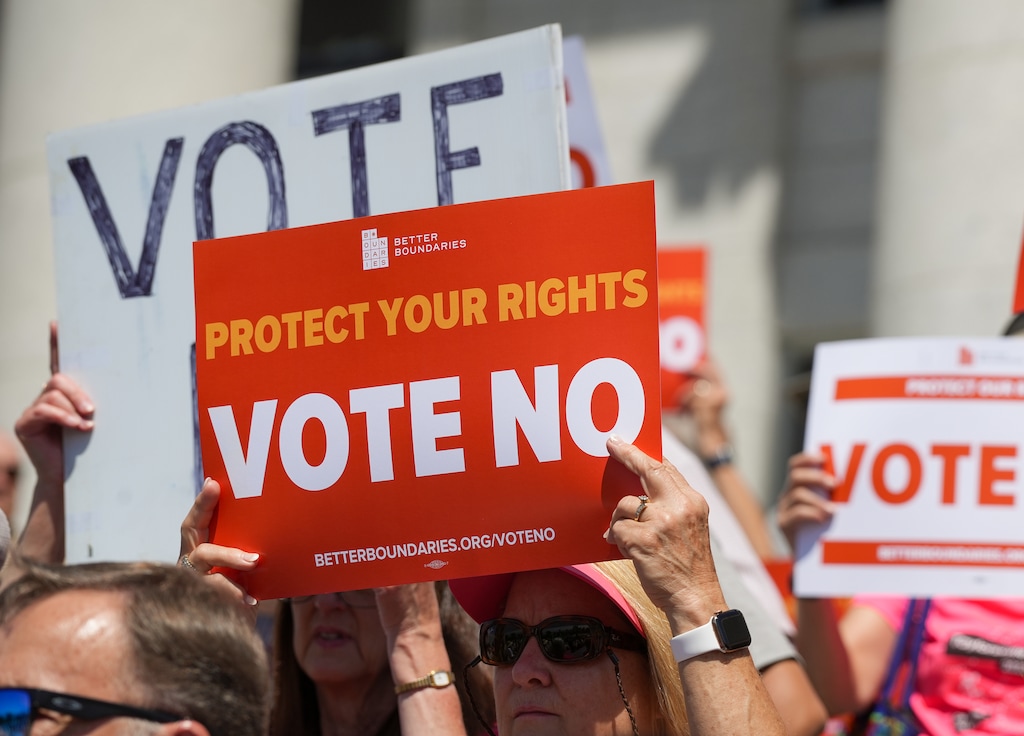
Elizabeth Rasmussen, executive director of Better Boundaries, the group that led the fight to pass Proposition 4 in 2018, said Republican lawmakers’ decision to back down is a victory for Utahns.
“Utah voters can breathe a little easier today,” she said. “For years, the Legislature has looked for opportunities to undermine Proposition 4 and Utahns’ constitutional right to alter or reform their government through the ballot initiative process. … We’re glad to see lawmakers step back from this effort, and we’ll remain ready to defend Utahns’ right to use the ballot initiative process if it comes under attack again.”
Despite the Legislature’s stand-down, there will be two amendments on the ballot this year.
The first removes the constitutional requirement that future amendments be published in newspapers and leaves it to the Legislature to decide how they should be published — which was used as a legal basis for disqualifying the former Amendment D.
The second will require any future ballot initiative that includes any tax increase to get 60% of the vote to pass.
Better Boundaries is opposing that amendment, saying it is an attempt to rewrite the constitution “to make it harder for Utahns to use ballot initiatives to hold their government accountable. We’re not going to let them undermine that constitutional right.”
Robert has spent more than 20 years primarily covering government and politics in Utah and the West, including seven years in Washington, D.C.