 Jordan Miller
After a defendant was charged with killing her family member, a woman cycled through caseworkers who were supposed to keep her updated on the court process, go to hearings with her and keep her connected with resources.
But she was assigned to one, then another, then yet another, until she eventually found herself in a two-hour conversation with Juli Miller.
“‘Nobody has ever listened to me,’” Miller recalled the woman telling her. “‘You’re the seventh advocate that I’ve had, and nobody has ever listened to me like this.’”
Miller’s job at the Salt Lake County District Attorney’s Office was to help people navigate the bureaucracy that follows a traumatic crime. She liked the work. Helping victims was “amazing,” she said, and it was a team she wanted to be a part of.
But in June, after four months on the job, she was fired. Miller is one of four former victim advocates The Salt Lake Tribune interviewed who described what they believe was an unhealthy work environment within the Division of Survivor and Victim Support Services.
They say a culture of fear and unclear communication has led to high turnover at the division’s downtown Salt Lake City office. That means victims often have to explain their traumatizing experiences over and over again to new advocates who are still learning the ropes, they said.
“That’s the part that makes me angry,” Miller said. “It was very jarring. I can’t imagine how awful this is for people that have been severely sexually abused, or have gone through homicides and gang violence and all these things that are so awful, and they need somebody to be there in their lives for them.”
District Attorney Sim Gill and his director of Survivor and Victim Support Services, Asha Parekh, rejected the assertion that turnover is unusually high and that the division has an unhealthy work environment.
They acknowledged, however, that it’s a difficult job — and in a section of their office that is underfunded, leading to advocates in Utah’s most populous county having to support as many as 170 victims at once.
(Francisco Kjolseth | The Salt Lake Tribune) Asha Parekh, director of the Survivor and Victim Services Division at the Salt Lake County District Attorney's Office, speaks alongside Salt Lake County D.A. Sim Gill during a news conference on April 22, 2026.
To give more consistency to victims, Gill said, his office in the past three years has changed how it assigns prosecutors and social workers to cases. It now assigns a team of five prosecutors to each judge’s courtroom, meaning victims will still see familiar faces even if an attorney or other staffer leaves.
Social workers are similarly assigned to courtrooms, but handle two judges’ caseloads. Case managers for victims are assigned to fewer cases, but still carry a workload that extends beyond what is handled by a single judge.
“Our work is rooted in our mission, providing exceptional personalized services to victim-survivors in the interest of healing and justice,” Parekh said. “We are here to serve victims in the best way possible.”
Parekh said the office pursues a “culture of high accountability and excellence,” and has a strong team doing the work. Most people, she said, stay for several years.
Heavy caseloads
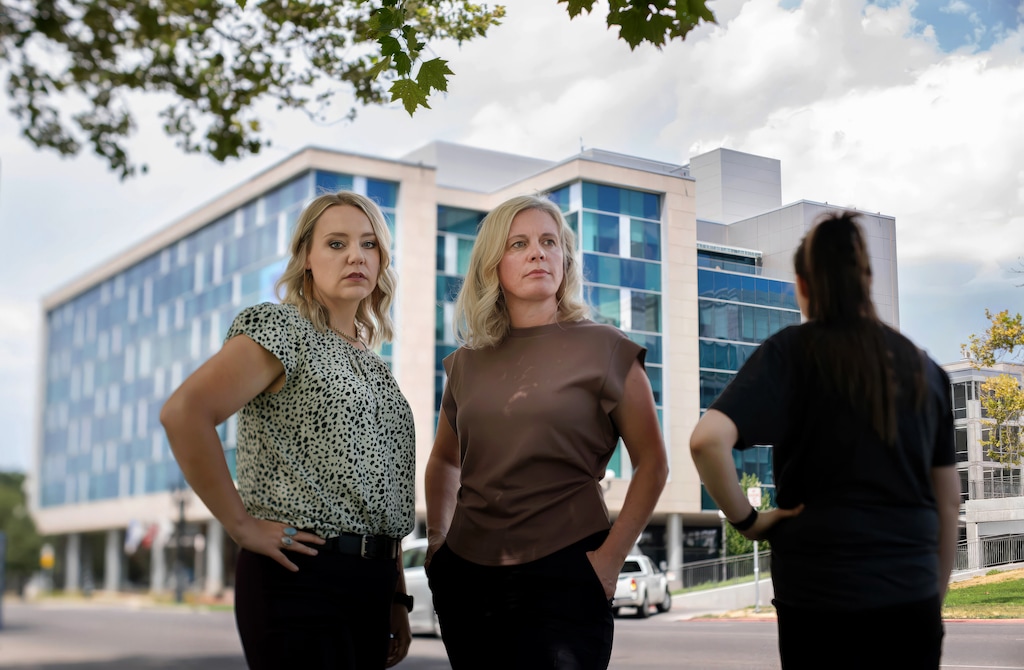
(Francisco Kjolseth | The Salt Lake Tribune) Social worker Juli Miller is seen in Salt Lake City on July 28, 2026. Miller, a former caseworker for the Salt Lake County District Attorney’s Division of Victim and Survivor Support Services, alleges she experienced hostile behavior from superiors before she was fired.
By Miller’s third week on the job, she said, she had 160 cases to manage by herself.
This caseload is typical for advocates, Parekh said. Gill said employees who come to work at the district attorney’s office understand that challenge, since the office screened 20,000 cases last year. Gill said he wants to get caseloads under 100, and he emphasizes that goal when he approaches the County Council for more funding.
Some of Miller’s assignments involved crimes that affected large families or multiple victims who needed lots of resources and support, but she said she didn’t feel supported herself as she did the work.
Parekh said new employees generally receive support through the division’s onboarding process, have access to an in-office therapist and can attend meditation sessions or other trauma-informed training. She said Miller had worked closely with her supervisor, who had carried Miller’s caseload himself for some time.
At one point, Miller recalled, she told her supervisor that she was struggling and he told her, “You can’t be a turtle in this job,” which she took to mean that the supervisor felt she was being weak.
“I quickly learned that if I needed anything, to not go to that supervisor,” Miller said, “because there was no help.”
Miller said she received glowing reviews from her colleagues until May, when she had a check-in with the same supervisor. In that meeting, she said, he warned Miller that her job requires her to “juggle a lot of balls,” and that if she “put a ball down,” she “better not forget to pick it up.”
Other social workers and prosecutors had commended her performance, she said, even with the heavy workload she carried, so she didn’t know what he thought she was doing wrong.
Then, in a meeting on June 11, she said her supervisor told her that prosecutors had complained she wasn’t keeping up. When Miller pushed back and said she felt she’d been on top of her cases, she recalled the supervisor telling her, “Well, at least I’m not telling you to pack up your s--- and leave.”
Miller said he told her the D.A.’s office had a different job offer for her, but she would have to let them know her answer by the next day, because otherwise she would not have a job by the end of her standard probationary period.
Parekh disputed Miller’s account of the conversation, and said that the division leaders were attempting to move Miller into a different position that they felt was a better fit for her.
Attorneys and caseworkers she talked to were “baffled,” Miller said. “I had almost twice as many cases as some of the case managers that I had started with. And they were just like, ‘No, you are doing so good.’”
Later the night of June 11, the supervisor sent Miller a message that she needed to stop talking with people about his conversation with her, and that they’d talk about it more the next day. When Miller met with him and another supervisor, she said, they told her they were rescinding her job offer because of her “behavior.”
“And I was like, ‘What behavior?’” Miller recalled. “‘Because I went and asked what I did wrong?’”
He fired her at the end of the meeting, she said.
Parekh said Miller had communicated “false information” with her colleagues, which she said created disruption within the division, and that’s what led to her firing. The office didn’t need to have a reason for her firing, Gill said, because Miller was in her six-month probationary period — where employees can leave or be terminated for any reason.
When Miller reached out to human resources with concerns about how and why she was terminated, Parekh told her she could no longer use her work email since she had been fired, according to an email exchange Miller shared with The Tribune.
A ‘detrimental’ culture for advocates
(Francisco Kjolseth | The Salt Lake Tribune) Social worker Emily Long is seen outside the Salt Lake County District Attorney’s Office in Salt Lake City on July 28, 2026. Miller, a former caseworker for the office's Division of Victim and Survivor Support Services, alleges she experienced hostile behavior from superiors before she was fired.
Emily Long worked as a victim advocate for nearly three months last fall, helping victims in homicide and sexual assault cases as a licensed clinical social worker.
She believes her termination stemmed from a dispute over how much paid time off she was entitled to as part of her job offer. She had racked up 30 years of experience before working with the D.A.’s office — 20 of it in clinical social work — and said she was told she’d get additional time off in her new position because of her expertise.
“That was one of the reasons I took the job,” Long said. “I wanted that time off. That would help me mentally stay feeling well and being able to come in and do my job.”
Experience does not guarantee additional leave beyond what county policy outlines, Gill said. Long, he said, was not promised any additional leave during her hiring “that we know of.”
When Long started, she didn’t get the time off she was promised, she said, so her supervisor recommended she speak with the office’s Human Resources Department. The department gave her a bit more time off — which Parekh, the division director, said was the maximum amount of leave — and Long thought she had worked it out. But hours later, she had a meeting with her boss and Parekh.
Long said Parekh was “frustrated” that she had continued to pursue the issue.
Parekh told her that human resources wasn’t “interested in taking any more time” debating her years of experience, so she could “take it or leave it.” At one point in her meeting, Long said, Parekh “slammed her hand down” on a table in the room and told her “we’re not talking about this any further.”
“Everything up until that point, I had been supported in asking HR for [credit for] those years” of experience, Long said, “and I had never seen anyone’s personalities be aggressive or harassing at that point.”
“What scared me about that meeting was that my supervisor,” who had encouraged her to seek the extra time off, “didn’t speak up for me in any way whatsoever,” she said.
Parekh said she doesn’t recall being aggressive in the meeting, which she said ended with Long saying she was unsure she wanted to stay with the county. Long disputes Parekh’s account.
Three days after that meeting, Long was fired. She was never given a reason, she said, even when she followed up. Gill said no reason needed to be given because she was still in her six-month probationary period.
“What I think is detrimental,” Long said, “is that we were handling these cases where victims really felt unable to speak for themselves. But then you have this weird office environment where the employees also weren’t allowed to advocate for themselves respectfully in a professional manner.”
Dispute over HR investigation
Another former employee who spoke to The Tribune was hired in 2019, and said she was also fired by Parekh for an issue she thought was resolved. The Tribune verified the former social worker’s employment but agreed not to name her because she fears sharing her story publicly will interfere with her job search.
The employee said an attorney in the office had shared that a married supervisor was making her uncomfortable by sending inappropriate messages. The employee said the attorney asked her to talk to human resources. She said she shared this information with HR in early January 2024.
“I just said, ‘Sim is always on the news, saying that he supports victims, and he wants to uphold victims’ rights,’” the employee said. “And I just said, ‘I think that that’s pretty hypocritical, and I don’t think I want to work here anymore if you guys don’t take any action on this.’”
The meeting itself didn’t make her think her job was in jeopardy, the employee said, but weeks later, she was gone.
Parekh told her she was fired due to frequent absences, but the employee said those absences were due to health issues, and were resolved with supervisors months earlier.
“I was on what they call a time-limited contract, and they make it very clear that if you’re on one of those, that they can fire you at any time for any reason,” the employee said.
The Tribune shared the employee’s account but not her name with Gill and Parekh. They said they did not know of an investigation that involved a caseworker in that time period. Parekh said there was an employee who was fired at that time for performance after they missed a day in court with a victim.
This former employee said although she did have an absence three weeks before her termination, she didn’t have a court appearance planned for that day.
‘I was emotionally a wreck’
Another longtime case manager who was fired last fall was initially optimistic when Parekh joined the division in 2023, she said. The Tribune confirmed the former worker’s employment but is not naming her because she fears retaliation in her new job.
She’d heard that Parekh had been brought in to help transition advocates to positions with more job security, since many of them rely on grant-funded contracts renewed every two years to maintain their employment.
(Francisco Kjolseth | The Salt Lake Tribune) Asha Parekh, director of the Survivor and Victim Services Division at the Salt Lake County District Attorney's Office, is pictured alongside Salt Lake County D.A. Sim Gill, during a news conference on April 22, 2026.
A year later, at the end of 2024, Parekh prohibited remote work days for victim advocates — a perk that had just been reintroduced earlier that year, the former employee said. She and other employees asked to talk to Parekh about the change, but Parekh refused to discuss her decision, the former case manager recalled, and the division began work full-time in the office beginning in January 2025.
Months later, the former case manager said, a co-worker said she planned to meet with Parekh to ask what the differences in productivity were between remote and in-office work. The former case manager said the co-worker later told her Parekh had refused to meet — an accusation Parekh denies.
Believing Parekh had refused, the former case manager said she spoke with another upper administrator about the issue, plus her concerns about grant-funded work.
“I assumed that would be more of a confidential meeting,” the former case manager said.
But shortly after, Parekh met with the former case manager and questioned her about why she felt she could “bypass the chain of command” by speaking with the upper administrator, the former employee recalled, and pressed her on why she never raised issues with her supervisor.
The former case manager told Parekh that she had spoken with her supervisor about the issues, but that supervisor, who was also present in the meeting, remained silent.
“[Parekh] was very hostile towards me in the meeting, yelled at me throughout the whole entire thing,” the former employee said.
Parekh said she didn’t shout during the conversation, but did ask why the former case manager didn’t feel comfortable talking with her — an “attempt to understand,” Parekh said, why this former employee went to someone else.
After the meeting, the supervisor recommended that the former case manager and the other grant-funded employees meet with Parekh to talk with her as a group. Parekh refused, and from there, she met with employees individually to “basically confront them,” the former employee said.
“People were scared,” the former case manager said, based on her conversations with co-workers. “They were scared of [Parekh] and losing our jobs.”
Parekh told The Tribune some employees had private reasons for why they wanted to discuss schedules, which is why she met with employees individually.
On Oct. 14, 2025, the case manager was fired, three months after she had signed another two-year contract with the office. She said she wasn’t given a reason. Gill said that at-will — or grant-funded — employees are not guaranteed future employment when they renew a contract. That contract, he said, is a commitment from the worker.
(Rick Egan | The Salt Lake Tribune) Salt Lake County District Attorney Sim Gill speaks at a news conference on Dec. 3, 2025. Gill and his director of Survivor and Victim Support Services, Asha Parekh, reject assertions that turnover is unusually high in the division.
“I was super upset that I spent seven years there working my butt off,” the former employee said. “I was an excellent employee. I never had a single complaint filed against me. I never had any corrective action, nothing — nothing negative other than Asha not liking me.”
Several prosecutors within the district attorney’s office wrote a letter to Parekh, saying the former case manager’s firing was “a big mistake,” and that she shouldn’t have been fired. The Tribune has reviewed a copy of the letter.
The former case manager added that many who signed the letter told her they had their jobs threatened by Parekh. Parekh said she has “never threatened anyone” in any job she has had as a supervisor, and Gill added that Parekh does not have authority over attorneys.
“I was emotionally a wreck for a couple months,” the former case manager said. Based on her conversations with current employees, she said, she believes “it’s still just as bad. Everybody is so terrified to say anything, or rock the boat, because they don’t want to get fired.”
This former case manager and Long, the caseworker who believes she was fired over a dispute about paid time off, both filed complaints with the county’s Equal Employment Opportunity office. But they were told their complaints didn’t meet the requirements for harassment, they said.
A county spokesperson said in an email that they could not comment on the conversation because it is a “confidential personnel matter.”
The county’s employee relations manager encouraged employees from the office to come to her, either on or off the record, to “build up a history,” Long recalled. But even then, the former employees said, there was no path to hold leaders within the victim support office accountable.
Long said she told the employee relations manager that it was a disappointing outcome, considering the work advocates do for victims in what felt to her like an abusive environment.
“That’s just how it is,” she said the manager told her.
Jordan is a breaking news reporter at The Tribune. She graduated from the University of Oklahoma and has written for the Houston Chronicle along with the Enid News & Eagle. When she's not reporting, she loves watching football, reading books and painting.