 Julie Jag
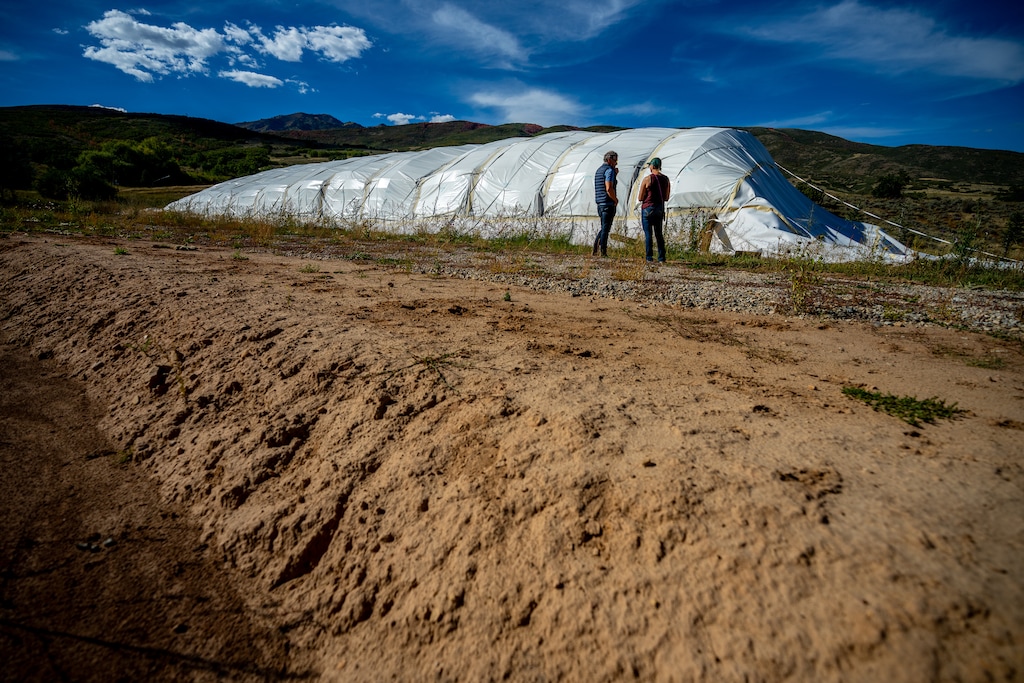
Midway • All summer, people have come from miles around to see the pile.
As long as a football field, as wide as a big rig and about 20 feet high, it can be seen from the deck of the lodge at Soldier Hollow Nordic Center. Still, they insist on traipsing a quarter mile to a nondescript field for a closer look. They want to feel the heat of the sun radiating back to them off the pile’s stark white exterior and contrast that with the shiver-inducing cold underneath. They want to examine the ground for fluids.
General manager Luke Bodensteiner calls the bodybag-shaped structure “a pretty unremarkable facility.” Others say it might be the future of snow in a warming world and an insurance policy for Utah’s 2034 Olympics.
“I think they’re all curious, like we are,” Bodensteiner said, “to see what comes out of this pile.”
What should come out is snow. Bodensteiner and his crew, using eight snow guns, piled up tons of it in that location last winter. Then they covered it with specialty insulated blankets he said could have doubled as gym mats. Atop that, they secured a brilliantly white tarp.
Then they waited.
(Trent Nelson | The Salt Lake Tribune) A large snow pile covered with insulated material at Soldier Hollow Nordic Center in Midway on Thursday, Sept. 24, 2026.
When Bodensteiner removes the tarp, which he expects to do next month, he’d like to find enough remaining snow to cover 1.5 kilometers of cross-country ski trail. If that happens, he might start to believe he has found a relatively low-cost and low-tech solution to ensure the Nordic center has enough snow to host events during Utah’s 2034 Winter Olympics.
Call it Soldier Hollow’s very own snow-security blanket.
Utah 2034 officials already knew Soldier Hollow could be a hot spot among its venues. The ski area’s base elevation of 5,463 feet is the lowest of Utah’s outdoor venues. While that puts it near the upper limit of elevation for endurance-centric Nordic events it could host — like biathlon, cross country skiing and Nordic combined — it also makes the resort particularly vulnerable to the effects of climate change. Soldier Hollow felt that at its core last winter, Utah’s warmest on record. At the end of January it had received just 3 inches of snow and it closed in late March, about a month earlier than usual.
(Trent Nelson | The Salt Lake Tribune) Soldier Hollow Nordic Center in Midway on Friday, Jan. 23, 2026.
“We just had a preview of what 2034 could look like, or worse,” said Scott Hotaling, a Utah State professor who specializes in climate change and climate resiliency. “That wasn’t the worst-case scenario. That was a bad scenario, And so, yeah, I think everyone is understanding that we need to be looking for answers and tools basically anywhere that we can.”
Hotaling applauded Bodensteiner’s forward thinking when it comes to the snow blankets. The snow-piling technology has been employed for more than a decade at ski areas in Europe, but it only recently caught fire in the United States. Idaho’s Bogus Basin — which has a climate similar to Soldier Hollow’s — experimented with a new, extruded polystyrene blanket in 2024-25, and the results convinced Bodensteiner to do the same.
With the help of a grant from the Utah Division of Outdoor Recreation, he bought 16 panels from the Finnish company Snow Secure for roughly $150,000 and installed all but three of them. He’d planned to use all of them, but by February temperatures had warmed so much that snowmaking became impractical, so the pile is about 80% the size he hoped. And instead of laying the blankets on during a snowstorm, as is recommended for optimal results, Bodensteiner’s crew worked through a downpour.
(Rick Egan | The Salt Lake Tribune) A bunk or of snow near the Soldier Hollow Biathlon course on Tuesday, March 24, 2026.
Then, one of the warmest summers in state history threw its worst at Soldier Hollow’s pile. That’s when the parade of looky-loos began. Bodensteiner said they included local and out-of-state operators of both Nordic and Alpine ski areas — like Deer Valley Resort and Woodward Park City. Coaches from the University of Utah ski team also stopped by, as did a number of snow and climate researchers.
Hotaling was among them. He is part of a group of state climate and snow experts looking into how Utah can ensure it has enough snow for the 2034 Olympics and beyond.
“If this works at Soldier Hollow, it can work essentially anywhere that is skiing related in Utah,” he said, “because that place is low and dry and warm — all of those things.”
Bodensteiner said Soldier Hollow is the lowest-latitude ski area to have used the snow blankets.
And from what he can tell, they are working. Bodensteiner said he expects about 80% of the snow will remain when the tarps come off. That’s on par with what was left following a similar pilot program at Colorado’s Aspen-Snowmass that began in April and ended Aug. 31.
(Trent Nelson | The Salt Lake Tribune) Luke Bodensteiner with a large snow pile covered with insulated material at Soldier Hollow in Midway on Thursday, Sept. 24, 2026.
Bodensteiner said he expects the snow to be nearly equal in quality as what the resort pumped out for the pile last February. Even if it’s not, Hotaling said, that shouldn’t be a problem. The snow from such piles is usually used as a base with fresh snow piled on top.
Just by virtue of the pile’s size, Hotaling seemed ready to declare the snow blanket a success. Still, he said, he’d like to study it to identify and eliminate inefficiencies. He wonders if, like a glacier, a larger pile would retain more snow than a smaller one. What are the best places to put the piles? Will they develop a permafrost base that keeps each pile colder than the previous year’s?
“I’m hoping that we can use this as a laboratory to learn about it,” Hotaling said, “and show what’s possible.”
(Al Hartmann | The Salt Lake Tribune) Skiers take the first hill off the starting line in a mass start in the cross-country skiing men’s 30km freestyle during the 2002 Winter Olympics at Soldier Hollow, Saturday, Feb. 9, 2002.
Bodensteiner is already talking about possibly breaking in the season two weeks earlier than usual and opening Soldier Hollow to Nordic teams from around the country. He’s also talking about building more snow piles. By 2033 — the summer before the Olympics — he said he expects to have “five or six of these piles around.”
Still, he’s waiting to see what comes out of the pile before he deems the snow blankets the answer to Soldier Hollow’s snow problems.
“I wouldn’t call it that yet,” he said. “It’s definitely still an experiment.”
(Trent Nelson | The Salt Lake Tribune) Luke Bodensteiner at Soldier Hollow in Midway on Thursday, Sept. 24, 2026.
Julie left the beach of Santa Cruz, Calif., where she worked for 17 years, for the mountains of Salt Lake City in 2019. She has covered the NBA Finals, the Super Bowl, the World Series, the Maverick's big wave surf contest and two Olympics. A Colorado native, she enjoys creating her own adventure, occasionally with her husband and two kids in tow.