 Samantha Moilanen
Utahns turned out on St. Patrick’s Day to protest a massive new U.S. Immigration and Customs Enforcement detention center planned for Salt Lake City’s west side.
But instead of chanting or marching, the crowd gathered at the Utah Governor’s Mansion sang.
“This is for our neighbors who are locked inside, together we will abolish ICE,” sang Rebecca McCarthy, guiding protesters through a series of short, call-and-response songs. Another song followed: “Don’t lose hope. It shines like gold in these dark times.”
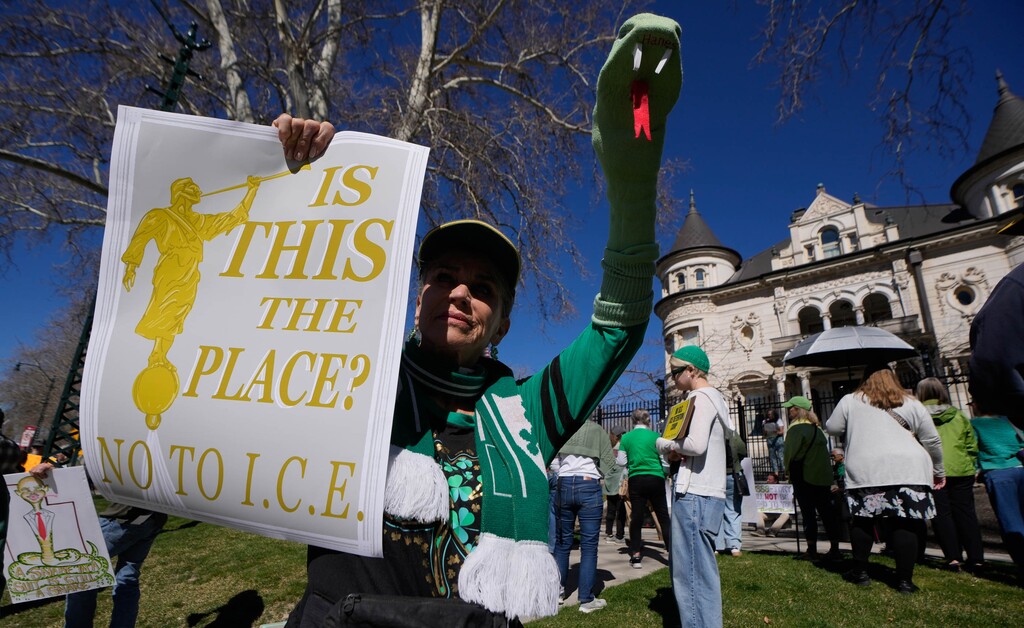
The “singing resistance” Tuesday aimed to “drive out the snakes,” organizers with the grassroots group Salt Lake Indivisible said.
The crowd, many dressed in green, clapped along and held signs reading, “We are ALL immigrants” and “Gov. Cox STOP ICE concentration camps in Utah.”
Others held up snake hand puppets, which were made by a Utah artist, organizer Sarah Buck said.
As protesters sang, passersby frequently honked.
(Francisco Kjolseth | The Salt Lake Tribune) Marv Poulson joins others gathered outside the Governor’s Mansion in Salt Lake City in response to the recent purchase of a warehouse by ICE on Tuesday, March 17, 2026.
(Francisco Kjolseth | The Salt Lake Tribune) People begin to gather outside the Governor’s Mansion in response to the recent purchase of a Salt Lake City warehouse by ICE on Tuesday, March 17, 2026.
The aim of the rally was to call on Gov. Spencer Cox to reconsider and “close” the planned facility, organizer Melissa Barbanell said.
Cox last year said he supports a detention center in Utah so migrants don’t have to be transported to Las Vegas or other cities for processing. He has not commented on ICE acquiring the Salt Lake City warehouse.
“It’s particularly alarming that this facility will sit in the heart of one of Utah’s most diverse communities,” Barbanell said. “Life as we know it on the west side is about to change dramatically, and many families will now live in constant terror.”
“This is a defining moment for our state,” she continued.
A growing ‘singing resistance’
More than 100 people turned out for the first of two protests this week tied to the planned facility. The second, on Wednesday evening, will take place at the warehouse site, Buck said.
The Tuesday gathering was part of a growing movement across Utah and the U.S. that uses song as a form of protest, she said.
“The idea behind singing resistance is not only to gather in song, but to gather in protest,” she said, noting that while the tactic has a long history, its use has increased recently following the fatal ICE shooting of Renée Good in Minneapolis earlier this year.
McCarthy jumped at the chance to lend her voice. The songs, she said, were given to the Utah group by the organizers in Minnesota.
(Francisco Kjolseth | The Salt Lake Tribune) Protesters gather outside the Governor’s Mansion in response the recent purchase of a Salt Lake City warehouse by ICE on Tuesday, March 17, 2026.
(Francisco Kjolseth | The Salt Lake Tribune) Protesters gather outside the Governor’s Mansion in response the recent purchase of a Salt Lake City warehouse by ICE on Tuesday, March 17, 2026.
The singing resistance group had initially planned its debut for the planned March 28 “No Kings” rally, but news of the warehouse purchase pushed them to act sooner, she said.
“Singing is kind of a way to draw people in,” Buck said. “When we chant, sometimes it’s aggressive and it kind of repels people.”
“It’s really amazing how different you feel when you’re singing,” she continued. “And I think that people who hear it are affected differently than having people shouting.”
Warehouse deal ‘came out of nowhere’
(Chris Samuels | The Salt Lake Tribune) A warehouse in Salt Lake City that records show was recently purchased by the U.S. Department of Homeland Security, photographed Friday, March 13, 2026.
Diane Crim and Niki Hack, retired teachers from a Rose Park school, said at the rally that they felt the quiet purchase of the west-side warehouse was “sneaky” and “came out of nowhere.”
Last week, ICE, through the Department of Homeland Security, spent $145.4 million to buy the 24.9-acre industrial site at 6020 W. 300 South, near Salt Lake City International Airport.
On the property sits an 833,000-square-foot warehouse intended to eventually hold thousands of detainees.
The purchase has sparked outrage among local officials, and Mayor Erin Mendenhall has vowed to oppose the facility.
Crim said that while she supports removing people with criminal histories — something the Trump administration initially emphasized — she believes that hasn’t been the reality of ICE enforcement.
To her, housing a detention center is “not what Utah stands for.”
“I think that we should stand for supporting people who are trying to build a great life,” Crim said. “But we shouldn’t be snatching people from courthouses or off the street or in their homes.”
(Francisco Kjolseth | The Salt Lake Tribune) Protesters leave messages in chalk for Governor Spencer Cox outside the Governor’s Mansion in response the recent purchase of a Salt Lake City warehouse by ICE on Tuesday, March 17, 2026.
(Francisco Kjolseth | The Salt Lake Tribune) Floyd Mori who was involved with the Japanese American Citizens League, compares Utah’s troubled past with the internment of Japanese American’s at Topaz during WWII, and the recent purchase of a Salt Lake City warehouse by ICE on Tuesday, March 17, 2026. Mori joined numerous others to protest the recent purchase at the Governor’s Mansion.
Floyd Mori, who grew up in Murray and whose parents immigrated to the U.S., told the crowd he couldn’t help but think of Utah’s past.
Mori, a former president of the Japanese American Citizens League, pointed to the Topaz internment camp in Millard County, where Japanese Americans — many from the San Francisco Bay Area — were held during World War II.
A new detention center, he said, could echo that history.
“Let us not let people lose their freedoms just because of who they are or where they came from,” he told the crowd.
The mix of music, signs and honking cars created an almost festive energy — a peaceful but pointed event that McCarthy said was meant to center “joy” rather than anger.
“Because what you’re doing is you’re singing your soul,” McCarthy said. “I think a lot of people get confused about joy in resistance or joy in protesting. Singing feels like ‘foo-foo’ — it doesn’t feel like action, but it is action.”