 Brooke Larsen
Price • Carbon County officials gave a massive proposed nuclear, natural gas and data center project the green light with a series of conditions on Thursday night.
The county’s planning commission approved a conditional use permit for Valar Atomics’ proposed Raceway Energy Campus — a large industrial project on 640 acres of land owned by the Utah Trust Lands Administration — after nearly two hours of discussion between the company and commission members.
This permit does not mean the project will break ground immediately, though. The company will still need to get a building permit and various plans, such as a traffic plan, approved by the county. It also will need state and federal approvals, such as an air quality permit from the Utah Division of Air Quality and a construction permit from the U.S. Nuclear Regulatory Commission.
The planning commission did not give the public a chance to weigh in on Valar’s application during the meeting. The planning commission was not required to hold a public hearing to approve the permit, Carbon County Attorney Christian Bryner said at the start of the meeting.
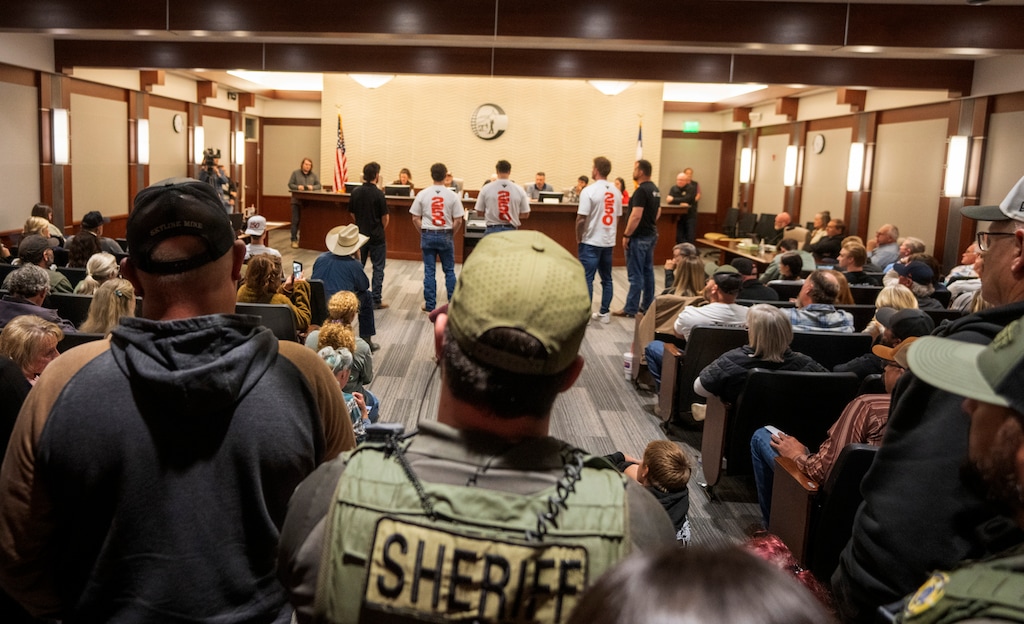
While they couldn’t provide comment, the nearly 200 people who showed up filled the commission chambers and the overflowing hallway with a mixture of boos, cheers and a few tears.
Some of the company’s employees filled seats and donned white matching t-shirts with the Valar logo. Some residents in the audience showed their opposition by holding signs that said “We Disagree” and “No Project Beehive” — an additional project Valar has proposed on 9,000 acres of adjacent federal land.
A few residents yelled out their frustrations with the project one too many times for the commission and sheriff’s deputies forced them to leave the room.
(Rick Egan | The Salt Lake Tribune) The crowd at the Carbon County Planning Commission is meeting hold signs protesting a conditional use permit for Valar Atomic's industrial site near Price, on Thursday, Nov. 12, 2026.
(Rick Egan | The Salt Lake Tribune) Protester gets escorted out of the Carbon County Planning Commission meeting to approve the conditional use permit for Valar Atomic's industrial site near Price, on Thursday, Nov. 12, 2026.
The Raceway Energy Campus will generate and use around 3 gigawatts of electricity, according to the company. For comparison, the entire state of Utah consumes about 4 gigawatts.
Valar plans to first power the electricity-hungry data centers with a natural gas plant. Eventually it aims to build 40 to 120 nuclear reactors on the site.
To access the state trust lands, the company will initially use East Coal Creek Road — a rural road through a community east of Price.
“That’s where I live, Coal Creek Road!” Debbie Durrant cried out as she walked out halfway through the meeting in tears.
The road has “probably two inches thick of asphalt,” said Planning Commissioner Kurt McFarlane. “It just won’t hold up because of the trucks.”
(Rick Egan | The Salt Lake Tribune) Carbon County commission member Lisa Simmons and Kurt McFarlane question Representatives from Valar at Carbon County Planning Commission, on Thursday, Nov. 12, 2026.
Cory Gardner, head of commercial development for Valar, said the company is “committed and willing to make the upgrades to that road.”
“The long-term plan is to not use that road,” he added. The company plans to eventually build a new road on land managed by the Bureau of Land Management off of Airport Road, which turns off Price’s Main Street near Walmart.
“Our biggest thing is like, why here?” Elizabeth Trostle, who also lives along East Coal Creek Road, told The Salt Lake Tribune. “Like right next to Price, like so close to people’s homes.”
Trostle said the Coal Creek area is “untouched” and that Valar should build the project on already disturbed land.
(Rick Egan | The Salt Lake Tribune) The Carbon County Planning Commission approved a conditional use permit for Valar Atomic's industrial site near the Coal Creek Road in Wellington, on Thursday, Nov. 12, 2026.
Planning Commissioner Lisa Simmons, who gave the only “nay” vote, asked the company about emergency protocols. Max Ukropina, head of projects at Valar, said nuclear energy is safe.
“The United States government does not hand out permits willy-nilly. It is a rigorous thing,” he said.
“Nuclear is the safest form of energy,” he added. “It’s even more safe than solar because too many old guys like myself are going on top of roofs and falling off.”
(Rick Egan | The Salt Lake Tribune) Thursday, Nov. 12, 2026.
(Rick Egan | The Salt Lake Tribune) The crowd at the Carbon County Planning Commission is meeting hold signs protesting a conditional use permit for Valar Atomic's industrial site near Price, on Thursday, Nov. 12, 2026.
Some meeting attendees raised their signs that said, “We disagree.”
“That’s not industrial solar,” Carl Ingwell, a Price resident and recent Democratic candidate for Utah House District 67, shouted from the crowd.
As part of the conditional use permit, Valar must submit an emergency response plan to the county’s building department in coordination with the sheriff’s office and fire marshal and cover any additional needed emergency management staff.
Justin Needles, who previously worked as the county’s emergency manager for a decade, is currently the emergency manager for Valar’s test site at the Utah San Rafael Energy Lab and will oversee the emergency plans at the Raceway campus.
“I really believe in what the project is, what we are doing for power,” Needles told The Salt Lake Tribune. “That’s what made me interested, is to help build and grow the next generation of energy workers in our area.”
Needles was born and raised in Price, and his dad worked for the railway hauling coal. “I always understood that it was the coal that ran his job and kept these power plants going,” he said.
Carbon and Emery counties are known as “Utah’s Coal Country,” but no mines currently pull coal from Carbon County. Needles and others see nuclear as a path for the area to remain an energy producer.
(Rick Egan | The Salt Lake Tribune) The Hunter Power Plant with the San Rafael Research Center in the foreground, in Emery County near Orangeville, on Thursday, July 21, 2022.
Others county residents worry about the longterm waste from nuclear, though.
“My major concern is we’re going to get halfway through the project, and then they’re going to make a big mess,” said Price resident MariAnne Lawrence. “We’re going to have nuclear waste.”
Valar’s application says that the company will store low-level radioactive waste on site “only until shipped to a licensed off-site disposal facility.”
The application lacks details of where it will store that waste temporarily and long-term, though.
“I think our biggest concern is we aren’t being told anything,” Lawrence said.
Other conditions of the permit include housing for the project’s workforce, community engagement and management plans for noise, water and waste.
Valar also plans to use “zero local water,” Gardner said. “We recognize that may not be legal for us to do and truck water in, but we are going to look into that as our primary source.”
If it can’t truck in water, Valar plans to acquire private industrial use water rights and non-culinary municipal water shares, Gardner said.
The company plans to use helium circulating in a closed loop to cool the reactor cores; the data centers will use “closed-loop systems that are filled once and topped up periodically,” according to the company’s application.