 Leia Larsen
Note to readers • This story is made possible through a partnership between The Salt Lake Tribune and Grist, a nonprofit environmental media organization.
As the number of planned data center projects seemingly explodes across Utah, most residents aren’t happy with how their elected leaders have handled them, according to a new survey.
A vast majority of Utahns – 86% – also don’t feel the cost of data centers, including their water and energy demands, outweigh their touted economic benefits, according to results from Utah State University’s Community and Natural Resources Institute’s survey. And nearly 76% of residents oppose or strongly oppose building more data centers in Utah.
The findings offer clues as to why the developments are facing intense backlash across the state, from Box Elder County to Spanish Fork to Utah’s coal country.
“We thought it would be nice to have a representative sample of voices from across the state to see what people are thinking about this emergent issue so people can’t say that what they’re necessarily hearing is just the loudest voices,” said Jessica Schad, director of the institute and administrator of the survey.
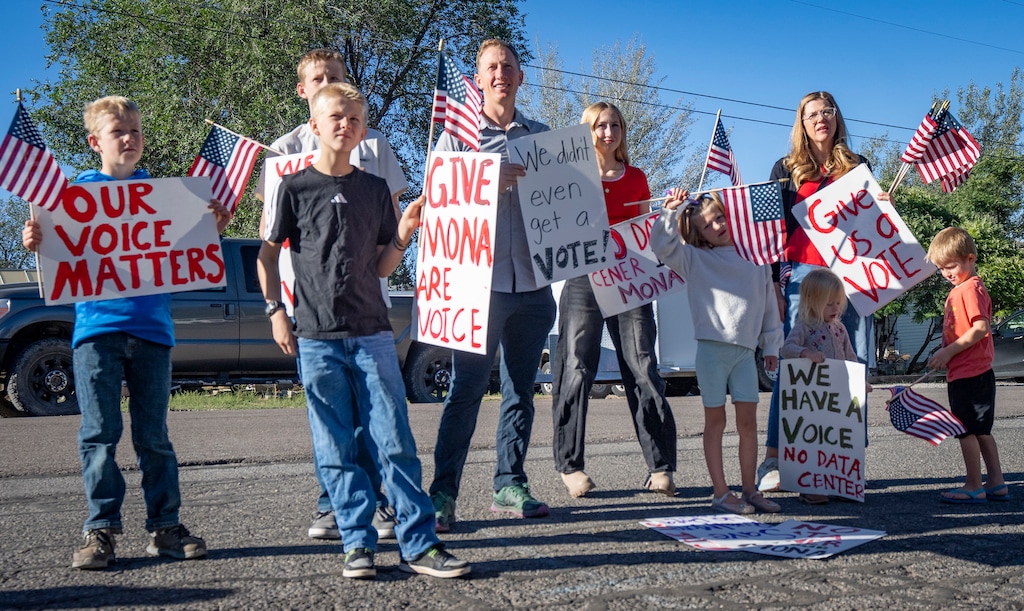
Researchers surveyed nearly 900 Utah residents about data centers in August. But they began preparing their study in the spring, before plans emerged for the massive Stratos hyperscale data campus in Box Elder County. That project, led by celebrity investor Kevin O’Leary, drew large crowds of protestors and factored heavily into Box Elder County commissioners and Senate President Stuart Adams losing their primaries.
Schad had time to include a few questions about Stratos in the survey. Nearly 95% of respondents had heard about the project, and 78% either opposed or strongly opposed the project.
“The thing that was most surprising to me,” Schad said, “was just how much people voiced a desire to be heard more in the process of data center development.”
Eighty-five percent said it was “very important” to have a public process for locals to participate in decision-making about data centers, according to the survey results. Another 10% called it “somewhat important.” And 89% want the state to ensure the public and local residents can influence decisions about data centers.
Details about other large data centers have emerged in the months since Stratos grabbed national headlines, including two sprawling data and energy sites planned for Millard County that will collectively consume more than 1.5 times energy than Stratos. More than 1,000 Tooele Valley residents signed a letter protesting a 500-megawatt data center and natural gas in their county near the Great Salt Lake. And details recently became public about a 9,000-acre computing, manufacturing and small modular nuclear reactor campus on Bureau of Land Management lands near Price.
About 30% of residents said using nuclear energy sources would make them “slightly” or “much” more likely to support data centers, but 41% said it would increase their opposition. More than half — about 51% — said they would be more likely to support data centers if they relied on renewable energy. Only 18% said renewables would increase their opposition. Another 54% said using recycled water or non-drinking water would increase their support for data centers.
Nearly 78% also want the state to enact environmental regulations for data centers, and 87% want regulations that restrict local water uses by the computing complexes. Another 79% want the state to restrict the volume of energy data centers consume.
More than half of respondents — 56% — want the state to leave decisions about data centers to the local residents who will leave near them. Only 19% want the state to leave those decisions to local governments.
But an overwhelming majority of Utahns are also disappointed with how governments have handled data center development in the state so far. About 52% are “very dissatisfied” or “dissatisfied” with their local or city government, 58% feel that way about their county government, 76% feel that way about state lawmakers and 74% feel that way about Gov. Spencer Cox.
Cox previously responded sharply when critics of the Stratos project voiced concerns that the project was moving too fast.
“It’s the dumbest thing ever,” Cox said in April. “We think that taking time makes things better or safer. It absolutely does not.”
The governor also said Utah had an “obligation” to build hyperscale data centers. But following statewide backlash, Cox has since walked back his stance.
Still, 84% of survey respondents said the data center development process in Utah is moving too fast.
And despite state and federal leaders touting national security and global competitiveness as a rationale for building data centers, only 35% of Utahns “agree” or “strongly agree” with those justifications. Even fewer, at 29%, agree or strongly agree that data centers are important for economic prosperity, while 31% feel they are important for scientific leadership.
Tabitha Benney, a professor in the University of Utah’s School of Public Affairs, was not involved in the survey but reviewed its findings.
She said the response rate was surprisingly small — the USU researchers mailed 20,000 randomly selected Utahns, but only 4.8% completed the survey online. Utahns who don’t understand data centers or aren’t following data center news may have been among those who opted not to respond, Benney said.
“Overall, it seems like a decent survey,” Benney said. She added that the results aren’t surprising, particularly the overwhelmingly negative attitudes toward data centers and frustrations with lawmakers.
“Decisions are being made behind closed doors in a way they weren’t before,” Benney said. “It’s a shame, in my opinion.”
Slightly more men responded to the survey than women, and the average age of respondents was 51, with respondents ranging from 18 to 92 years old. About 52% of respondents said they were registered Republicans, while 15% were registered Democrats. And 41% voted for Donald Trump in the last presidential election, while 36% voted for Kamala Harris. The USU survey also oversampled in counties outside of the urban Wasatch Front.
“There’s been a big uptick in focusing on developing data centers in rural places, so we wanted to make sure to bring their voices into this study,” Schad said.
The USU survey left room for respondents to provide comments on data centers in Utah. Water scarcity emerged as a top worry, including potential impacts to the Great Salt Lake, which hovers less than a foot about setting another record-low elevation.
“In Utah, it’s all about water,” one respondent wrote. “Bottom line.”
Transparency and trust in government was also a common theme.
“When state leaders favor development and revenue over citizens, it only sows distrust,” one resident wrote.
USU plans to continue further research into public attitudes about data centers, Schad said. Her team will interview more residents, policymakers and politicians, and conduct a follow-up survey next year. Questions will include other apprehensions that are surfacing for communities with data centers planned in their backyards, including e-waste.
“People are wanting more information about what the impacts are, and it’s just not out there yet,” Schad said. “You see a lot of that concern coming up in in our data.”
Leia Larsen is a sixth generation Utahn and a water and land use reporter reporter for The Salt Lake Tribune. She has covered environment, energy and political issues throughout the West. When she’s not chasing the news, Leia can be found exploring the Wasatch Mountains, sleeping in the desert or rooting around her garden.