 Jason Batacao
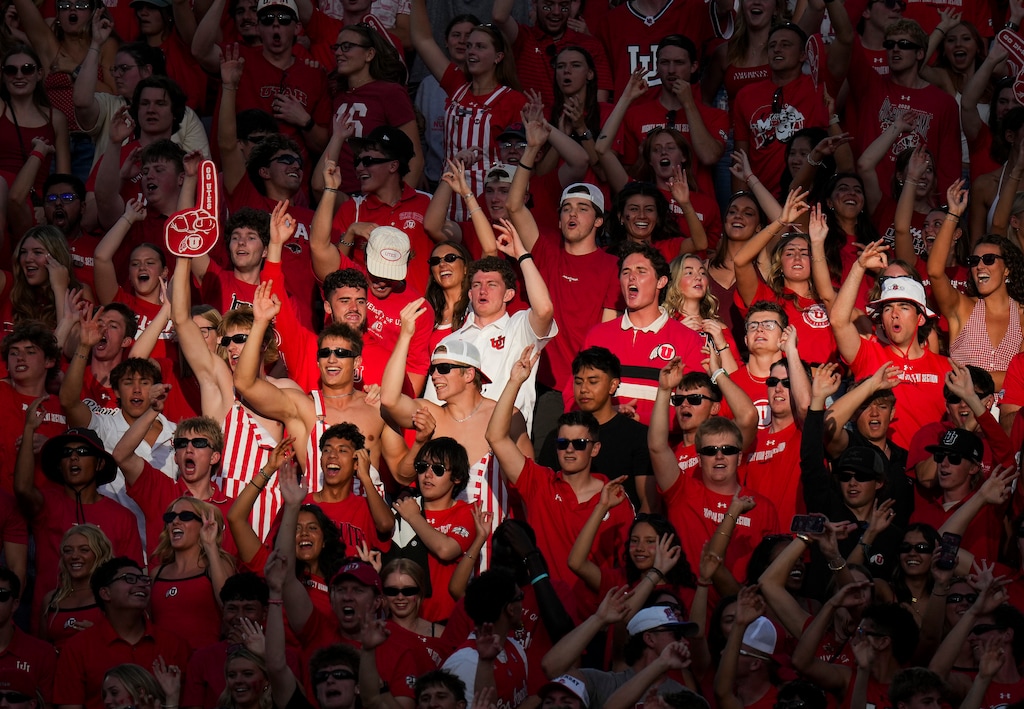
If you pay attention to the usually sold-out Rice-Eccles Stadium crowd, the first few minutes of the first quarter are often filled with fans slowly filtering into the stadium.
Early games. Afternoon games. Late games. For one reason or another, a portion of the fan base arrives late.
The MUSS, Utah’s student section, hasn’t been immune. At least, not until recently.
The students had been just like everyone else — with some spending an extra beat tailgating, struggling with parking or grabbing one final drink before heading inside to cheer on the Utes.
And there was a reason for that.
“In previous years, the ticketing system had assigned seating — for the lower bowl, and for the better part of the upper bowl — but after about five minutes left on the pregame clock, those assigned seats were then relinquished, so anybody could sit anywhere,” MUSS president Kai Cruz told The Salt Lake Tribune in an interview.
“This kind of led to some students knowing they could have their seat saved until later, and so students wouldn’t necessarily prioritize getting to the stadium early.”
This year, they’ve tried something new.
So far, it’s worked.
(Trent Nelson | The Salt Lake Tribune) Students in the MUSS participate in the Moment of Loudness as Utah hosts Utah State in Salt Lake City on Saturday, Sept. 19, 2026.
When No. 12 Utah (4-0, 1-0 Big 12) welcomes Kansas for its Big 12 opener Saturday, MUSS leaders will get their fourth look at the general admission system they implemented this season.
For the first time, MUSS members are incentivized to arrive early. And if the first three games are any indication, when the Jayhawks take the field for the first time, they’ll be greeted by 6,000 cheering (eh, maybe booing) students.
“This year, we’re there an hour before kickoff, the MUSS is almost full, and everyone’s incredibly juiced,” Cruz said.
The MUSS also changed how members bought tickets, according to MUSS student leader Trevor Coyle. The Ute student section adopted a new lottery-based system instead of the first-come, first-served model it had used for the last 24 years.
“In previous years, all the tickets that’d been claimed in carts were unavailable,” Coyle told The Tribune. “It started to become about being lucky with your operating system, being lucky with your browser and your computer in order to get a ticket.”
Cruz added: “It led to inequitable experiences such as computers crashing or networks not working. It just wasn’t fair.”
The new lottery-based system was open for six weeks in the spring, from April to May.
MUSS leaders also leveraged the lottery system to drive attendance for other sports around campus. For every non-football game attended, students earned points that could then be used to earn another entry in the football ticket lottery.
“At the standard rate, all students get one entry,” Cruz said. “Then, as they were going to other events and building it up, they could earn more football lottery entries.”
Students earned 500 points for every non-football contest attended. At 2,000 points, students would earn an extra lottery entry for football games.
There were also double- or even triple-point nights when the MUSS wanted to drive attendance.
“We had some students with close to 50 extra entries,” Cruz said. “It’s almost like a MUSS battle pass. There are prizes they can earn all along the way, and so those extra entries are kind of slipped into that prize ladder.”
Utah assistant athletic director Gavin Gough said the GA and lottery-ticketing move was also meant to “increase the connection” between the MUSS and the football team.
The new MUSS waiting area is adjacent to The Ute Walk, which is where fans can watch players walk into the stadium roughly two-and-a-half hours before kickoff.
“That’s something that we in athletics have been really excited about,” Gough told The Tribune. “There’s now a good number of students that are lining up and coming to the stadium early.”
With scarcity comes reward for the most hardcore Utah MUSS fans.
(Trent Nelson | The Salt Lake Tribune) Utah hosts Utah State in Salt Lake City on Saturday, Sept. 19, 2026.
“The GA ticketing decision was made this year to like to really get students in there early to start that atmosphere in Rice-Eccles,” said Utah’s Chief Alumni Relations Officer Kris Bosman, who oversees the MUSS.
She also hopes it can have a spillover effect with other Utah fans.
“People will be curious,” Bosman added. “Like maybe they’ll think, ‘If the students are here early, maybe I should be here early.’ That passion is contagious.”
So far — through three home games — the idea has worked, with the section filling up much faster than in years past.
“They are getting great lower-bowl seats, and they’re there, and they’re bringing that energy, especially when our student-athletes come take the field and start their warm-ups,” Gough said.
Jason Batacao, a former Oklahoma City resident who graduated from the University of Oklahoma, covers the University of Utah for The Salt Lake Tribune. When he’s not covering the Utes, Jason enjoys watching movies, playing on his Xbox Series X and reading books.