 Brooke Larsen
Outdoor retail giant Patagonia along with environmental and tribal groups filed lawsuits on Wednesday challenging President Donald Trump’s move to shrink Bears Ears and Grand Staircase-Escalante national monuments.
The lawsuits, filed in the U.S. District Court in Washington, seek to reactivate cases initially filed in 2017 when Trump previously reduced the size of the two monuments. The new filings challenge both Trump’s 2017 and 2026 proclamations.
After Trump shrank the monuments in 2017, President Joe Biden then restored and expanded the boundaries in 2021. The lawsuits had not received a final judgment at that point, so the cases were administratively closed. Trump then shrank the monuments again by roughly 90% on July 13.
“President Trump’s unlawful attack dismantling Grand Staircase-Escalante and Bears Ears National Monuments was a dark day for America and our nation’s long tradition of protecting parks, monuments and wild places for current and future generations,” said Steve Bloch, legal director at the Southern Utah Wilderness Alliance. “With the filing of these lawsuits, we intend to make sure Trump doesn’t have the final word over the fate of these treasured landscapes.”
Taylor Rogers, a White House spokeswoman, said in an email that Trump “rightsized” the monuments.
“The Obama and Biden administrations abused the Antiquities Act to lock up millions of acres of Utah’s public lands, impoverishing local communities and sharply restricting access for recreation, grazing, resource development, and fire prevention,” she said.
A Department of Interior spokesperson echoed the White House, saying in an email that Trump is “ending the abuse of the Antiquities Act, restoring access, protecting our heritage, and putting Utahns and all Americans first.”
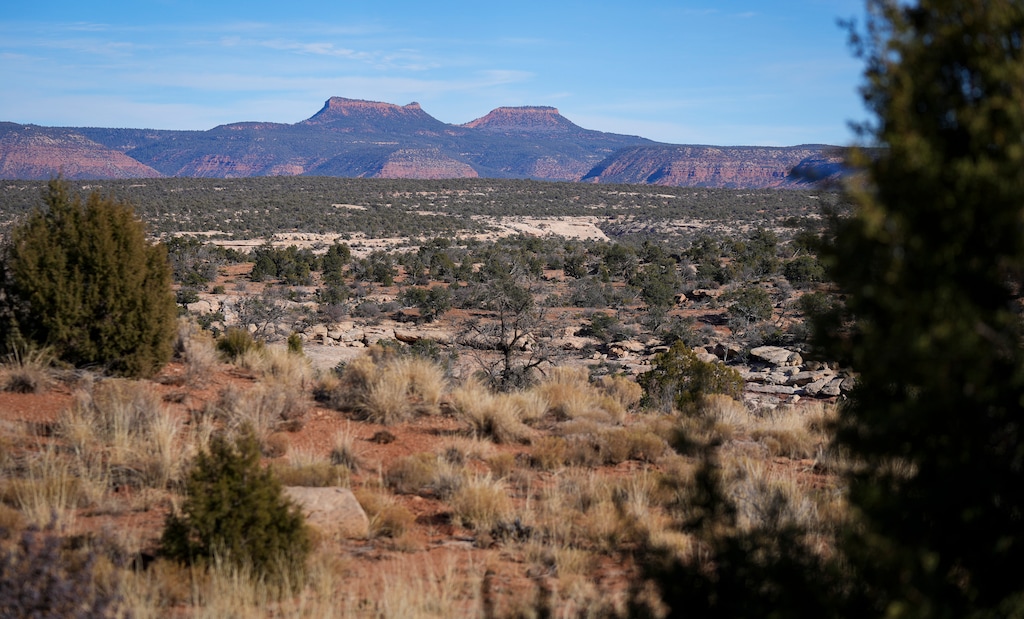
(Bethany Baker | The Salt Lake Tribune) Grand Staircase-Escalante National Monument from Homestead Overlook outside Boulder on Tuesday, Dec. 17, 2024.
Hunting, fishing, hiking and other types of recreation were allowed in both Bears Ears and Grand Staircase-Escalante National Monuments, according to the Forest Service and the Utah Division of Wildlife Resources. The New York Times reported that Utah officials told the Trump administration in June that there was “current recreational access” in Bears Ears, specifically highlighting two popular trails.
The lawsuits argue that the Antiquities Act gives the president power to designate national monuments and reserve land for protection, but does not give the president authority to abolish monuments “in whole or in part.”
“The Antiquities Act doesn’t provide the president with the authority to revoke national monuments — only to designate them,” Heidi McIntosh, managing attorney at Earthjustice, told The Tribune.
Utah Gov. Spencer Cox and the state’s congressional delegation supported Trump’s reductions of the monuments. The state has challenged the extent of a president’s authority under the Antiquities Act, filing a lawsuit against the federal government in 2022 after Biden restored the monument boundaries.
“There have been challenges to monument designations,” McIntosh said, “but no court has overturned a monument designation.”
Trump also disbanded the Bears Ears Commission, which guided the monument’s management and consisted of representatives from the Hopi Tribe, Navajo Nation, Ute Mountain Ute Tribe, Zuni Tribe and the Ute Indian Tribe of the Uintah and Ouray Reservation.
“It’s been disappointing to see how much work has been put into trying to do co-management with the tribes and the federal agencies, and then having all that work put on hold or shelved,” said Angelo Baca, an enrolled citizen of the Navajo Nation and member of the Hopi Tribe. Baca is a media consultant for Utah Diné Bikéyah, an Indigenous-led nonprofit that is a plaintiff in one of the lawsuits.
He said that the the 2017 monument reduction was illegal, and “it’s illegal now. I don’t think any of the tribes are wavering in their position.”
The shrinking of Bears Ears National Monument has been “devastating” and “traumatic,” said Deena Ute, a member of the Ute Mountain Ute Tribe and director of the nonprofit A’Nuche, which serves the White Mesa community and is a plaintiff in one of the suits.
“The erasure — it’s so devastating,” she said.
(Bureau of Land Management) Federal agency leaders and tribal representatives on the Bears Ears Commission stand in front of the newly installed Bears Ears National Monument sign on June 18, 2022. Pictured from left, former Agriculture Department Under Secretary Homer L. Wilkes, Ute Indian Tribe Business Committee Member Christopher Tabbee, Ute Mountain Ute Councilman Malcolm Lehi, Zuni Tribe Lieutenant Governor Carleton R. Bowekaty, Hopi Chairman Timothy Nuvangyaoma, Navajo Nation Executive Assistant Davis Filfred and BLM Director Tracy Stone-Manning.
In total, three complaints challenging the shrinking of the national monuments were filed on Wednesday.
Patagonia, tribal-led groups such as Utah Diné Bikéyah and A’Nuche, as well as archaeology, outdoor recreation and conservation groups filed to reactivate their lawsuit over the shrinking of Bears Ears National Monument.
“We need leaders in all levels of government and from across the country to push back against the administration’s order and the greater whole-of-government assault on public lands, climate action and environmental protection,” Patagonia CEO Ryan Gellert said in a statement. “We must hold them accountable if they do not.”
A group of ten environmental groups, including the Southern Utah Wilderness Alliance, Natural Resources Defense Council and the Sierra Club, also filed supplemental complaints to lawsuits over both Bears Ears and Grand Staircase-Escalante national monuments.
Tribes that sued in 2017 did not file a new complaint on Wednesday.
“This latest court filing by conservation groups and advocates is an important step in the ongoing defense of these lands against efforts by this administration to irrevocably alter this sacred landscape,” said Matthew Campbell, deputy director of the Native American Rights Fund, in an email statement.
The Native American Rights Fund filed a lawsuit on behalf of the Hopi Tribe, Pueblo of Zuni and Ute Mountain Ute Tribe in December 2017. The Navajo Nation and Ute Indian Tribe also joined the suit as plaintiffs.
“We look forward to continued partnership defending these monuments as it is Tribal Nations’ sovereign right to steward Tribal homelands,” Campbell said.