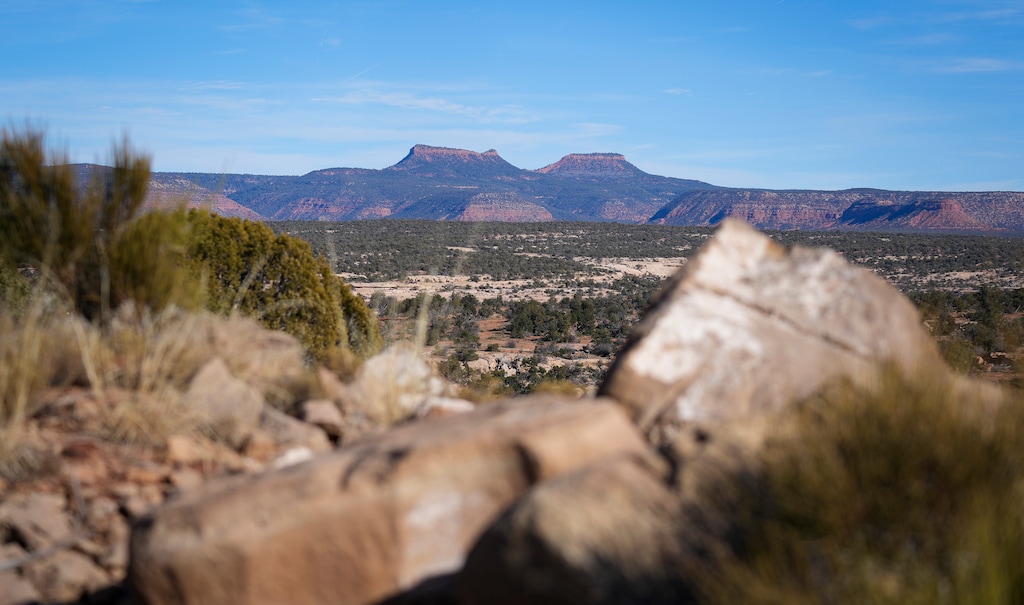
 Brooke Larsen
Bears Ears isn’t just public land for Davina Smith-Idjesa.
The area has long been the sacred ancestral homeland for her tribe and others.
“When I talk about Bears Ears, I’m not talking about a place I occasionally visit,” said Smith-Idjesa, a member of the Navajo Nation and co-chair of the Bears Ears Inter-Tribal Coalition who lives in Blanding. “I’m talking about home — a landscape that continues to care for our people.”
President Donald Trump on Monday gutted Bears Ears and Grand Staircase-Escalante national monuments, shrinking both by roughly 90%.
His order also disbanded the Bears Ears Commission, which guided the monument’s management and consisted of representatives from tribes that have long considered the land sacred, including the Hopi Tribe, Navajo Nation, Ute Mountain Ute Tribe, Zuni Tribe and the Ute Indian Tribe of the Uintah and Ouray Reservation.
“We are deeply disappointed that this decision was made without the meaningful government-to-government consultation the federal government had promised, particularly after the Tribal Nations spent years working collaboratively and in good faith with federal agencies,” said Mikah Kewanimptewa, vice chairman of the Hopi Tribe and a member of the commission, in a statement.
No consultation
In June 2025, the Interior Department stated in a letter that it would meet with the Bears Ears Commission if it was considering changes to the monument, according to the commission. No such meeting happened, it added.
“The Antiquities Act does not require tribal consultation prior to the signing of proclamations related to national monuments,” an Interior Department spokesperson said in an email to The Tribune. “Tribal consultation will be part of the monument management planning process.”
Utah’s elected leaders also didn’t consult tribes, Smith-Idjesa told The Tribune. Utah’s congressional delegation, Gov. Spencer Cox and Utah House Speaker Mike Schultz stood behind Trump as he signed the proclamations shrinking the monuments.
(Julia Demaree Nikhinson | AP) President Donald Trump speaks after signing executive orders modifying the Bears Ears and Grand Staircase-Escalante National Monuments in the Oval Office of the White House, Monday, July 13, 2026, in Washington. Behind Trump, from left: U.S. Reps. Blake Moore, Celeste Maloy, and Mike Kennedy; U.S. Sens. John Curtis and Mike Lee; Gov. Spencer Cox; House Speaker Mike Schultz, R-Hooper; and Department of the Interior Deputy Secretary Kate MacGregor; and U.S. Rep. Burgess Owens.
Any one of them could have spoken up for tribes but didn’t, Smith-Idjesa said. “It was another form of erasure for tribal nations.”
The offices for Utah’s Congressional Delegation and Cox did not respond by the time of publication.
A spokesperson for Mike Schultz declined to comment on the issue and said that Utah’s Public Lands Policy Coordinating Office and the White House were better suited to answer questions.
“It is not typical to reach out to tribal leaders / nations regarding monument changes on BLM property,” a White House official said. “No tribal leaders reached out to the White House.”
The Public Lands Policy Coordinating Office did not respond to The Tribune’s request for comment.
Undoing an ‘extraordinary’ collaboration
When President Barack Obama designated Bears Ears National Monument in 2016 after tribes petitioned the former president to protect their ancestral homelands, he established the Bears Ears Commission for tribes to guide the management of the monument.
Terminating the commission “is a major setback to one of the nation’s most extraordinary models of collaborative management of public lands between Tribal Nations and federal agencies,” the commission’s statement said.
Trump’s latest proclamation maintains an advisory committee that includes representation from each of the five tribes, but it also will include one member each from San Juan County, Monticello City, Blanding City and the town of Bluff, as well as six members recommended by Utah’s governor that represent stakeholders, including livestock grazing permit holders, off-highway vehicle users, private landowners and conservationists.
Obama’s monument designation “was not just an opportunity to heal from past removals, but a chance to lead with Traditional Indigenous Knowledge and protect a living cultural landscape for future generations,” said Betsy Chapoose, designated proxy to the commission and cultural rights and protection director for the Ute Indian Tribe of the Uintah and Ouray Reservation, in a statement.
The commission worked alongside the Bureau of Land Management and the U.S. Forest Service in developing and implementing the monument’s resource management plan, which was finalized in 2025.
(Photo courtesy of the Bears Ears Inter-Tribal Coalition) Flanked by Undersecretary of Agriculture Homer Wilkes, left, and BLM Director Tracy Stone-Manning, right, members of the Bears Ears Commission gathered at the newly unveiled monument sign on State Road 261 in June 2022. Pictured left to right are Commissioners Christopher Tabbee and son (Ute), Malcolm Lehi (Ute Mountain Ute), Carleton Bowekaty (Zuni Pueblo), Timothy Nuvangyaoma (Hopi) and Davis Filfred (Navajo).
“The plan remains a historic achievement, demonstrating how Tribal leadership, Indigenous Knowledge, and western science can work together to care for one of America’s most significant regions,” the commission said.
The collaboration between Tribes and the federal government was not always easy, Smith-Idjesa said. They didn’t always agree. It took time to build trust.
“But we came to the table. We had difficult conversations. We listened, and we worked towards solutions,” she said.
The commission was significant because the federal government finally recognized that tribes are “not simply stakeholders to be consulted after decisions are made,” Smith-Idjesa added. “We are a sovereign government with knowledge, responsibility and a direct ancestral connection to this land.”
A living cultural landscape
Trump’s proclamation breaks up what was once 1.36 million acres of protected land into smaller parcels and sections that range from an 88-acre parcel that includes an Ancestral Puebloan site to the 106,816-acre Shash Jáa Unit, which is now considered “the heart of the monument” and includes the Bears Ears buttes.
An Interior spokesperson said Trump is “rectifying” overreaches by Obama and President Joe Biden who “weaponized the Antiquities Act to lock up millions of acres of Utah’s public lands over the explicit objections of the state’s elected leaders.”
They said “not a single archaeological site, artifact, or cultural resource loses protection under this action” because of federal laws, such as the Archaeological Resources Protection Act and the National Historic Preservation Act.
“What changes is that the vast surrounding acreage with no qualifying objects to protect, is no longer off-limits,” the spokesperson added.
Existing federal laws don’t protect the interconnected landscape in the same way as a monument designation, Anthony Sanchez Jr., head councilman of the Zuni Tribe and co-chair of the commission, said in an email to The Tribune.
Other policies focus more on a specific archaeological site or resource, he said, and consultation does not guarantee protection of a resource from activities such as mineral development, road construction, vandalism, looting and other disturbances.
“From a Tribal perspective, you cannot separate the sites from the land around them because together they form the cultural landscape,” Sanchez Jr. said. “The absence of a publicly documented archaeological site does not mean an area lacks cultural significance.”
For Tribes, the cultural significance “lies in the relationship among sacred places, traditional-use areas, plants, animals, migration routes, shrines, and ancestral sites across a broader landscape,” he said.
“These landscapes embody centuries of history, traditional knowledge, and continuing cultural relationships that remain vital today,” he continued.
For the Ute Indian Tribe, it has always been part of their seasonal migrations, where the tribe’s people “gathered medicines, hunted game, and connected to the power of the land through ceremony,” said Chapoose.
The Hopi people traveled through and lived within the Bears Ears landscape, “leaving place names, petroglyphs, cultural belongings and stories,” said Kewanimptewa.
The footprints of the Zuni Pueblo ancestors are “everywhere across the landscape,” Sanchez Jr. said.
The ancestors of the Ute Mountain Ute Tribe “lived, hunted, gathered and prayed” in Bears Ears “long before boundaries were drawn,” said Gwen Cantsee, vice chairwoman for the Ute Mountain Ute Tribe.
And for the Diné, the connection to Bears Ears is “living and ongoing,” said Curtis Yanito, Navajo Nation council delegate and commission co-chair.
“This landscape holds our prayers, our medicines, and the stories of our ancestors,” he said. “We are not visitors here; we are locals, and we are still here.”
The Bears Ears landscape was also a place that some Diné people found refuge during the Long Walk, Smith-Idjesa said, when the U.S. government forced the Diné people to march hundreds of miles away from their homelands to an internment camp in 1864. It wasn’t until four years later, when the Navajo Treaty of 1868 was signed, that the Diné people were allowed to return to some of their homelands.
(Zak Podmore | The Salt Lake Tribune) Davina Smith-Idjesa, co-chair of the Bears Ears Inter-Tribal Coalition, stands near the Colorado River on August 15, 2019 with a medicine bundle of plants she gathered in Bears Ears National Monument as she prepared to run from the Bears Ears Buttes to Salt Lake City.
Bears Ears has continued to be a refuge for Smith-Idjesa and her relatives. It’s where she gathered plant medicine to carry with her on a 330-mile prayer run she completed between Bears Ears and Salt Lake City after President Donald Trump shrank the monument during his first administration.
Smith-Idjesa felt heartbroken, disappointed and exhausted after Trump’s executive orders on Monday. But she and the rest of the coalition and the commission members also expressed their ongoing commitment to their ancestral homelands.
Their connection to the landscape did not begin with the creation of the monument, she said, and it won’t end with “a stroke of a pen.”