 Leia Larsen
Note to readers •This story is made possible through a partnership between The Salt Lake Tribune and Grist, a nonprofit environmental media organization.
Deer Valley • When U.S. Forest Service Chief Tom Schultz saw Utah’s dire snowpack conditions over the winter, he knew he’d have a catastrophic fire season ahead.
Those dry conditions combined with unseasonable heat have proved disastrous. The Cottonwood Fire near Beaver has burned 93,000 acres and counting, becoming one of the most destructive fires in Utah history. Along the state’s border with Colorado, three wildland firefighters died while trying to contain the Knowles Fire.
Meanwhile, the U.S. Forest Service in the process of relocating its headquarters from Washington, D.C. to Salt Lake City. The Trump administration announced the move in March. Schultz said the poor state of Western forests highlights the need to shift the federal agency’s presence closer to the communities it serves.
“If you look at the intent behind it, it’s really to get the office closer to where the people are,” Schultz said in an interview Tuesday. “We see 90% of the national forests are west of the Mississippi. A preponderance of the land is in the West.”
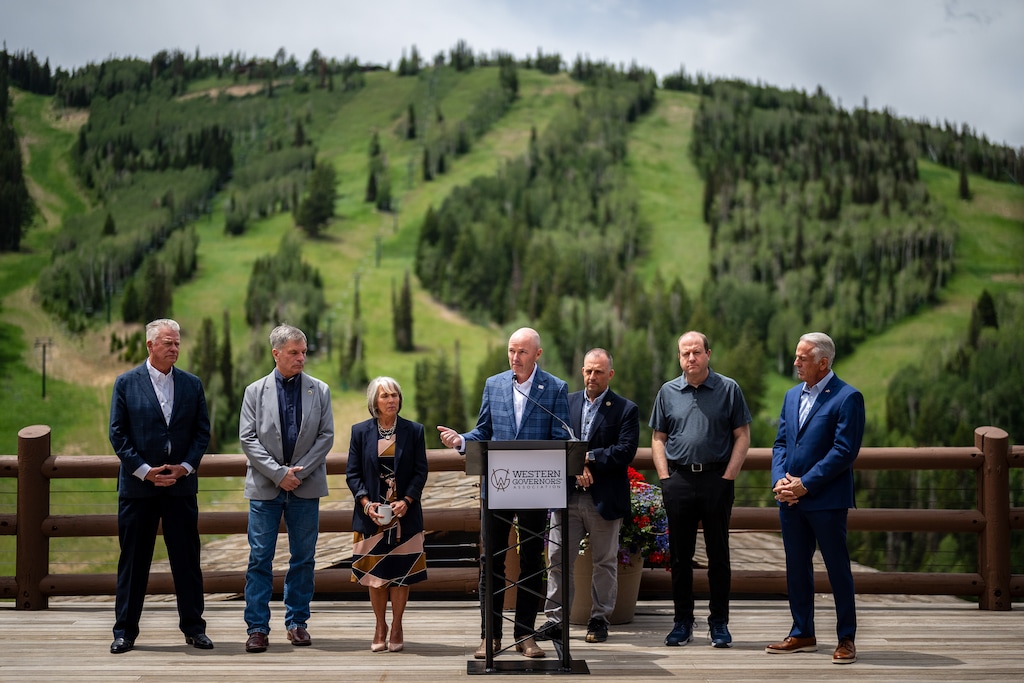
(Trent Nelson | The Salt Lake Tribune) Chief of the Forest Service Tom Schultz speaks at the annual meeting of the Western Governors' Association in Park City on Tuesday, June 30, 2026.
The forest service is in the process of remodeling the second floor of the Wallace F. Bennett Federal Building to accommodate the new headquarters, Schultz said, and he expects his staff will start relocating in the fall. The forest chief also doesn’t expect it will cause much disruption for his agency, even as employees uproot their lives and move to the Beehive State.
“We’re looking at probably less than 300 people that are going to have to relocate across the entire agency,” Schultz said. “We’re still going to have a footprint in D.C.”
Utah’s Uinta-Wasatch-Cache National Forest is one of the most popular federal forest for recreation in the nation, falling second to the White River National Forest — and its 11 ski resorts — in Colorado.
Despite anxieties that the Trump administration, with help from U.S. Sen. Mike Lee, R-Utah, may be looking to sell off public lands to the highest bidder, Schultz said the forest service remains dedicated to preserving access and abiding by Congressional directives. He also prioritizes improving forest health.
“We’re committed to science, we’re committed to research,” Schultz said. But his agency is also committed to saving taxpayer money by consolidating its offices, including the move to Salt Lake City.
(Trent Nelson | The Salt Lake Tribune) Chief of the Forest Service Tom Schultz speaks at the annual meeting of the Western Governors' Association in Park City on Tuesday, June 30, 2026.
Schultz was in Utah this week to tour the Cottonwood Fire and give a keynote talk at the Western Governor’s Association conference high in the mountains near Park City. Utah Gov. Spencer Cox is stepping down as chair of the association after spending the past year focusing on initiatives to build energy “superabundance” across the West.
Those same Western governors issued a bipartisan letter supporting the forest service’s relocation to Salt Lake City on June 18.
“Improving state-federal communication and coordination is a goal that transcends party lines,” the letter said, “and it is among the Governors’ highest priorities.”
In his keynote address to the governors, Schultz highlighted some sobering statistics about the nation’s forests. Forests in Western states like Utah, Colorado, Idaho and Montana now have negative growth rates, meaning more trees are dying than growing.
“Forests are supposed to be a carbon sink,” Schultz said. “In the Intermountain West, most of the forests are emitting more CO2 than they are storing.”
Schultz has a background working for the commercial timber harvesting industry, which landed him some criticism from environmental groups when Agriculture Secretary Brooke Rollins appointed him to his current role in February 2025.
But conservation of federal, fire-prone landscapes requires active management, Schultz said, although he acknowledged around 75% of the forest system can’t be managed with logging or other mechanical treatments because it’s protected by Congress as wilderness or roadless areas.
Of the remaining 25% of forested public land, however, the agency currently only has the capacity to treat around 1% of the landscape each year, Schultz said.
If the Forest Service followed its own plans adopted in each forest system, Schultz said, the agency could sell around 7 billion board-feet of timber each year. It currently sells around 3 billion.
Utah’s commercial timber industry has lagged for decades, unable to compete with the fast-growing and profitable trees that grow in wetter and cooler climates like the Pacific Northwest and Canada. Two of its few remaining sawmills, in Kamas and Panguitch, burned down in 2024.
The private sector is developing innovative ways to use Utah timber, however, Schultz said in an interview. He sees promise in current industries salvaging timber for firewood, and companies developing biochar and sustainable aviation fuel made from wood.
“This is what we’re trying to focus on — what are the markets we can help create?” Schultz said. “If the forest service is consistent in what we say and what we do, then I think the market can respond.”
Leia Larsen is a sixth generation Utahn and a water and land use reporter reporter for The Salt Lake Tribune. She has covered environment, energy and political issues throughout the West. When she’s not chasing the news, Leia can be found exploring the Wasatch Mountains, sleeping in the desert or rooting around her garden.