 Leia Larsen
Note to readers • This story is made possible through a partnership between The Salt Lake Tribune and Grist, a nonprofit environmental media organization.
This story is also an excerpt from the Open Lands newsletter, delivered to inboxes every week. For a sneak peek from the environment team about what we’re working on and news we’re following, sign up to have Open Lands delivered to your inbox.
This summer is really getting to me, and I have a feeling I’m not alone.
There’s something psychologically taxing about checking the forecast and seeing day after day of temperatures above 90 degrees. Or watching clouds build in the sky, hoping they’ll bring some relief, but rain never comes. Or spending most of my time holed up indoors because it’s too hot to even pull weeds. Or visiting higher-altitude places, where I could typically go to preserve some of my summertime sanity in a cooler climate, only to see them slammed with masses of Utahns doing exactly the same thing.
I know this is subjective and sounds slightly paranoid, but it also feels like the heat keeps following me. I took a road trip through Colorado in March and hit that state’s exceptionally early spring heat wave. In June, I took a girls’ retreat to Palm Springs —which, I get is in the Sonoran Desert and famously hot — but my timing coincided with the highest temperatures for that month ever, with multiple days above 120 degrees. For July 4, I celebrated the nation’s 250th birthday in Philadelphia and the Jersey Shore when an extreme heat dome besieged the East Coast. I returned home just in time for Salt Lake City and Logan to hit unprecedented temperatures on July 12, at 109 and 103 degrees, respectively.
Heat poses a danger to our physical health, causing heat stroke and exhaustion. It’s the leading cause of weather-related deaths. A spokesperson for the Department of Health and Human Services said the state saw fewer than 11 heat-related deaths statewide each year between 2020 and 2023. But in 2024, there were 15. They don’t have data for 2025 or 2026 yet.
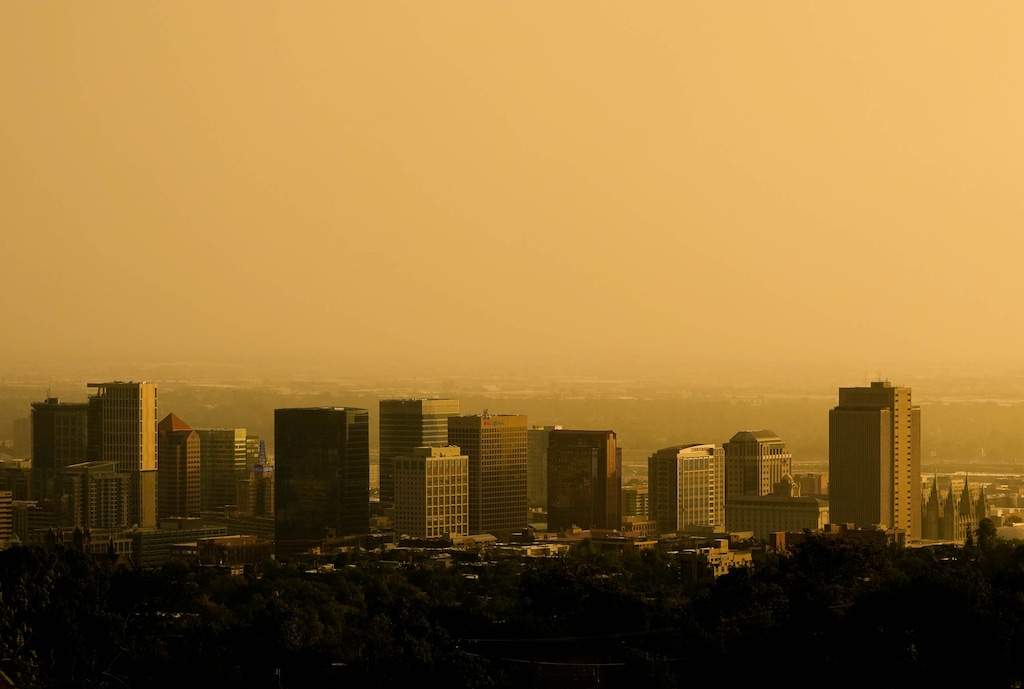
(Trent Nelson | The Salt Lake Tribune) In extreme heat, a Southwest plane makes its approach to the Salt Lake City International Airport on Monday, July 13, 2026.
Studies show heat can take a toll on our mental health, too. Chronic heat exposure causes stress, anxiety and cognitive impairment. It can disrupt our hormones and our sleep patterns. It makes us irritable and spurs violent behavior.
We know climate change is cooking the West, fueling drier and more extreme weather. That makes everything somehow feel worse. I feel guilty every time I crank up the air conditioning because I know it puts more strain on the grid. I feel bad every time I water my garden, knowing the Great Salt Lake saw almost no spring runoff. The snow drought that gripped the American West in 2026 was four times more likely because of climate change, and 14 times more likely in the Upper Colorado River Basin, according to a new study.
I used to look forward to summer – outdoor barbeques, swimming pools, camping trips. But in the last few years, I’ve come to dread it. This year felt particularly bad for reasons I couldn’t quite put my finger on, but after talking with Alex DeSmet, a meteorologist with the National Weather Service in Salt Lake City, I have a better idea why.
This isn’t the hottest summer on record, at least so far. DeSmet ran the numbers from June 1 until now, and found this is the 10th-warmest summer for Salt Lake City since we started keeping track in the late 1800s. That’s because monsoons keep rolling in pretty soon after the mercury spikes.
“We’ve had the heat kind of in spurts,” DeSmet said.
So despite multiple days of record highs, the monsoons have cooled our average temperature.
What’s actually messing with me this summer isn’t that it’s warmer than summers past, though. It’s that the heat came so early.
When I asked DeSmet to run the numbers starting on March 1, when the heat waves began, he found this is actually the hottest year recorded in Salt Lake City so far. He then ran them starting on Jan. 1, and again, 2026 is shaping up to be the worst year for heat. Salt Lake City’s average March temperature was 53.6 degrees, for example, which obliterated the previous record of 50.1 degrees set in 2017. Much of the Wasatch Front saw an extreme heat watch last week, with temperatures climbing to 100 degrees or higher by the weekend.
DeSmet offered advice we’re probably used to hearing by now for coping with feverish weather. Stay indoors during the hottest part of the day, typically between 10 a.m. and 6 p.m. Don’t leave children and pets alone in vehicles. Check on your neighbors, especially the elderly.
Most of us are probably aware of seasonal affective disorder, a form of depression typically associated with the winter blues. But I find myself grieving our lack of winter this year — no skiing or cozy, snowy days — and feeling sad about summers where I spend most of my time inside. Heat makes our air pollution worse. It’s making our forests burn. It causes toxic algal blooms in our lakes and reservoirs. I’m bummed the March heatwaves made my peach tree bloom way too early, and I have no fruit to look forward to in August because a cold snap wiped out the crop.
How are Utahns handling the heat?
I asked Open Lands readers if the heat was making them miserable too, and it seemed to resonate.
“I’m feeling anxious and depressed this summer as never before,” Kim Duffy from Holladay said in an email. “And I feel guilty about it, as we have 3 charming grandkids to play with and shouldn’t that make me feel grateful and happy?”
Duffy said she was grappling with a heart-breaking decision to sell her century-old home and 1.6-acre property covered in native woodland so she can retreat to a cooler climate in Driggs, Idaho.
Megan Curtis, who said she grew up on the Wasatch Front and feels a strong connection to Utah, is also debating selling her “dream home” in her “dream neighborhood” to move to the Northeast in search of a safer climate to raise her children.
“I never loved winters in Utah and neither did my husband,” Curits wrote, “but now that they are gone we miss them terribly. I long for cozy snowy days and clean air that follows.”
Many of you pointed out that the heat and ensuing wildfires are a product of climate change, and the result of humanity’s own hubris for continuing to burn fossil fuels even after we understand the consequences.
“I read recently that the herpetofauna of the Southwest deserts are suffering with the heat and populations are declining,” wrote Jill Carpenter from Salem, Virginia. “In just a very short time, we have heated the Earth up for all its inhabitants. But we think only of ourselves.”
Amadeus Guy from Vernal wrote about all the positives that came from cheap energy in the form of oil and coal over the last two centuries – robust economies and modern lives largely freed from manual labor.
“I wish the large petroleum companies would consider themselves ‘energy companies,’” Guy wrote, “and use their capital and infrastructure to transition to safer forms of energy.”
Still, he said he holds out hope.
“There will be further hardship,” Guy wrote, “yet often in the face of real challenges - is the moment when people’s best nature shines through and there is unity in purpose.”