 Leia Larsen
Note to readers • This story is made possible through a partnership between The Salt Lake Tribune and Grist, a nonprofit environmental media organization.
This story is also an excerpt from the Open Lands newsletter, delivered to inboxes every week. For a sneak peek from the environment team about what we’re working on and news we’re following, sign up to have Open Lands delivered to your inbox.
Leia Larsen here with a bit of a travel log. Earlier this month I went on a girls’ trip to Palm Springs. Lounging by the pool was fun and all, but what I really wanted to do was swing by the Salton Sea.
For some reason I couldn’t convince my friends to also check out a drying-up lake in the middle of the desert that’s often associated with dead fish and dust storms, so on our last day, I took a solo drive south. The vintage motels, antique stores and coffee shops quickly gave way to groves of date palms and vineyards. Then, there it was, shimmering like a mirage. That familiar sight of rare water in the desert, surrounded by craggy mountains and a vast playa. A distinct smell filled the air, the kind you only get at salty lakes.
(Leia Larsen | The Salt Lake Tribune) The Salton Sea on June 14, 2026.
Salton Sea landed on my saline lake bucket list after I took a reporting trip to Mono Lake and Owens Lake in 2022, which we dubbed the Great Salt Lake’s “sister lakes” since they have so much in common. Mono, Owens and Great Salt lakes all lie in the Great Basin with no outlet to an ocean. Water only leaves them through evaporation. They serve as important stopovers for millions of migrating birds. They’ve all dried significantly due to unsustainable water consumption upstream.
The Salton Sea, however, lies in the Colorado River Basin. It formed by accident more than a century ago when the river broke through an irrigation canal and flooded an ancient sink. It would have dried up again, if not for irrigated fields and orchards across the Imperial and Coachella valleys. The excess made its way to the sea and helped it recharge.
It’s heyday came in the 1950s, after the state of California stocked the lake with game fish and land speculators began peddling lakefront lots. It became a destination for water skiing. Frank Sinatra and the Beach Boys famously vacationed there.
(Leia Larsen | The Salt Lake Tribune) The Salton Sea on June 14, 2026.
The farmland that kept Salton Sea full, however, also washed salts and fertilizers into its water. Massive fish die-offs, bugs and an unpleasant odor kept the tourists away. And more efficient irrigation practices upstream meant less water for the lake. It began to shrivel.
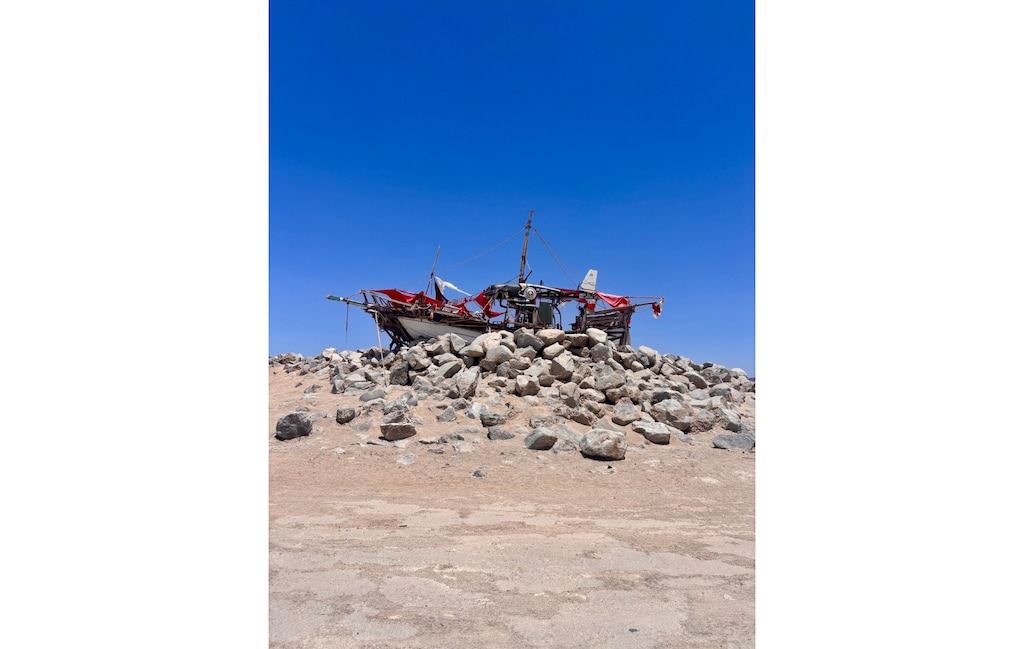
I spent most of my day trip at Bombay Beach, a modest enclave where artists have transformed rusted-out boat hulls, driftwood and old Cadillacs into eccentric sculptures.
Since I was there for pleasure, not work, I didn’t seek out interviews. A few shorebirds were the only signs of life I saw, anyway. I suspect the 110-degree temperatures kept everyone indoors and, frankly, it was fatiguing. I only stayed a few hours.
(Leia Larsen | The Salt Lake Tribune) The Salton Sea on June 14, 2026.
But the long drive home got me thinking about what lessons, if any, the Salton Sea holds for the Great Salt Lake. A few years ago there was clamor from environmental advocates urging California officials to save it. Like the Great Salt Lake and its Great Basin sister lakes, it had become an important ecosystem supporting birds traveling across the Pacific Flyway. Its drying playa had also created a major public health hazard, with studies showing dust was taking a toll on the lungs of children and low-income communities living nearby.
But things seemed to have quieted down. I called up Michael Cohen, senior fellow at the Pacific Institute, to find out why. He has studied the Salton Sea for more than two decades.
Turns out, for the first time in a long time, there are reasons to feel hopeful about the Salton Sea. State officials began work last year on a 2,000-acre wetland pond that will both provide bird habitat and keep the dust down. A year and a half ago, the California Legislature created the Salton Sea Conservancy to find and fund projects preserving the lake. The board held its first meeting last month.
“I suppose the problem with good news is it doesn’t always make the paper,” Cohen told me.
With the ecosystem project, the birds have already returned. Some fish have, too, Cohen said, probably swimming their way down the vast network of canals. It goes to show the resilience of these terminal lake systems.
“Just add water,” Cohen said, “and there’s a quick and positive ecological response.”
(Leia Larsen | The Salt Lake Tribune) The Salton Sea on June 14, 2026.
Still, Cohen says he’s envious of the progress made at the Great Salt Lake. Even as it shrinks, the lake generates a lot of economic value for Utah, between recreation, mineral extraction and brine shrimp aquaculture. It’s also right next to the Wasatch Front, the state’s urban core, and visible from Utah’s Capitol Hill. That means it gets a lot more attention from those in positions of power.
“That’s not the case with Salton Sea,” Cohen said. “The refrain was if the Salton Sea were upwind of Sacramento, or Los Angeles, or San Francisco, the problem would have been addressed decades earlier.”
Like the Salton Sea, agriculture is the primary water user upstream of the Great Salt Lake. But at the Salton Sea, paying farmers to water less, to line their canals and use more efficient irrigation technology has escalated the sea’s decline. At the Great Salt Lake, water leasing and more efficient irrigation are the primary tools Utah policymakers identified to help it refill. As of the start of this year, donations and leases from canal companies and municipal water providers dedicated 476,115 acre-feet to the Great Salt Lake – enough to meet the basic needs of almost 1 million households. Under old water right laws, that wasn’t possible even a few years ago.
(Leia Larsen | The Salt Lake Tribune) The Salton Sea on June 14, 2026.
That’s not to say Utah has solved the Great Salt Lake’s issues. We just slogged through a record-hot spring, preceded by a record-dry and warm winter. Our terminal lake depends almost entirely on snowmelt to refill, and this year it barely saw a blip. The south arm currently sits 1.7 feet lower than this time last year, and hovers less than three feet above the historic low it hit in 2022.
But, as with the Salton Sea, people no longer talk about the Great Salt Lake as a waste of water that should be allowed to dry up. It has grabbed headlines, inspired incredible works of art and captured our attention.
In the dry West and unholy heat, water is a magnet, including for people. And that should give us a glimmer of hope, even as conditions remain dire.