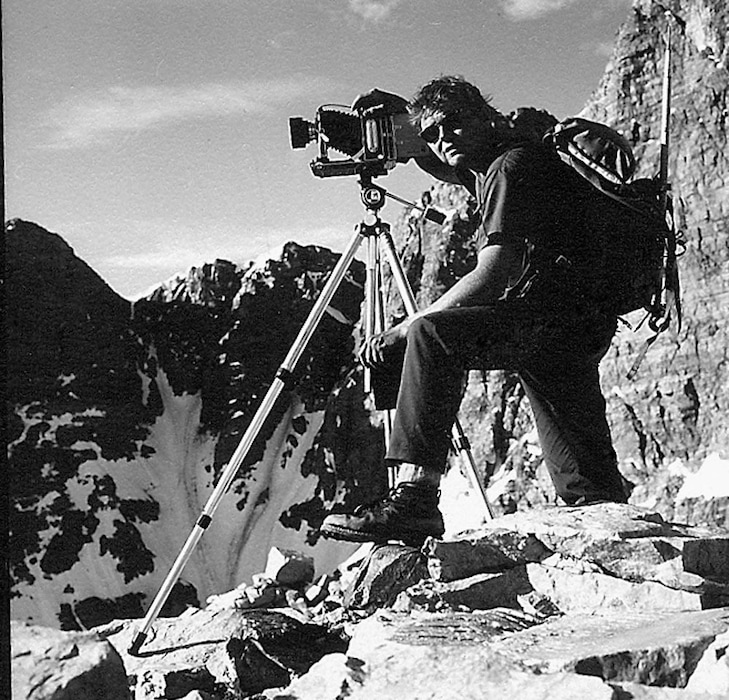
 Julie Jag
The idea of partnering with hunters on land issues raised eyebrows at the Wasatch Mountain Club, an outdoor recreation group with an environmental tilt. But Alexis Kelner, who approached conservation with creativity, humor and a big-tent attitude, saw a clear benefit.
“They are also interested in conservation,” he said, “and they have guns.”
After immigrating to Utah from a German displaced persons camp as a child, Kelner became one of the people most influential in shaping recreation along Utah’s Wasatch Front.
He skied most lines in the Cottonwood canyons, both at resorts and in the backcountry. Then he captured his expeditions and the threats to future ones in books and articles. He took photos that brought light to the beauty of the area. A gadfly, he used his knack for debate to keep Olympic organizers and backers on their toes. Perhaps most notably, he cofounded Save Our Canyons, which has been a watchdog on development in the canyons since 1972.
His watch over the Wasatch finally ended Sept. 23, when Kelner died at the age of 87.
“The mountains were a lifelong passion,” Gavin Noyes, a former executive director of Save Our Canyons, wrote in a tribute to Kelner, “and his effectiveness in protecting them would shape the lives of every member of Save Our Canyons and all local residents.”
Many of those residents might not recognize Kelner’s name. What they would recognize is his work, which is evident in the tall pines, open meadows and meandering trails that characterize the mountains that dominate the Salt Lake City skyline.
Lessons from the backcountry
Kelner learned to ski and appreciate the mountains when his family moved from Latvia to a camp in Germany’s Bavarian Alps following World War II. He said in a 2012 interview that the only options for fun the kids there had were skiing, hiking or ice skating on the pond surrounded by the brick barracks. In 1950, his family moved to Salt Lake City, where he attended Horace Mann Middle School and West High, from which he graduated in 1957.
(Alexis Kelner, Courtesy of Save Our Canyons) Environmentalist and adventurer Alexis Kelner used his photography - including this photo of Chipman Peak - in advocating for the preservation of open spaces along the Wasatch Front. He died in September 2026 at the age of 87.
On short days in high school, he and a few buddies would head to the slopes. At the time, a day pass at Alta Ski Area or Brighton cost no more than $3. After a while, though, they got bored of the then-limited lift-accessed terrain and began backcountry skiing. Around the same time, construction began on Solitude Mountain Resort in Big Cottonwood Canyon. The disruption it caused in the canyon and to the cross-country trails Kelner loved likely was at the root of his proclivity for environmental activism. He said he penned his first letter to the editor in high school, questioning the long-term validity of the Glen Canyon Dam.
Kelner attended the University of Utah as a chemistry major but switched to journalism partway through. Ultimately, he became a professional photographer and shot — “very thoroughly,” he said — Salt Lake City’s first gay pride parade and various equal rights demonstrations around Temple Square.
His main focus, however, was the mountains he loved. Kelner joined the Wasatch Mountain Club after high school and regularly tagged along on ski mountaineering and spelunking adventures. In 1958, he and a couple of friends staged the first technical climb of Lone Peak’s Summit Wall. He also became one of the early explorers of the now-closed Neffs Cave near Mount Olympus.
Kelner began quietly advocating for protecting the lands around Lone Peak in 1965, but the opening of the Snowbird Ski & Summer Resort in Little Cottonwood Canyon in December 1971 drove him into the public forum.
Stopping Snowbird
Snowbird started with just a few lifts. Yet, from the beginning, cofounder Dick Bass announced aspirations of building slopes and villages in the surrounding peaks and canyons, much of which was on federal land.
(Alexis Kelner/courtesy of Save Our Canyons) Alexis Kelner captured backcountry skiers making their approach to Cardiac Ridge between Alta Ski Area and Brighton Resort.
The prospect appalled Kelner. The following year, he joined with Gale Dick and Floyd Sweat to create Save Our Canyons, a nonprofit focused on protecting recreation and open space along the Wasatch Front. Over the next six years, the organization harnessed opposition to Snowbird’s expansion plans and used it to convince local, state and federal politicians and land managers to install environmental safeguards. In 1978, that effort resulted in the establishment of the 30,735-acre Lone Peak Wilderness — Utah’s first designated wilderness area.
“It still means a lot to me, even though I don’t get into it as much as I’d like,” Kelner said in 2007. “Just knowing the fact that it’s there for thousands and thousands of people into the future generations, I think that’s a wonderful thing.”
That effort primed Kelner for an even bigger fight against the Olympics.
Taking on the Olympics
Kelner began pushing back on Utah’s bid for the Winter Games in 1972 and carried that opposition through 2002, when the state hosted the global event. He feared large-scale environmental destruction and tried to blow the whistle on a land swap that gave Snowbasin Resort terrain it needed to host the downhill competitions.
(Courtesy of Save Our Canyons) Environmentalist and adventurer Alexis Kelner shows off a copy of his third book, "Utah's Olympic Circus."
Kelner also cautioned against the Olympics’ potential cost to taxpayers. He acknowledged that stance made for strange bedfellows — just like his idea to team up with hunters.
“I am the first environmentalist,” he said in 1989, “to explore alliance with people who have concerns about taxation.”
Part of what made Kelner an effective advocate was his ability to get people of all ilks to see his side, his peers said. It helped that rather than just rant, he wove humor into his arguments.
Noyes recalled a 1972 Salt Lake City Council meeting where the city was considering making a bid for the 1976 Winter Games, which had just been rejected by Denver residents. Kelner went around the table and hung a head of garlic around each council member’s neck. Kelner explained it was to protect them from the Olympics, which were “like a vampire coming to suck the blood out of the Wasatch.”
“Alexis understood that protecting the mountains required more than knowing the landscape or wielding facts,” Noyes wrote. “It required finding ways to communicate to make people care, to laugh, and to help them feel that they belonged in the effort.”
Sometimes his approach worked. Sometimes it didn’t. And sometimes it was a split decision. The Olympics eventually did come to Utah, but the efforts of Kelner and others kept them out of the Cottonwood canyons.
Whatever the result, Kelner didn’t dwell long on it.
“If we lose [the fight against the Olympics], and I suspect we might, my anguish will last five minutes,” Kelner said in 1989. “And then I will be back.”
A lasting legacy
And Kelner kept coming back — both to protect the Wasatch Mountains and play in them. The pains he took to document his and others’ efforts may ensure future generations can do the same.
(Al Hartmann | The Salt Lake Tribune) Dave Hanscom and Alexis Kelner in 1998.
In his early, more adventurous years, Kelner would write articles about his expeditions that would be published in the Sunday edition of The Salt Lake Tribune. Later, he penned three books, which he first published — along with Save Our Canyons newsletters — on a printing press in his basement. One of those books, “Wasatch Tours,” which he cowrote with Dave Hanscom, is considered perhaps the definitive guide to ski touring the mountains around Salt Lake City. He also served as the Wasatch Mountain Club’s historian for more than a decade.
“It is hard to emphasize how important Alexis has been to the Salt Lake community over the last 65 years,” Jack Stauss, Save Our Canyons’ executive director, wrote on the nonprofit’s website.
“We are forever thankful for the foundation he laid out for us,” Stauss added. “He showed us to think big, stay true to our values, and to fight for the land we care so much about. It will be hard to see a future without Alexis’ massive presence, but we will do our best to carry that legacy forward.”
That means gathering the hunters and the climbers and everyone who cares about the Wasatch and rallying them toward a common purpose.
“You need to fight for them,” Kelner said in 2012, when asked what advice he would give to people who enjoy the mountains. “You need to fight every possible way you can.”
Kelner was preceded in death by his wife, Karla, whom he met while working at Saltair in high school. He is survived by his son, Eric; his daughter-in-law, Kristi Clark; and his granddaughter, Calista.