 Julie Jag
In Utah, as the snow goes, apparently so does resort visitation.
The state’s ski areas saw 26% fewer skier and snowboarder visits during the record-warm 2025-26 season than they did the previous winter, according to preliminary numbers released Friday to The Salt Lake Tribune by Ski Utah, the industry’s marketing arm. That’s a 30% drop compared with the average of the previous three seasons.
To be fair, that three-year average includes 2022-23, which is considered the snowiest year in Utah’s history (903 inches reported at Alta Ski Area). However, the 2024-25 season produced slightly below-average snow (537 inches).
In total, about 4.8 million people visited Utah resorts last winter. The last time that few people got onto the slopes was the COVID-shortened 2019-20 season, when Ski Utah reported 4.4 million skier visits. A skier visit is a single ticket or pass scan at a single resort on a given day.
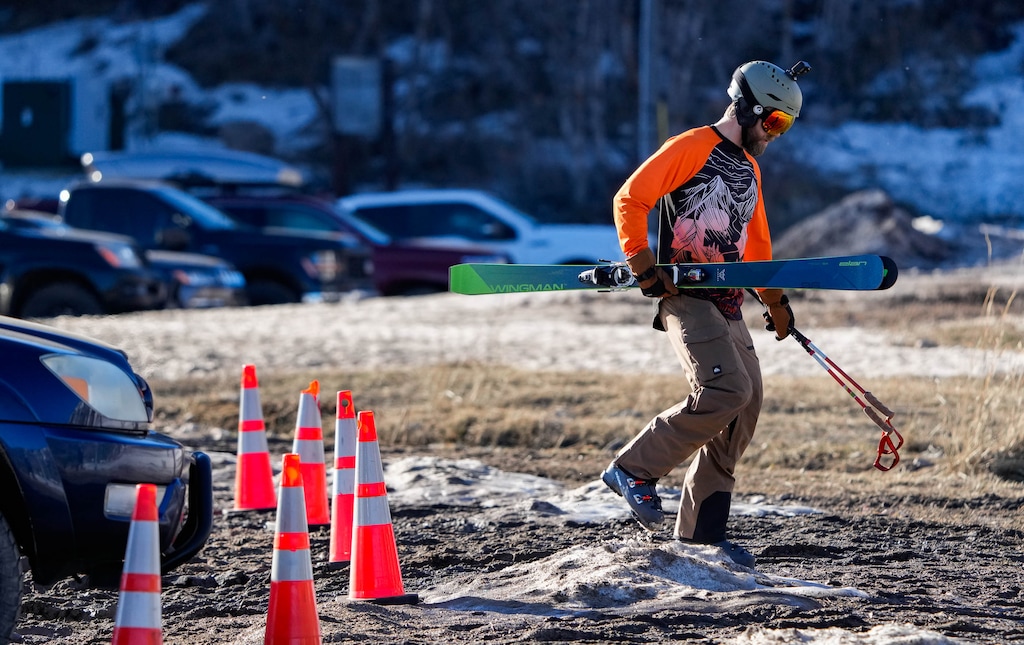
Ski Utah spokesperson Alison Palmintere said record-low snowfall in 2025-26 is likely responsible for keeping skiers and snowboarders away from the state’s 16 public ski areas. The resorts also lacked opportunities to make snow due to warm temperatures.
“It’s definitely a decline from previous years,” Palmintere said, “but it’s not entirely unexpected given the snow conditions.”
Alta reported receiving just 320 inches by April 30, which is 3.5 inches less than the previous record low set in 2014-15.
The loss in visits could translate to a loss in money for the state.
During the 2024-25 season, the ski industry generated $2.51 billion in skier and snowboarder spending, according to a report from the Kem C. Gardner Policy Institute. It also produced more than $342 million in state and local tax revenue. If spending declined proportionally, Utah would stand to lose an estimated $652 million in skier spending and $89 million in taxes.
“This year is an anomaly,” Palmintere said, “and we’ll hope for more snow next year.”
Utah isn’t the only state whose slopes were bare, though.
Colorado resorts also experienced a precipitous slide this season. After four straight winters of record-setting visitation, the Colorado Sun reported the state’s 26 ski areas experienced a 24% decline in 2025-26 — the worst drop in more than 40 years.
Nationwide, visitation fell by about 14%, or 9 million visits, according to the National Ski Areas Association. In that tally, dramatic declines in skier visits across the Rocky Mountain region and the West outweighed upticks in the Northeast and Southeast, where snow generally was in abundance.
“Few seasons demonstrate as clearly as this one how dependent our industry remains on regional weather patterns,” Michael Reitzell, NSAA’s president and CEO, said in a news release. “Challenging conditions across much of the West — including a slow start, rain events, and record March warmth — significantly impacted visitation throughout the season.”
The Rocky Mountain Region, which includes Utah and Colorado, still recorded the most visits — 20.1 million — according to the NSAA. That’s nearly twice as much as the Northwest, which had the second-highest total with 12.9 million visits.
Extra-large resorts — such as Park City Mountain — took the brunt of the fallout. They saw a 20% drop in visits, the NSAA reported, compared to single-digit losses for all other categories of resorts.
Utah skier visits: 2016-2026
2025-26: 4.8 million skier visits
2024-25: 6.5 million skier visits
2023-24: 6.7 million skier visits
2022-23: 7.1 million skier visits
2021-22: 5.8 million skier visits
2020-21: 5.3 million skier visits
2019-20: 4.4 million skier visits
2018-19: 5.1 million skier visits
2017-18: 4.1 million skier visits
2016-17: 4.6 million skier visits
Source: Ski Utah