 Julie Jag
Vernal • They were going on a bear hunt. It was going to be a big one. It was far from a beautiful day, but they weren’t scared.
Clint Sampson, a wildlife biologist for the Utah Division of Wildlife Resources, called out over the crowd circled around him in the snow near the northern boundary of the Book Cliffs last month. He wanted to prepare them for the adventure ahead — one that would bear a striking similarity to a certain children’s story.
Rather than a single family going through obstacles in search of a bear, though, an unusually large number of people planned to go on this hunt. They were a gaggle of nearly 50 — many of them wildlife researchers, DWR employees from other regions and search-and-rescue volunteers. Some had driven hours just to see a bear in its natural environment. And, probably even more so, to see its newborn cubs.
Sampson told them bluntly he couldn’t promise all that.
“I’ve been on too many of these to where, yeah, I can’t promise much,” he said. “But I promise you: You’ll probably get a little cold, and we’ll go on a hike.”
Every winter for decades, small groups of wildlife biologists have quietly performed den checks across Utah. They look at the health of the animals, take measurements, check for cubs and replace tracking collars — all of which can be used to monitor the health of the local bear population.
Sampson’s checks are different, though. He performs all the typical examinations and research, but he also invites along almost anyone who expresses an interest.
(Francisco Kjolseth | The Salt Lake Tribune) Wildlife Biologist Clint Sampson talks about the work of gathering data on wild black bears during a visit to a den in the Book Cliff of Utah on Friday, March 6, 2026.
Having people there does no harm to the bears, Sampson said. In fact, he believes it does just the opposite: It connects people to them.
“When you come and you look at a bear and where it lives, it changes you,” he said. “It flat out changes you.”
The group visits originated with Hal Black, a retired Brigham Young University integrative biology professor. Black began bringing students — and really, anyone else who was up for the trip — out to the Book Cliffs to track, trap and study bears in 1991. The information they gathered gave them insights into the health of black bears — the only kind found in Utah — over time. The data also has been used by the DWR and the Bureau of Land Management to craft land-management strategies.
Bear populations are believed to have remained fairly stable over the past 30 years. However, one of Black’s former students, Janene Auger, said that pattern might be shifting. Auger — who is now the managing editor of a natural history journal at the Bean Life Science Museum on the BYU campus — said a new study that has not yet been published found the number of bears in Utah is slowly declining.
(Francisco Kjolseth | The Salt Lake Tribune) Hal Black, Professor Emeritus of Integrative Biology at Brigham Young University, joins a visit to a bear den in the Book Cliff of Utah on Friday, March 6, 2026. Black who started studying black bears and their habitat starting in ’91, provides a historical knowledge to students and scientists along for the ride.
Black’s research ended in 2012. However, the 88-year-old returned for this year’s excursion along with a handful of his former students. Black was asked why he took such an interest in bears. What did he like about them?
“Well, about the same thing I like about nematodes or mosquitoes and fish,” he said. “They’re all cool.”
To Marek Farnsworth, 11, and Camen Clyde, 9, of Vernal, though, bears are especially captivating. Clyde’s father is a state wildlife officer and Farnsworth’s is a DWR predator specialist, so the young friends have been on several of Sampson’s bear hunts. Touching the bear’s soft, brown fur is a highlight. But nothing has compared to when they’ve gotten to hold the cubs — which, according to Black, has shown no detrimental effects on the animals or their relationship with their mother in this type of one-off encounter.
“That is very, very, very cool,” Farnsworth said.
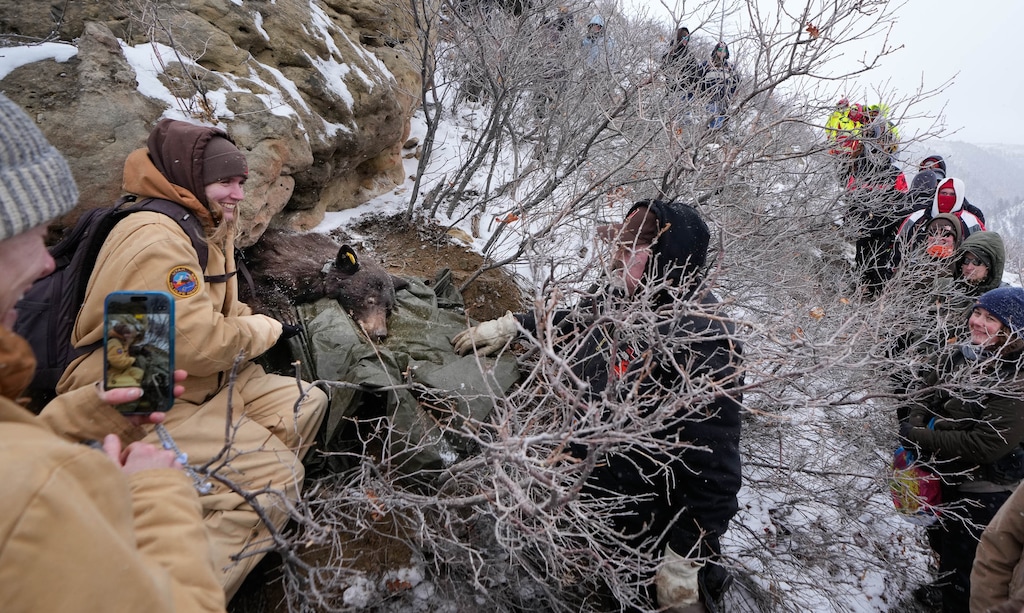
(Francisco Kjolseth | The Salt Lake Tribune) A sedated bear is pulled from her den in the Book Cliffs of Utah for a wellness check on Friday, March 6, 2026. The young bear has adopted the nickname, Tripod, since it is missing her front left leg. The reason is unknown, but she seems to be taking care of herself despite the loss.
Of the five bears he was tracking, Sampson chose this one for a few reasons. Despite missing her left paw — he’d nicknamed her Tripod — she was the healthiest (read: plumpest) female they’d seen last summer. At 4 years old, she was just about the right age to start having cubs. Perhaps most convincing, her den wasn’t far from a two-lane track of road. On a dry day, it was easily accessible.
This day wasn’t dry. It was cold and snowy.
For more than half a mile, the long trail of observers followed orange ribbons and a DWR officer over a relatively steep and slick snow-covered hillside. An icy wind blasted them, accompanied by the occasional snowflakes. They came to a stop midway down a slope, just above an almost indiscernible outcropping of tan boulders. Beneath it was the bear’s den.
Female bears den alone. They only rendezvous with the males in the summer. If they are impregnated, the females will carry the egg until they find a den, usually in late October. Then, if they are not fat and healthy enough to bear offspring, the egg will be absorbed back into their bodies. If she is healthy, the egg will implant and she will give birth to between one and four cubs while she is in a state of torpor during hibernation. By the time she fully awakens, the cubs are typically between two and three months old.
Healthy females give birth every two years.
(Francisco Kjolseth | The Salt Lake Tribune) Wildlife Biologist Clint Sampson talks about the work of gathering data on wild black bears during a visit to a den in the Book Cliff of Utah on Friday, March 6, 2026. Though the day’s visit to a young mother’s den for a wellness check did not yield any cubs, Sampson has experienced the cuteness many times before in his work.
Sampson and a small crew approached the den as everyone else waited as quietly as possible above. The opening to the den was narrow, barely wide enough for Sampson to squeeze his shoulders through. He injected her with a sedative. Then they all stepped back to wait.
Once they were sure the bear was sedated, they carefully pulled her to the mouth of the den to take their measurements. They measured the pads of her paws, each of which extended into five razor-sharp claws. They checked her teeth and gums and looked for sores. And, they sized up her weight.
“She’s thin,” Black later said upon his inspection of her. “She’s not one you’d expected to have cubs to be this thin now. And if she had cubs, she would be even thinner, or they’d be dead.”
Bears in the Book Cliffs typically indulge in pinyon pine nuts and acorns to fuel them through hibernation. However, not many could be found late last summer, possibly the result of warming temperatures, drought or the trees’ natural boom-bust nut-production cycles. When asked if he was concerned about the health of the bears in the area next winter and their ability to have cubs, given that Utah just had its hottest winter on record per National Weather Service records, Sampson gave a dry chuckle.
“Always,” he said. “Always.”
But it’s not all doom and gloom. Black pointed out that grasses and ants will return in the spring and said that rainfall will serve the oak and pinyon pine trees just about as well as snowpack. So, Tripod will likely be able to find enough food to get through next winter, and maybe enough to have cubs.
“It’s seldom that we hear a bear’s starved to death,” Black said.
(Francisco Kjolseth | The Salt Lake Tribune) A team of biologists and student scientists navigate the terrain in the Book Cliff of Utah during a visit to a bear den on Friday, March 6, 2026. Biologists with the Utah Division of Wildlife Resources get up close and personal to wild black bears to collect data and better manage the state’s population.
Adult bears in Utah are also fortunate to not have any natural predators other than each other and humans. And on this day, all the humans wanted to do was touch, admire and possibly measure her.
They passed by, one by one, gaping at the bear’s inch-long claws and teeth and admiring her thick chocolate coat and endearing face with its long nose and dark, dainty eyes. Their own noses filled with the earthy smell of the den, the entrance to which was almost entirely obscured by the bear’s body. Several asked someone to take their photo as they knelt near her.
Then, they hiked back up the hill, wondering out loud about the life of the animal they just saw.
Tonya Kieffer-Selby, a DWR conservation outreach manager, said she would call this bear hunt a success — even if no one got to see cubs.
“We had a lot of attendees, and gave the ability to a lot of people to come see what it’s like for biologists to work one-on-one with wildlife,” Kieffer-Selby said.
“It’s unpredictable. It’s raw. It’s, you know, it’s something of an experience. And I hope that everybody that came today gets to take that away.”