 Courtney Tanner
Chris Mallett credits Weber State University with twice transforming his life.
The first time came when he was 22, working as a carpenter building houses in Kaysville, when he enrolled in his first night class at the Ogden school.
“Until then, I never thought a university experience would be right for me,” Mallett said. “It was not held up as an example in my life.”
But he had just met his soon-to-be wife, Charlet, who was finishing up her bachelor’s degree there, and Mallett decided to follow her lead.
That first course in American government set Mallett on a path in higher education that became his career. He has since held leadership positions at the nonprofit Western Governors University and at private Northeastern University.
Now, for the second transformation, the alumnus is returning home to Weber State University as its next president.
“This university has changed my life,” he said.
Mallett’s selection was announced by the Utah Board of Higher Education on Thursday to an eruption of cheers and claps from the auditorium packed with students, faculty and staff waiting to hear his name over the microphone. Each of the chairs covered in purple fabric — Weber’s signature color — was filled with community members also all wearing purple for the celebration.
Walking into the room for that announcement, Mallett said, was only slightly less nerve-racking than walking into his first class at Weber State more than 30 years ago now.
“We began so much of our lives at this university,” he said, pointing to his wife. “I can’t tell you how excited I am to be here with you and come home to Utah this morning.”
A picture of his graduation day from 2001 was displayed on a screen. He stood in his cap and gown, with his wife and their first son, as well as his mother- and father-in-law.
(Screenshot) Pictured is Chris Mallet and his family when Mallett graduated from Weber State University. Mallett was named the new president of the Ogden school in an announcement on Thursday, May 21, 2026.
(Bethany Baker | The Salt Lake Tribune) Incoming Weber State University President Chris Mallett, third from left, sits with his wife Charlet Mallett, second from left, during a press conference at Weber State University in Ogden on Thursday, May 21, 2026.
Charlet and her parents, Taunya and Dave Brooks, sat in the crowd Thursday, too, cheering him on again. Mallett’s three kids, Andrew, Benjamin and Nic, joined in watching the online stream.
It took a little more than six months to find a new president for Weber State. And now Mallett will be tasked with leading the public school of more than 32,000 students with a unique dual-mission to offer both associate and bachelor’s degrees. Its annual operating budget is $237 million.
Mallett takes the helm after previous Weber President Brad Mortensen left the post to become the new leader of Utah State University in November. Mortensen had been Weber’s beloved leader for nearly seven years.
Weber’s board of trustees chair, Keith Titus, said he believes Mallett is the perfect choice to enter the school’s next chapter “from a position of strength.”
“We’ve established a lot of momentum at Weber State,” he said, “and that is not slowing down.”
With Mallett at the helm, Titus believes, a third transformation is on the horizon.
(Bethany Baker | The Salt Lake Tribune) Keith Titus, Weber State University trustee chair, speaks at Weber State University in Ogden on Thursday, May 21, 2026.
Challenges and opportunities
Walking into the new post — with an Aug. 1 start date — Mallett will face some challenges.
Weber State has drawn attention in the past few months around how it implemented Utah’s anti-diversity, equity and inclusion, or DEI, law.
Organizers of an academic conference on censorship at the school, planned for last fall, canceled their program after they say university officials wanted speakers to remove some of what they were going to present because it allegedly ran afoul of the law.
A similar controversy arose when the school instructed an invited campus speaker, Indigenous author Darcie Little Badger, that she couldn’t talk about anti-racism, bias, oppression and intersectionality during her December visit; she pulled out of the event.
The Legislature this year clarified its anti-DEI measure in response, saying the law doesn’t apply to guest speakers on campus. It instead solely applies to the services that schools provide, along with any mandatory trainings or events, which cannot promote or cater to a specific identity group.
Mallett also comes as state leaders have placed increasing pressure on the Utah’s higher education institutions to perform. The Legislature instituted a $60.5 million budget cut across the Utah System of Higher Education last year.
Schools could earn that money back as long as they showed it would be reinvested in programs that lead to high-demand, high-wage jobs that the state needs. Weber State ultimately got its $6.7 million returned after largely eliminating liberal arts degrees.
The chair of Utah’s higher education board, Amanda Covington, said Mallett was specifically selected to rise to the moment and the expectations of state lawmakers for graduates to be more workforce ready.
She cited Mallett’s past work, specifically and most recently, as the chief administrative officer for Northeastern University building up the Roux Institute for the school’s campus in Maine.
The institute has developed a model for working with industry and community partners to get students hands-on work experience while pursuing their degrees.
Covington said Mallett’s “entrepreneurial leadership style” is what “positioned him as a compelling leader for Weber State.”
He was at Northeastern University — based in Massachusetts but with campuses across the country — for nearly 12 years, starting in online strategy. That’s what he focused on, too, for 13 years as part of the founding team for Western Governors University, leading out on new models for online education. He left his post there in 2014, as an associate provost.
Ally Isom, a Weber State trustee, said she would like to see Mallett bring that experience with online expansion to Weber State and continue expanding enrollment for both traditional and nontraditional students.
(Bethany Baker | The Salt Lake Tribune) Ally Isom, Weber State University trustee, speaks at Weber State University in Ogden on Thursday, May 21, 2026.
Mallett said that aligns with his goals. He envisions more partnerships with industry leaders and local northern Utah companies, building on the work Weber State has already done with Hill Air Force Base and Intermountain Health.
“That will return for us tenfold,” he said, in giving students more experience.
His focus is also on affordability, he said. There’s opportunities for the new president to build on what Weber has accomplished there, as well.
Last year, the school froze tuition rates for two-year programs to help students save money. The plan was immediately heralded by the state’s commissioner over higher education. And it drew attention and praise from Utah lawmakers.
The school also launched the state’s first accelerated bachelor’s degrees programs, meant to be completed in three years.
And it created a direct admissions program with two neighboring technical colleges for Utah high schoolers in Davis, Weber and Morgan counties.
“Let’s capitalize on this Weber State excellence that you’ve all created,” he said to the faculty and staff watching.
That includes, Mallett said, getting out of the way of employees doing great work. “It’s the faculty and the staff of this great institution … not the administrators that change people’s lives,” he said.
That was his experience at Weber State, he said, where he recalled having a professor who taught him how to respectfully debate, plus another who showed him the value of travel. It was the faculty, he said, that ultimately made him feel comfortable as a nontraditional student himself.
And students, Mallett added, are the most important focus of the university.
Utah’s higher education leadership shuffle
Mallett is notably the second university president to be picked under the state’s now entirely secret hiring process for higher education’s top posts.
The public was not informed about any finalists or told about their experience, as they had been in the past.
Now, the final name is only made public when the Utah Board of Higher Education announces a new leader.
On Thursday, the only details revealed about the search for a new Weber State president came when Chair Covington said the pool of candidates included both local and national applicants.
Mallett is set to make a comparable salary to what Mortensen was previously earning in the position at $393,636. The figure is set by the Utah System of Higher Education.
The leadership swap with Mortensen — and resulting vacancy at Weber — continued to spin the revolving door among higher education leaders in the state that’s stretched over the past several years and has been marked by generally short terms in office.
Before Mortensen went to USU, the previous president there, Elizabeth “Betsy” Cantwell,” suddenly resigned after a short 18-month tenure.
There also is an ongoing search to find a new president for Utah Valley University in Orem after Astrid Tuminez stepped down at the start to this month.
After earning his associate and bachelor’s degrees at Weber State, Mallett went to the University of Utah for a master’s in public administration, finished in 2004. Then he graduated from Pepperdine University, a private Christian school in California, with his doctorate in education in 2016.
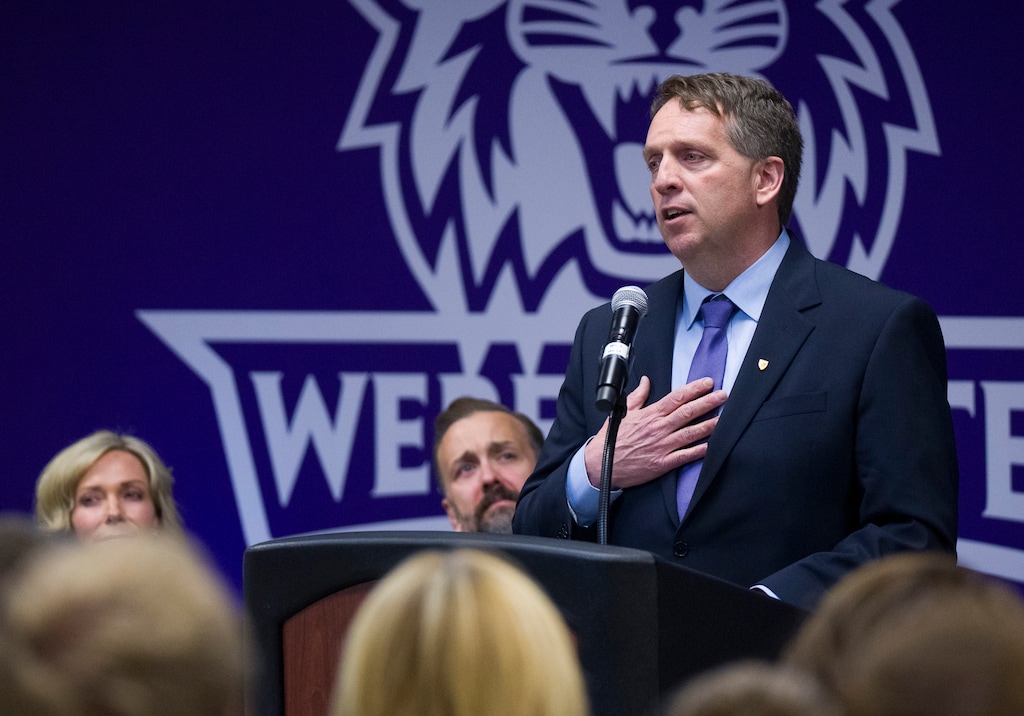
He choked up at the podium Thursday delivering his first remarks, calling it a “once in a lifetime chance” to return to his alma mater.
Mallett thought back to when he was building homes, not sure what he wanted to do with his life. Now, he said, he is so glad to be back at a place that made him feel at home.
(Bethany Baker | The Salt Lake Tribune) Incoming Weber State University President Chris Mallett, left, speaks with interim Weber State University President Leslie Durham after a press conference where the Utah Board of Higher Education announced Mallett's appointment at Weber State University on Thursday, May 21, 2026.
Courtney is a reporter at The Tribune, where she has worked since May 2016. She unwinds by fishing in the mountains far away from cell service. She’s a fan of bacon and Kevin Bacon.