 Courtney Tanner
The University of Utah has been pushing for more students to live on campus — opening a brand-new residence hall with a climbing wall inside and trademarking the phrase “College Town Magic” as it looks to expand its dorm offerings.
But this fall, the school isn’t seeing that interest entirely reciprocated.
The U. confirmed this week that it has more than 900 empty beds in its residence halls for the academic term that started Monday. A school spokesperson said roughly 15% of the 6,946 beds now available on campus sit unoccupied.
“Student housing is part of a complex city and regional housing market which ebbs and flows, particularly since the COVID-19 pandemic,” said spokesperson Rebecca Walsh in a statement.
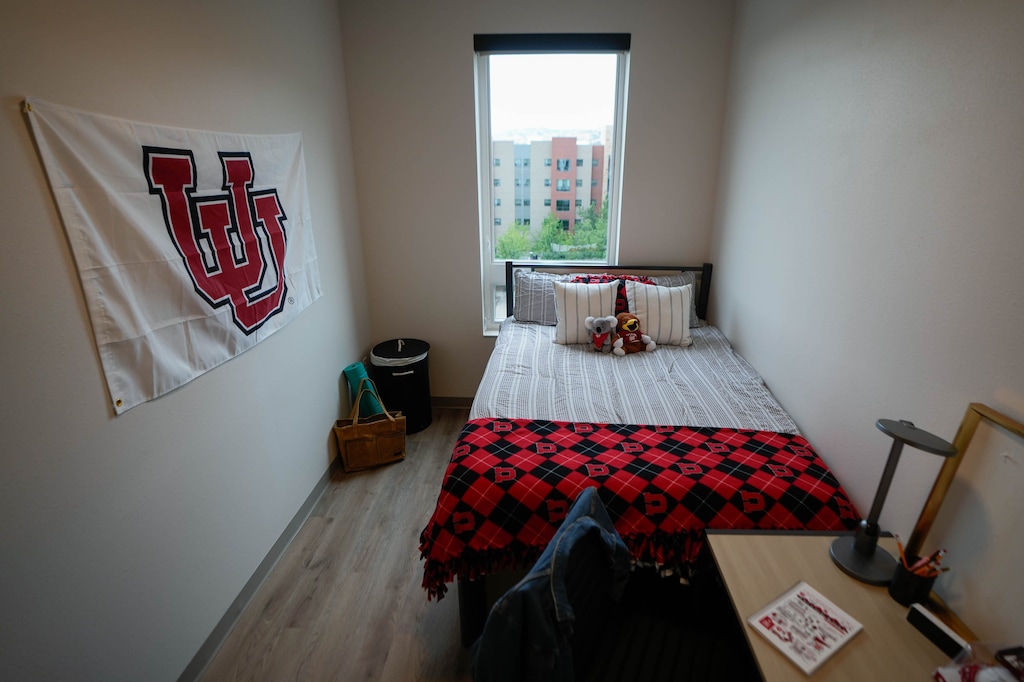
The bed surplus comes just weeks after the U. unveiled its latest, top-of-the-line dorm addition and students started moving into it earlier this month. The $155 million-dollar Trailhead building includes four in-house dining options, a gaming lounge and ski-and-snowboard storage for residents.
That new facility alone, which sits just east of the Jon M. Huntsman Center and was built in partnership with a private company, can house 1,447 students.
“At the time of the Trailhead groundbreaking, demand far outpaced supply and the trend was supported by market data,” Walsh added. “Two years later, the market has changed.”
The empty beds are spread throughout the U.’s campus housing options, largely in shared two- or four-person suites where one bed isn’t claimed.
The U. has 11 housing complexes for undergraduate students, including the newer Lassonde Studios and Kahlert Village, plus the 2002 Olympics-era Gateway Heights and re-envisioned Officers Circle on upper campus. There’s also one apartment complex for graduate students, married students and students with kids.
U. President Taylor Randall’s goal has been to get 11,000 students living on campus by 2027 — a little more than a quarter of the U.’s current student body (nearly 40,000).
The school is now able to house about 63% of that goal. But with the unfilled beds, the reality sits at about 50%.
(Christopher Cherrington | The Salt Lake Tribune)
Randall’s vision calls for the southeast end of campus to transform into an active student hub, brimming with housing, dining and retail. The U. recently acquired the last 50 acres of Fort Douglas, with the intention of adding more dorms.
But faculty are now questioning if that’s the best use of space. The concern came up around the end of an Academic Senate meeting Monday, where faculty said they’d been hearing rumors about empty dorms and want answers.
Randall, who was online for the virtual meeting and spoke at the top of the agenda as scheduled, had logged off by that point, along with other university administrators.
“I’ve heard there’s 900 empty beds in the dorms,” said Leslie Francis, a distinguished professor of law and philosophy. “And I’d like to hear from the administration about what’s going on.”
Competing with more off-campus options
Last year, there were 5,499 beds available on campus. All were filled last fall, as well as in 2024, with a waitlist of students who wanted to get in.
In fall 2024, in particular, the U. had guaranteed on-campus housing to all freshmen applicants. That caused a headache in the days before classes started, as staff scrambled to find space for everyone accepted.
In 2021, too, there was so much interest in living on campus that the school placed students in its University Guest House hotel rooms, typically reserved for visiting speakers or parents stopping in from out-of-state.
(Francisco Kjolseth | The Salt Lake Tribune) Students move into their dorm rooms at the University of Utah in Salt Lake City in August 2020.
Many factors have contributed to this fall’s about-face, the U. has said. But it points mainly to a “significantly” changed housing market in Salt Lake City, Walsh said, with more and cheaper apartments now available downtown that’s creating competition with campus.
The U. cited two reports — one from its own Kem C. Gardner Policy Institute and another from outside firm Yardi Matrix — that show the number of apartments opening in Salt Lake City appears to be outpacing the number of residents.
In total, the city has about 155,971 apartments for rent, plus another 13,924 units under construction, according to Yardi Matrix’s report from July 2026. Meanwhile, apartment vacancy rates across the city, according to the Gardner report, climbed from 7.4% in August 2020 to 11.2% this July.
That excess supply means landlords are lowering rent and offering other incentives to attract tenants, the U. said.
Walsh pointed to those new and “unusual” concessions, including one building in Salt Lake City that offers up to 10 weeks free rent and a $3,000 gift card, according to the Rental Housing Association of Utah.
Meanwhile, on average, rent for a one-bedroom apartment in Salt Lake City was $1,220 in September 2022 and has since dropped to around $1,083, according to the Gardner report.
Yardi Matrix puts Salt Lake City’s average rent between $1,400 and $1,700, depending on the location, but its report doesn’t distinguish by bedroom count.
(Francisco Kjolseth | The Salt Lake Tribune) A communal living space in a four-person suite at the University of Utah's new Trailhead residence hall.
At the U., Trailhead’s housing fees, for example, top out at $12,938 per student for the academic year (roughly eight months). That’s roughly $1,617 per month, not including summer, for a private room with a full-size bed in a four-person suite with two shared bathrooms.
The lowest price at Trailhead, $10,040, gets you a double “cluster” (a shared room with two smaller, twin XL-size beds and shared communal restrooms). That’s $1,255 per month for the eight-month period.
“Pods” at the separate Lassonde dorms go up to $14,038 per academic year, while the older dorms of upper campus run cheaper — $6,966 per academic year on the low end.
Many of the dorms also require a meal plan. The cheapest dining plan costs $4,918 per academic year. The most expensive is $7,142.
Still planning for future growth
Another factor, Walsh said, is fluctuating enrollment.
The U. estimates it just welcomed its biggest freshmen class ever this fall, topping 8,000 new students (formal counts won’t be in until October).
At the same time, out-of-state and international enrollment is down, Walsh said, citing preliminary counts that appear to show an impact from changing federal immigration policies under President Donald Trump that limit international student visas.
Normally, 85% of students coming from outside of Utah live in dorms, Walsh said.
Moving forward, the U. has launched a marketing campaign to get incoming high school applicants to elect to live on campus. The university is targeting freshman specifically, with the hope that they will see the perks of living on campus and want to stay year after year. Applications open Oct. 5.
In the meantime, the school still plans for future growth.
But Walsh said the U. will “continue to monitor the Salt Lake City and Salt Lake County housing markets when making decisions about future housing developments on campus.”
(University of Utah) Pictured is an ad the University of Utah is running aimed at getting more students, particularly freshmen, to live on campus.