 Courtney Tanner
Historic military barracks could transform into new student dorms. Former soldier training grounds could become a new field for intramural sports.
And the stable where cavalry horses were kept during the U.S. Civil War? Well, that might involve a little extra creativity.
As the University of Utah prepares to take ownership of the final piece of Fort Douglas that the U.S. Army Reserve had been using, it’s already envisioning how it will both preserve the site’s legacy and reconfigure what it inherits.
“Now it can be reimagined for its next life,” said Chris Merritt, the state’s historic preservation officer.
The university will officially receive the 50-acre parcel on Oct. 1 — 164 years after the fort originally opened as Camp Douglas in 1862.
At the time, the federal government wanted to keep an eye on leaders of The Church of Jesus Christ of Latter-day Saints, particularly Brigham Young, for suspected radicalism. The cannons that soldiers set up were literally pointed down at Salt Lake City.
(Fort Douglas Military Museum) This historic photo shows unidentified soldiers with cannons at Utah's Fort Douglas taken in the 1860s.
The U.’s history has always been intertwined with the fort’s, starting with an 1892 land transfer that shifted the school’s campus to the same hillside.
“You can’t have the University of Utah without the military presence,” Merritt noted.
Now, the U. is set to own the fort’s final holdout, a piece of real estate that’s prime for the school’s planned expansion under university President Taylor Randall’s “College Town Magic” vision.
Randall wants the area, on the southeast end of campus, to become a student hub, with new on-campus housing, parking, offices, retail, dining and open spaces where students can gather. There’s also talk of adding a second student union building.
“As we accept stewardship of this historic place, we do so with a commitment to honor its past while creating new opportunities for future generations through education, discovery, health care and innovation,” Randall said in a statement.
What exists on the property?
(Trent Nelson | The Salt Lake Tribune) Fort Douglas in Salt Lake City on Monday, Aug. 3, 2026.
The parcel is currently surrounded by black metal fencing along Mario Capecchi Drive, largely near what’s called Soldiers Circle. It has eight notable structures.
That includes seven nearly identical red-brick buildings once used as barracks, labeled 102 through 108.
Building 104 is slightly different, because it specifically housed the Army’s band, said Bob Munier, who has been running facility operations for the Army Reserve at Fort Douglas.
The military most recently used these spaces for offices, with cubicles still assembled on some floors. Inside building 108, the original ornate tin ceilings are still preserved.
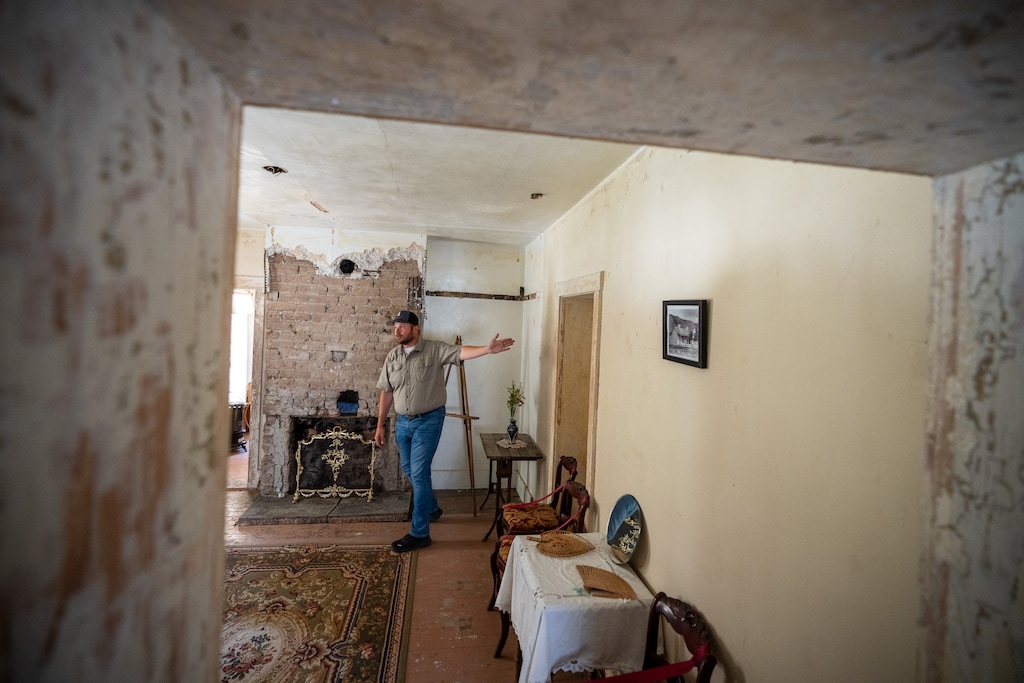
(Trent Nelson | The Salt Lake Tribune) The interior of a building at Fort Douglas in Salt Lake City on Monday, Aug. 3, 2026.
(Fort Douglas Military Museum) This photo shows inside the barracks at Fort Douglas in Utah, taken in the 1890s.
The barracks, constructed in the early 1900s, were also used to treat Utah patients sick with the Spanish flu. There’s rumors they’re haunted, Munier said; he considers building 108 the most active.
“There are smells you cannot explain,” he explained during a tour last week. Army Reserve officers would search for a culprit, he said, and the scent would disappear.
The site’s 303-foot-long stable, constructed in the 1890s, was also included in the transfer. It once housed 96 horses; in the 1930s, it became a garage for Chevy trucks used by members of the federal Civilian Conservation Corps, a government relief program that created jobs during the Great Depression.
(Fort Douglas Military Museum) The stables at Utah's Fort Douglas as photographed in the 1890s.
(Trent Nelson | The Salt Lake Tribune) Chris Merritt at the Fort Douglas stables in Salt Lake City on Monday, Aug. 3, 2026.
Most recently, the Army Reserve was using that space for storage, Munier said.
Among the not-so-historic places? A massive parking lot that had been filled with military vehicles. The U. started using it for additional student and faculty parking this summer.
What restrictions will the U. have on development?
All Fort Douglas property is on the National Register of Historic Places and the State Historic Register.
Despite those designations, the U. isn’t obligated to preserve the fort’s heritage. But it has vowed to do so, signing an Army agreement that required collaboration with the Utah State Historic Preservation Office.
The U. plans to repurpose historic buildings for more modern functions, like dorms and office space, which Merritt said will help keep them in good repair.
He hopes the U. will consider reserving a piece to teach about preservation and historic structures. He acknowledged the school isn’t new to this kind of project.
(Trent Nelson | The Salt Lake Tribune) Bob Munier at Fort Douglas in Salt Lake City on Monday, Aug. 3, 2026.
What has the U. done to preserve Fort Douglas in the past?
There have been several land transfers over the years, accounting for some 1,534 acres shifting to the university.
The most notable came in 1991, with about 200 acres. It’s also the model for how the U. wants to approach its latest acquisition.
At the time, that property included the first training grounds in the state with Stilwell Field, a theater used by soldiers and a chapel, as well as Officers Circle, a group of houses used by military lieutenants and captains at the fort.
(Utah State Historic Preservation Office) Pictured is a house in Officers Circle from Fort Douglas that the U. restored ahead of the 2002 Olympics.
(Utah State Historic Preservation Office) Pictured is a house in Officers Circle from Fort Douglas that the U. restored ahead of the 2002 Olympics.
The U. revitalized that acreage ahead of the 2002 Olympics to offer housing for athletes, then students moving forward. That includes Officers Circle — now some of the most highly requested dorms on campus.
The façades were updated to look like how they did when originally built, while the infrastructure was reinforced. The idea was to “weave the old and new together,” noted Rebecca Walsh, a university spokesperson.
The oldest structure left standing from Camp Douglas, Building 655, was also part of the 1991 transfer. It once housed the site’s post commander.
(Trent Nelson | The Salt Lake Tribune) Chris Merritt at Building 655, the oldest surviving building on Fort Douglas, in Salt Lake City on Monday, Aug. 3, 2026.
The U. eventually turned it into a museum that sits next to the added Peterson Heritage Center, where students eat meals and study.
But in 2021, university staff discovered a cellar door in the home’s wood floors, which then revealed a dirt dugout a few feet deep.
Merritt said when Camp Douglas first started, soldiers lived in these dugouts. They’d dig a hole and set a tent up over it to sleep. The post commander used the dugout the house was built over for cold food storage.
(Fort Douglas Military Museum) An ROTC camp is shown at Utah's Fort Douglas in this historic photo.
“This has been preserved pretty lovingly,” Merritt said of the house, which is open to scheduled tours. “This is a true time capsule. … You’re in Salt Lake City, but you’re transported back.”
Merritt considers this restoration work a major success. The U. won awards from the National Trust for Historic Preservation and the Utah Heritage Foundation at the time, as well as one this year from Preservation Utah for a more recent project.
Often, Merritt said, historic structures are viewed as a barrier to expansion.
“But historic buildings don’t have to be anti-future,” he said.
(Fort Douglas Military Museum) This photos shows the interior of the post commander's house at Fort Douglas, taken in the 1920s or 1930s.
(Trent Nelson | The Salt Lake Tribune) Building 655, the oldest surviving building on Fort Douglas, in Salt Lake City on Monday, Aug. 3, 2026.
What other U. locations used to be part of Fort Douglas?
• The Natural History Museum of Utah and Red Butte Garden & Arboretum sites were once live-fire testing zones for the military.
• The Block U, on the hillside above the U., used to house a military livestock slaughterhouse.
(University of Utah) Pictured is students covering the Block U with a fresh coat of white paint on the hillside above campus in this undated historic image.
• The U.’s main hospital.
• Research Park.
• 469 acres in a heritage preserve.
What won’t the U. get?
The Fort Douglas Military Museum will remain in the hands of the Utah National Guard.
So will the site’s 110-acre cemetery, which is owned by the U.S. Department of Veterans Affairs.
Fort Douglas held prisoners of war during World War I and II, said Munier. Some of those individuals are interred at the cemetery; their nations or families never asked for their remains to be returned, he said.
(Fort Douglas Military Museum) This photo shows of a group of prisoners of war being signed into Camp Douglas, Utah, in the 1910s during World War I.
When could any new dorms, offices open?
There’s currently no timeline for work on the newly acquired property, Walsh said.
That will be determined as the U. assesses the buildings — and will depend on funding.
The school intends to apply for preservation grants.
What does the military get in exchange?
The military agreed to the this transfer back in 2024 in exchange for $117 million in state funding.
That money was used to buy land and build a new headquarters for the Army Reserve at Camp Williams in Bluffdale. Construction finished on that 227,000-square-foot building in June.
(Chris Samuels | The Salt Lake Tribune) Dignitaries turn dirt at Camp Williams in Bluffdale, Monday, Aug. 19, 2024, at a groundbreaking ceremony for a new U.S. Army Reserve facility, below, which will replace Ft. Douglas near the University of Utah.
What’s the history of Fort Douglas?
The fort’s original property amounted to more than 10,500 acres, stretching from 900 South up to 6th Avenue, and from 1300 East over to the mouth of Emigration Canyon.
In addition to monitoring members of Latter-day Saint faith, the U.S. government wanted to guard the area’s mail system. That’s because the frontier soldiers assigned to protect it had to instead start fighting in the U.S. Civil War.
The site was named after the late Sen. Stephen A. Douglas, of Illinois, who rallied Americans behind then-President Abraham Lincoln and the Union side of the war.
The first infantry stationed there was largely made up of volunteers from California, led by Col. Patrick E. Connor.
In 1863, Connor launched an infamous attack on the Shoshone Tribe for allegedly stealing from white settlers and miners. Now referred to as the Bear River Massacre, his infantry killed at least 300 Indigenous people near today’s Utah-Idaho border — one of the worst attacks on American Indians in U.S. history.
During both World War I and II, Merritt said, the base was pivotal, housing 50,000 military personnel at its peak.
(Fort Douglas Military Museum) This photo shows unidentified soldiers with cannons in the 1860s or 1870s at Utah's Fort Douglas.