 Courtney Tanner
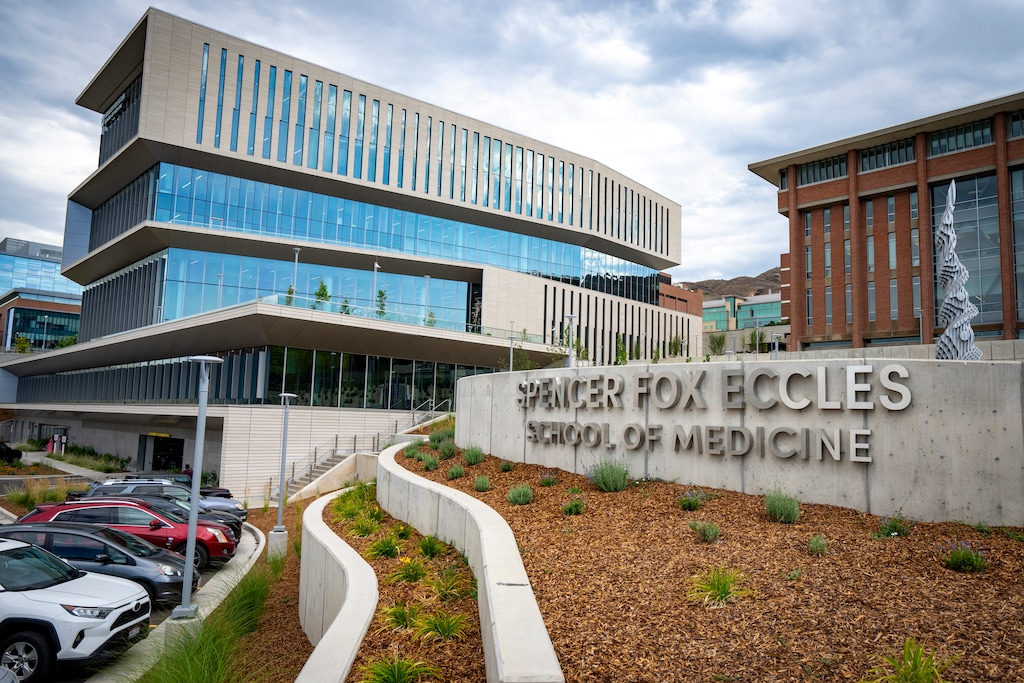
The University of Utah’s new medical school building is designed for the future — but it includes one very special nod to where it all started 107 years ago.
A tan brick carved with the word “MEDICINE,” from the original 1919 science building that once hosted the state’s first medical program, is embedded into the new facade’s east side.
Bob Carter, the U.’s senior vice president for health sciences and CEO of University of Utah Health, pointed out that detail on a recent tour of the new space, which opened to the public Wednesday. He hopes the state-of-the-art building’s next classes of students will remember that legacy.
“It’s been a long time coming,” he said. “But now we have a premier place for health sciences education for the state.”
(Rick Egan | The Salt Lake Tribune) Dr. Bob Carter, U. Health CEO, and Dr. Kristina Callis Duffin, dean of the medical school, lead a tour of the new Spencer Fox Eccles School of Medicine.
The new Spencer Fox Eccles School of Medicine officially opens with a ribbon-cutting ceremony Wednesday. There are 132 medical students who enroll at the U. annually, and this year’s class will be the first to use the building for their entire M.D. education.
After four years of construction and $215 million to build, the new facility replaces the previous medical school from 1965 (which replaced the one from 1919). That prior space, said Kristina Callis Duffin, the newly named dean of the medical school, became outdated and was deteriorating, and the department had outgrown it.
Students and faculty had to spread out into classrooms and offices across multiple buildings, wherever they could find space. Now, they’ll be united again under one roof — the first time, Callis Duffin estimates, in at least 30 years.
“It gives the M.D. program a home that they really haven’t had,” she added.
(Rick Egan | The Salt Lake Tribune) Dr. Kristina Callis Duffin, dean of the medical school, talks about University of Utah's new medical school building.
The new building is eight floors and 211,000 square feet, with top-of-the-line classrooms, experiential labs and a simulation center to train future doctors.
It sits just off of Mario Capecchi Drive, to the south of the U.’s main hospital, in a health-focused corridor on campus — surrounded by buildings for nursing, pharmacy and dentistry. Its opening in that spot wraps up the university’s efforts to have all advanced health science degrees housed in the same area. It’s also connected by tunnel to the Spencer S. Eccles Health Sciences Library.
Here’s a look at some of the new building’s features.
Classrooms for a new kind of medical education
For years, medical students traditionally gathered in a big auditorium where they looked down at their professor’s lesson. That’s not the most effective way to teach, Callis Duffin said.
All classrooms in the new building are flat — putting students and faculty on equal footing — and flexible. That helps make learning more approachable and collaborative, the dean added.
The largest classroom, which the U. refers to as a “learning studio,” can hold 320 students at a time. There are big round desks inside with wheels, rolling chairs and TV screens around the room that can display the professor’s computer.
(Rick Egan | The Salt Lake Tribune) A large classroom at the Spencer Fox Eccles School of Medicine at the University of Utah.
Students, Callis Duffin said, are encouraged to work with their peers at their tables to discuss and understand the materials. And the professor can walk around to answer questions or provide individual attention.
There are also smaller classrooms for 10 students, and medium-sized ones for 16 to 25 students.
The second-biggest classroom in the building can hold up to 160 students — more than an entire year of medical students at the same time.
(Rick Egan | The Salt Lake Tribune) A learning space in the University of Utah's new medical school building.
There are 112 students selected each year by the U.’s admissions team to attend the university. Another 10 are from Idaho, specifically, under a contract with the state.
An additional 10 are new this year; they will start their education at the Salt Lake City campus before transitioning after 14 months to a new medical school in St. George — also run by the U. in partnership with Utah Tech University — focused on training doctors who want to specialize in rural health.
In total, there are a little more than 500 medical students attending the U. at one time, combined over the different classes. The university would like to accept more in the coming years, given the new building’s extra capacity — which it hopes will help address the state’s physician shortage.
Cutting-edge simulation centers
The new building also features a simulation center where students can practice skills on dolls before they start working with live patients.
That includes adult-sized dolls on stretchers in an emergency room setting and smaller stations set up like a newborn intensive care unit, or NICU.
Callis Duffin said students will use those spaces to simulate everything from simple things like talking to patients to complex responses like surgical operations. There’s also space for other students to observe.
(Rick Egan | The Salt Lake Tribune) The simulation laboratory at the Spencer Fox Eccles School of Medicine at the University of Utah.
Additionally, the outside courtyard will be used to simulate a mass casualty event, where students from the medical school and nursing school will work together.
Those simulations will come early in the curriculum, which has also been overhauled.
Instead of the traditional path, where students spend their first two years in the classroom and their last two in the field, clinical work will now be incorporated after the first 14 months, Carter said.
Students more certain about what specialty they want to train in can also move on an accelerated three-year path. Callis Duffin estimates that could save degree-seekers about $250,000 by getting them into salaried positions sooner.
Global, rural and tribal health spaces
Utah is ranked last in the nation for the number of primary care doctors it has compared to its population.
The new school aims to address that shortage in key areas: global, rural and tribal health, with spaces dedicated to each of those specialties.
Callis Duffin said studies show about 70-80% of medical students stay in the area where they complete their residencies. Her goal is to get more students in rural Utah. That’s because the state is also near last for providing rural health care access.
“In the curriculum, we have numerous pathways for students who are rural-medicine interested,” she said. “That’s rural and really all underserved areas.”
Specialized anatomy labs
The school also includes advanced anatomy labs filled with silver tables, where medical students can continue to study donated cadavers.
(Rick Egan | The Salt Lake Tribune) An anatomy lab of the University of Utah's new medical school building.
It also has a secure space for those cadavers, along with a special loading dock where they can be brought in to ensure donor respect and privacy, Callis Duffin said.
A speciality biolab will also allow students to examine fresh tissue. And there’s a head and neck lab that Carter, a renowned brain surgeon, is particularly excited about.
“What nerve is this? What muscle is that?” he said, hoping students will be asking those questions, as he showed off the space.
(Rick Egan | The Salt Lake Tribune) Dr. Bob Carter, U. Health CEO, and Dr. Kristina Callis Duffin, dean of the medical school, lead a tour of the University of Utah's new medical school.
Dedicated family space
Callis Duffin believes the U.’s medical school is one of the first in the nation to provide space set aside for families.
On the third floor, there’s a lounge where students can bring their spouses and kids during study breaks to share a meal together, complete with play tables and toys for little ones.
“We didn’t have anything like this,” Carter noted, when he first became a father while studying medicine at Johns Hopkins University in Maryland.
(Rick Egan | The Salt Lake Tribune) Dr. Kristina Callis Duffin, dean of the medical school, leads a tour through the dedicated family space of the University of Utah's new medical school building.
Study spots throughout
There are study nooks and rooms on each floor of the building — some meant for individuals and others designed for small groups. Some also include standing desks with treadmills.
And there’s a private student lounge with sofas, refrigerators, microwaves and a ping-pong table.
An open atrium on the first floor is also filled with seating and natural light.
(Rick Egan | The Salt Lake Tribune) The student lounge at the University of Utah's new medical school building.
(Rick Egan | The Salt Lake Tribune) The atrium at the Spencer Fox Eccles School of Medicine.
A kitchen and a cafe
Another nod to the past is the new 521 Kitchen, the building’s main eatery.
It’s named after the 1965 medical school (which was the 521 building).
There’s also a cafe next door.
(Rick Egan | The Salt Lake Tribune) The University of Utah's new medical school building set to open this fall on Tuesday, July 21, 2026.
(Rick Egan | The Salt Lake Tribune) The Kahlert Foundation Café and Commons at the University of Utah's new medical school building set to open this fall on Tuesday, July 21, 2026.
A new name
The Eccles family’s legacy continues with the medical school’s new name: Spencer Fox Eccles is a U. alumnus and the son of Spencer S. Eccles.
Spencer Fox Eccles donated $110 million that went partially toward constructing the building and also into creating an endowment to fund scholarships and faculty positions for years to come.
Overall, the new building’s $215 million-dollar cost came from: $110 million in state funding, $10 million from the university’s separate coffers, $87.5 million in donor support, and $7.5 million from contingency accounts, according to Suzanne Winchester, a spokesperson with U. Health.
(Rick Egan | The Salt Lake Tribune) The atrium at the new Spencer Fox Eccles School of Medicine.
Courtney is a reporter at The Tribune, where she has worked since May 2016. She unwinds by fishing in the mountains far away from cell service. She’s a fan of bacon and Kevin Bacon.