 Courtney Tanner
There’s a tiny coffee shop tucked inside the University of Utah’s student union building, where swarms of kids come between classes seeking out a cold brew or latte or just some conversation.
The space was transformed out of an old storage closet. And now many see it as a sanctuary.
For the owner, Julio Cesar Durand, it’s his dream sprung to life.
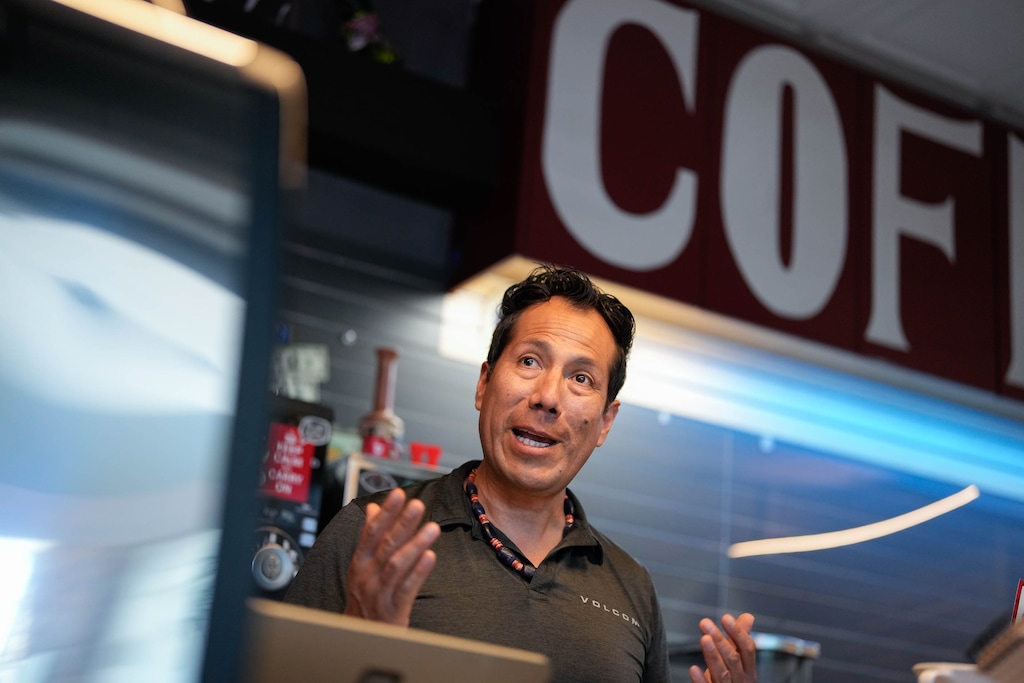
Over the quiet hiss of the espresso machine, Durand laid out how it came to be, from growing up in Peru to meeting a Utah woman visiting his homeland who later became his wife to opening up this campus shop in 2024.
“This is mine,” he said with a proud smile. “I built this.”
The shop, called INTI Specialty Coffee, is an homage to Durand’s heritage. “Inti” is the name of the ancient and revered Incan sun god who people prayed to for a good growing season. There’s also a special temple at Machu Picchu dedicated to Inti.
Durand, 45, likes to call his shop his “mini Machu Picchu,” with little nods throughout to his culture, including felt llamas by the shop menu, a “Cusco, Peru” sticker on the espresso machine, Spanish music playing over the speakers and — most importantly, to him — coffee beans sourced only from local farms in Peru.
“That’s why the coffee is so good,” he added with a playful wink. “It’s thanks to the sun.”
(Francisco Kjolseth | The Salt Lake Tribune) Julio Cesar Durand, of Peru, who runs INTI Specialty Coffee inside the Union building at the University of Utah, spent a lot time time and money converting a storage room into a beloved coffee shop, Friday, June 5, 2026.
(Francisco Kjolseth | The Salt Lake Tribune) Julio Cesar Durand, of Peru, who runs INTI Specialty Coffee inside the Union building at the University of Utah, spent a lot time time and money converting a storage room into a beloved coffee shop, Friday, June 5, 2026.
The flavor is a major draw to customers. But even more, students say, is Durand.
Nearly every Google review of his shop mentions him by name. One from seven months ago says: “The best coffee on the entire campus. Thanks to Julio, I developed a real taste for coffee, and now I can’t stop drinking it daily.”
Another adds, “Julio is the best barista and person.”
Rodrigo Fernandez-Esquivas, a U. senior studying political science and diplomacy, started going a couple months ago. Now he’s addicted, he said, to the cold brew and empanadas. He stops in multiple times a day, before class and after work at the Office of Graduate Admissions.
As soon as he does, Durand shouts his name and the two fall into an easy chat. Fernandez-Esquivas was born in Spain and loves Real Madrid; he usually updates Durand on the Spanish soccer league’s success, and the unfortunate lack thereof with Peru’s national team.
In April, Durand confided in Fernandez-Esquivas that the conversations they both loved may be numbered.
Durand had been told by the U. that his contract to keep running his beloved coffee shop was coming to an end, and it wouldn’t be renewed.
That’s when Fernandez-Esquivas and others, led by the student organizing group Mecha, started a monthslong fight that ultimately helped save it.
It started with a window
His shop at the U. opened in July 2024, but it wasn’t Durand’s first time in the coffee business.
He actually sold his first cup by accident — a decade earlier, out of his apartment window in Cusco, Peru.
At the time, Durand had been working as a map maker for the Peruvian government’s Ministry of Culture. It was a job he’d done for 14 years, taking him all across the country.
During his travels, he frequently visited the coffee bean farms nestled along the hillsides of the Andes Mountain range, which charts a jagged line through the country. He often took some beans home with him, enjoying a small roast in his kitchen each morning.
In 2013, he got an idea: In partnership with the farmers he met, he could start roasting and selling their beans. The side business was fairly popular, but small; Durand sold mostly to a handful of restaurants.
On Christmas Eve in December 2014, though, he was working on a new batch of roasted beans when someone walking past his apartment smelled the aroma and stopped. Durand had the window open, which faced a busy public street. The man set five Peruvian soles on the sill and ordered an Americano.
Not knowing quite how to respond, Durand recalled with a laugh, he walked into his kitchen and made the man a coffee.
He thought that would be it, but it was just the start. After a holiday break, Durand went back to his government job on Jan. 3, 2015, to hear his topography contract wasn’t going to be renewed under a new presidential regime.
He trudged slowly back toward home, trying to think of how he’d tell his wife. Their daughter, Emma, was just over a year old. They didn’t have a lot of money.
When he walked in, he made himself a cup of coffee and sat by the window. Outside, he could hear people walking by. This time, Durand decided to open the window again — intentionally.
He added decorations and a countertop and started up the first iteration of INTI. One of his restaurants he had been selling beans to was closing down; he bought their espresso machine at a sharp discount.
An Argentinean friend taught him how to grill, he said, so he added asado quesadillas and chorizo sandwiches to the menu.
By the following year, he and his wife, Audrey Evans, had a second daughter, Isabella. They moved into a bigger apartment — making sure it had a street-facing window, so Durand could continue selling coffee.
Today, Durand’s daughter, Daniela, from his first marriage, continues to run an INTI location in Peru. And he’s expanded from sourcing beans at four or five farms to now up to 100.
At the counter at the U., he flipped through photos on his phone, showing the early days, including his wife holding their baby outside of a pickup truck precariously filled with bags of beans. The same big “COFFEE” lettering from his window business are now stenciled on the INTI walls on campus.
(Francisco Kjolseth | The Salt Lake Tribune) Julio Cesar Durand, who runs INTI Specialty Coffee at the Union at the University of Utah, shows off a picture of his first coffee window business in Peru, Friday, June 5, 2026.
Luck and magic beans
When Durand first approached the U. with his cafe idea, his selling point was that he didn’t need a lot of space.
All he really needed, Durand likes to say, is good beans and good fortune. Today, he’s got each lucky $2 bill that’s ever come through his university shop affixed to the wall.
“I am very spiritual,” he says. “I believe in energy, destiny and luck most of all.”
He originally met Evans, his wife, in 2010, when Durand was boarding a bus to visit his beloved Machu Picchu, and the only seat left was next to her. She was visiting Peru to see the small coffee bean farm her mother still owned after moving to the U.S.; that farm later became one of his first coffee shop’s initial bean suppliers.
“You see?” Durand says, throwing up his hands with a laugh. “Luck.”
Evans stayed in Peru and the two married in 2012, starting their family and expanding their side business to more farms.
In 2019, his wife went to Utah to visit family for a month with their son, who was 7 months old. But that turned into two and three months when Evans decided to try for an international real estate license, Durand said.
She thought she could complete it quickly and return home, but balancing the classes with raising an infant was complicated. Durand decided to join her instead.
He boarded a plane with his two daughters, 4 and 5 at the time, and shipped a container full of coffee beans to their new house. Those arrived shortly after he did.
Durand took care of the kids while his wife juggled two jobs. He started learning English and, when he could, took his beans to roasters around Salt Lake City to sell. The magical taste won many over.
He sold at farmer’s markets, too, over a folding table he bought. A chance encounter landed him a spot inside a Trolley Square art gallery, too.
There, Durand bumped into Branden Dalley, the director of the U.’s student union building, for the first time.
“Would you have a spot for me?” Durand later asked Dalley, after running into him a second time — a sure sign to Durand that it was meant to be.
“I just need a tiny spot,” he said. Dalley told him he’d check.
(Francisco Kjolseth | The Salt Lake Tribune) Julio Cesar Durand, of Peru, who runs INTI Specialty Coffee inside the Union building at the University of Utah, spent a lot time time and money converting a storage room into a beloved coffee shop, Friday, June 5, 2026.
(Francisco Kjolseth | The Salt Lake Tribune) Julio Cesar Durand, who runs INTI Specialty Coffee inside the Union at the University of Utah, prepares drinks for people on Friday, June 5, 2026.
Shortly after, the director asked Durand to come up to the U. to check out a potential location. When Durand saw the storage room stuffed with chairs and speakers, he said with his characteristic optimism, “I love this spot.”
Dalley handed him the key, and Durand got to work. Spending an estimated $50,000 of his own money, Durand flipped the space until it was unrecognizable, adding a sink and an oven and a countertop for his espresso machine.
Then, he opened the glass door, which, he said with a smile, really looks more like a window.
Students find a space to belong
The timing of the opening was also fortuitous.
It fell just days after the U. closed its student identity centers under the Utah Legislature’s anti-diversity, equity and inclusion (DEI) mandate in 2024. That included the former Women’s Resource Center, the Black Cultural Center, the LGBT Resource Center and the Center for Equity and Student Belonging.
“Suddenly, we just didn’t have any space,” said Camila Hernandez-Ramos, a U. sophomore majoring in art and the first in her family to attend college.
Most of those centers had been in the student union. Quickly, she said, INTI filled the void.
At a predominantly white university, she said she found a space where the owner spoke Spanish and she could order a cheese empanada that felt like home. (And, always, a hot chocolate to go with it.)
Mecha, the student group that both Hernandez-Ramos and Rodrigo Fernandez-Esquivas are in, has foundations in a national organization that started to represent Latino students. The U.’s chapter started to hold its meetings in the lounge area just outside the coffee shop.
It’s where they drafted their resolution to encourage the U. to become a sanctuary campus for immigrants, which will be heard next in August by the school’s board of trustees. They often meet there, too, just to be around friends.
“It really has become a space for us,” said Fernandez-Esquivas, during a visit to INTI in June.
“This place means a lot,” added Jesus Loya, a senior. As Loya walked into the shop, Durand immediately shouted, “Oh, I like your hair.” Loya smiled and order a mocha — or, moka, as Durand spells it in his native Spanish.
Mecha also hired Durand to cater coffee at its annual conference. “And everyone was getting seconds and thirds,” noted Hernandez-Ramos.
(Francisco Kjolseth | The Salt Lake Tribune) Julio Cesar Durand, who runs INTI Specialty Coffee inside the Union building at the University of Utah, prepares drinks for Jesus Loya, left, and Rodrigo Fernandez-Esquivas, both U. Students and members of Mecha on Friday, June 5, 2026.
Fighting for a small business
In April, the U. first alerted Durand that his two-year contract for the space in the Union was approaching its July 9 expiration.
The school wasn’t going to renew it. Rebecca Walsh, a spokesperson for the U., confirmed that.
At the time, the university’s Housing & Dining Programs department told Durand that he could stay on campus, but he would have to move to another space, outside of the union building.
The U. declined to provide details about or a copy of Durand’s contract without a formal records request; The Salt Lake Tribune submitted one, but it remains in process.
Durand said he’s been paying $1,000 in rent to the U. each month to use the space in the union building. He said he’s always on time and has tried to be a model tenant.
The U. hasn’t disagreed. Instead, it has said a company the university contracts with to provide food on campus, Chartwells, has exclusivity over all dining options in that building. The university started reviewing all dining agreements about a year ago — and determined that Durand’s contract with the union building was technically out of compliance with its obligations to Chartwells.
Every food operator in the student union runs through subcontracts with Chartwells, including Panda Express and Einstein Bros. Bagels in the food court. Durand’s contract was set up differently, with the building manager.
The U. has used Chartwells as its main food partner since 1998.
The school offered to try to find Durand another location; in other campus buildings, independent operators, including other small coffee shops, can contract directly with the U.
Durand didn’t want that. “I put all my heart in this spot,” he said.
In an email to the U., he pushed back: “It feels deeply unfair that a multi-million dollar organization,” referring to Chartwells, “is choosing to shut down a small, family-owned business that I built from nothing.”
That’s when the students got involved. Led by Mecha, they launched a petition calling on Chartwells to allow Durand’s little shop to stay; it garnered more than 700 signatures.
They wrote letters to the school’s top administrators. They made signs and hung them around campus.
They even got the U.’s Academic Senate to take up the issue. The recent president of that faculty group, Richard Preiss, encouraged others to join the cause, calling INTI “charming” and noting that Durand contributes some of his profits to student scholarships.
The Tribune reached out to Chartwell’s corporate office for comment; the company deferred to the U.’s response.
(Francisco Kjolseth | The Salt Lake Tribune) Julio Cesar Durand, who runs INTI Specialty Coffee inside the Union at the University of Utah, prepares drinks for people on Friday, June 5, 2026.
(Francisco Kjolseth | The Salt Lake Tribune) Julio Cesar Durand, who runs INTI Specialty Coffee inside the Union building at the University of Utah, spent a lot time time and money converting a storage room into a beloved coffee shop, Friday, June 5, 2026.
“We want immigrant-run businesses on campus,” said Fernandez-Esquivas. “We want friendly faces at the counter.”
About two months later, Chartwells extended a new offer to let Durand become one of its subcontractors and keep his union building location. Walsh said that agreement will “bring the shop into alignment.”
Durand said he signed a yearlong extension with the company, to see how it goes.
“The signs, the petitions, the emails, all these things helped me to stay,” he said.
‘This happened for reason’
Behind the espresso machine, Durand looks like he’s conducting a symphony.
There’s another swarm of students to serve, but he’s composed.
His hands glide through the air as soft sizzles and hisses follow. He grinds the beans, tamps them, then pours and steams the milk. He keeps up with the conversation, too, like tapping in another section of the orchestra.
“I bought a new bike last week,” a student at the counter says.
“Oh,” Durand says with a smile. “A fancy one?”
And before their conversation is done, the ingredients for a mocha have come together in a to-go cup.
(Francisco Kjolseth | The Salt Lake Tribune) Julio Cesar Durand, who runs INTI Specialty Coffee in the Union building at the University of Utah, prepares an iced mocha on Friday, June 5, 2026.
Reflecting on getting to stay in this space, at least for a little while longer, he again turns to luck. The experience has been exhausting, he admits.
“But,” he adds, “I think this happened for reason.”
Seeing the students rally around him has been one of the most meaningful experiences of his life, he said. The attention has also been “buena promoción,” he added with a smile, with more and more customers coming in to support him.
Looking up at the INTI sign, with the sun god’s face worked into the logo, he offers a quiet “thank you.”
“If you don’t have the sun,” Durand said, winking, “you can’t grow anything.”
He waits for the next swarm of students to come.
(Francisco Kjolseth | The Salt Lake Tribune) Julio Cesar Durand, who runs INTI Specialty Coffee in the Union building at the University of Utah, talks about his life story around coffee on Friday, June 5, 2026.