 Megan Banta
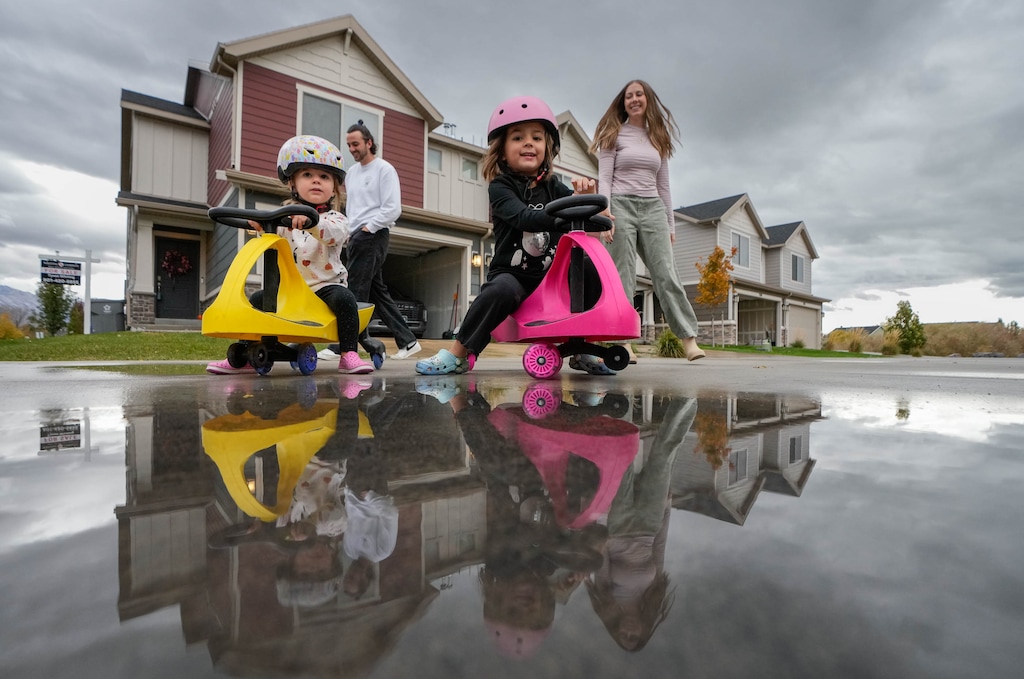
When Hannah and Lynden Whitaker bought their Saratoga Springs house in 2021, they were more than a decade younger than the national average first-time homebuyer.
But at 24, Hannah said, they couldn’t have done it without a $20,000 gift from her in-laws — assistance they gave on top of helping with college that meant the young couple didn’t have debt.
“It’s the only way we could afford to buy at that time and age,” she said. “We were living in a one-bedroom apartment and expecting a baby.”
They’re now among about 54% of Utah households where people between the ages of 25 and 34— a range that includes Gen Z and millennials who are increasingly becoming homeowners — own instead of rent.
That’s nearly 10 percentage points higher than nationally and a “surprisingly high” rate given home prices here, according to a new report by economist James Wood commissioned by the Salt Lake Board of Realtors.
One key is that it’s often easy to misunderstand what reports about housing prices mean for people searching for their first home, said Scott Colemere, president of the Salt Lake Board of Realtors and principal broker at Colemere Realty Associates.
First-time buyers aren’t necessarily looking at the typical home prices in those reports, he said.
There are more opportunities than people think even though it can “absolutely” be challenging, Colemere said — but that isn’t new.
“Newsflash,” he said. “It’s always difficult for first-time buyers to get into a home.”
‘This big, hairy, scary thing’
For some, like Cayden and Maddie Morton, it wasn’t as hard as they thought.
“It seemed like this big, hairy, scary thing,” Cayden Morton said,
They initially didn’t think they were ready, especially because Maddie Morton was unemployed and had just started a new business that wasn’t yet in the black.
“There’s a lot of doom and gloom narrative out there about buying a home,” Maddie Morton said. “We just bought into that narrative, and we didn’t think it would be possible until we talked with Scott [Colemere].”
Colemere said the Mortons aren’t alone in their thinking and that many first-time buyers “are really surprised that they actually are in good financial space to buy a home” and more able to qualify for a loan than they thought.
“Then they move from delight and surprise to ‘oh wow, we have options,” he said, before looking at where they can get a home within their budget.
Speaking of budget: Young Utahns have a higher median income, according to Wood’s report — $102,400 a year, compared to the typical young household income of $93,200 nationally.
They’re also largely employed; 84% of Utahns between 25 and 34 have a job.
Dual income was key for Kyler Wakefield and his wife, Afton. They don’t have kids, and even with seven years of savings, no student debt and limiting themselves to one car payment, they could “barely” afford a house in West Valley City.
“We got lucky in the sense that we were able to rent from a family member for a while for a reasonable price while we saved up,” he said.
They wanted to be in Salt Lake County and wanted a single-family home. Their finances are a little tighter after buying, he said — their mortgage and utilities are nearly triple their previous rent payment.
But they’re still happy with their choice to buy, he said, and their pride in owning a home they’ve worked to improve keeps them going.
Housing options, ‘historically low interest rates’ helped young buyers
While the Mortons got the single-family home they wanted, Wood’s report details that many young homeowners are able to buy because there are more condominiums, townhomes and twin homes available.
Those kinds of homes are nearly ¼ of new homes built and make up 27% of home sales, Wood writes in the report.
That sector worked for the Whitakers, who bought an attached townhome-style unit.
So did their timing. They bought in the window from 2019 to 2022, when Wood writes that “historically low interest rates” helped young households buy.
Even then, Hannah Whitaker said, they had to offer $375,000 for an attached unit that was listed at $370,000.
But it was the home that felt right for them, she said. They also looked at homes in Daybreak, Riverton and Draper, but the one they bought “already felt right” even when they were just driving through the neighborhood.
The Mortons had a similar feeling and found what Maddie called a home in “the cutest neighborhood” near Springville High School.
It’s an older area with homes from the 1940s, Cayden Morton said, but their house was “nicely remodeled within the last five years.” Other places they toured needed a lot of work, he said, and they were “not necessarily where we would have been amped to move in.”
Getting creative with financing
It was easier for them to afford their home for a different reason than the Wakefields or Whitakers.
They put down 5%, Cayden Morton said, and got $10,000 in seller concessions that helped with closing costs.
That’s something that realtors, including Colemere, have told The Salt Lake Tribune is starting to come back.
Colemere recalled his dad working with buyers in the early 1980s who were fighting 17% and 18% interest rates and coming up with creative solutions like seller financing — where the buyer makes monthly installment payments directly to the seller based on agreed-upon terms — to make it work.
“That kind of mentality is what’s coming back,” Colemere said.
Cayden Morton said they initially were planning to wait another year or two before getting serious about buying. Now, he wishes he’d started exploring possibilities five years ago to start getting a handle on things.
Because, as Maddie Morton says, they “were not in the correct demographic to be doing this” — especially on just Cayden’s income — but they still qualified and bought a house.
“If we can do it, I feel like other people can do it, too,” she said.
They did it without help from their parents, Cayden Morton said, but did get some help from other means. Their mortgage servicing company had assistance programs, he said.
There’s other help available for first-time buyers, as Wood highlights in the report, like the state’s program for up to $20,000 in down-payment assistance on some new construction.
Benefits and limits of owning
The “powerful financial benefits” of owning in a market where prices are still rising are another factor, Wood writes.
Owning has made it easier for the Whitakers to be mindful about finances and budgeting, Hannah said, and they like building equity instead of seeing rent money “going out the door.”
She clarified that they’re now “able to better prepare for our future financial goals” because of the privilege they experienced getting help from family.
“It’s hard to not keep up with the Joneses, but you have to keep those things in mind,” she said.
Homeownership itself was a goal Lili Donosso set for herself at 18. She worked three or four jobs to save up and bought her Eagle Mountain home at 22 in January.
She describes the experience as magical.
“It feels like so many answered prayers,” Donosso said. “It feels kind of surreal sometimes, even though it’s almost been a year.”
Donosso said she talks with people who doubt they could do the same, but she feels having the right mindset is key.
While willingness to put in the hard work works for some, Colemere said, not every story is “so rosy.”
Some people “just aren’t in the right position,” he said, like a family he recently worked with that had reasonable credit but no savings and a single income and wanted a single-family home in a specific school district.
He encouraged them to make a plan to save and find more income. He’s said he’s seen some buyers return after taking those steps, better informed and more patient, and eventually find success.
“It’s not rocket science, but it takes effort,” Colemere said.