 Brooke Larsen
St. George • After two hours of fiery debate and public comments, the St. George City Council approved a new sales tax to increase funds for the St. George Fire Department late Thursday evening.
The controversial resolution first failed, though, with only two out of five votes in support. That resulted in cheers among some of the roughly 100 people who filled city hall.
But City Council Member Dannielle Larkin, who originally voted against the resolution, introduced a new motion with an amendment: the city would levy a new tax but also refund primary residents for its contribution to the city government’s utility costs.
“We don’t pay back our utility department,” Larkin said, referring to the city government. “So one thing that we can do is pay our utilities for this building, which then, for every resident, we can send them $40 back.”
The resolution with Larkin’s amendment passed with a 3-2 vote.
The new emergency service tax will add 33 cents to every $100 spent on taxable items in the city. This excludes a variety of items, including fuel, prescriptions, some medical equipment, food and food ingredients, according to Utah law. The city estimates the tax will cost residents, on average, an additional $56 per year. But with the amendment, primary residents of St. George will get around $40 refunded to them.
The tax will raise an anticipated $12 million annually to improve response times, address equipment needs and increase staffing for emergency medical and fire services as the city grows. The utility refund for primary residents will cost the city $1.35 million, though, according to Robert Myers, assistant city manager.
The city aims to fund six new full-time fire stations, 72 new full-time fire fighters and 15 new and replacement fire apparatuses with the increased revenue. St. George currently has 83 firefighters and 10 stations, according to the city.
The city decided to add the new sales tax instead of increasing property taxes in part because the sales tax will bring in revenue from tourists. Visitors generate around 30% of the sales tax revenue in Washington County, according to the Kem C. Gardner Policy Institute.
“This ensures these visitors to our community help pay for their impact, and that impact is not just borne by St. George residents,” Myers said regarding the sales tax.
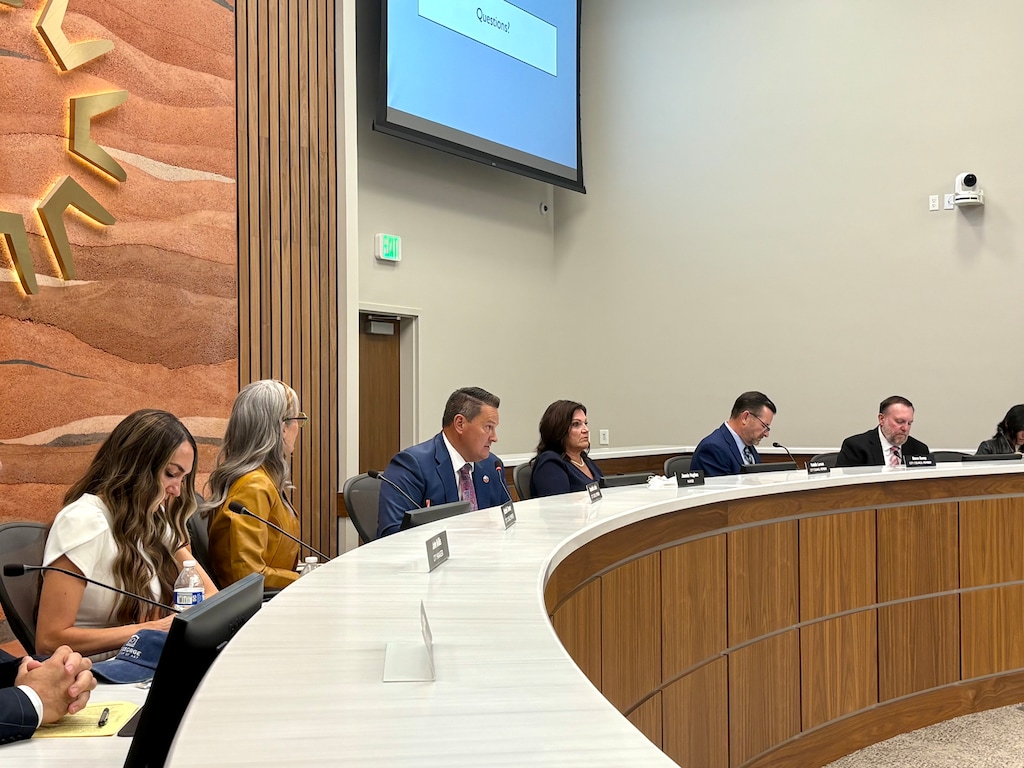
(Brooke Larsen | The Salt Lake Tribune) Assistant City Manager Robert Myers presents info about the emergency services sales tax at the St. George City Council meeting on Thursday, Oct. 1, 2026.
Cities and towns across the state may levy such a tax to fund emergency services thanks to a 2024 bill sponsored by Rep. Joseph Elison, Republican lawmaker who represents the eastern half of Washington County.
St. George is the fifth most populous city in the state and its sales tax rate, 6.75%, is the lowest rate among Utah’s 20 largest cities. Layton and Ogden have the next highest at 7.25%, so with the added emergency services tax, St. George will still have the lowest rate among the state’s most populous cities.
The tax will last for 10 years. At the end of that period, the city may reauthorize the tax for another 10 years.
Why the fire department needs more money
The fire department has seen an increase in call volumes over the past eight years, according to Myers, rising from around 7,000 in 2018 to an estimated 10,000 in 2026.
The city’s fire department does not currently meet the national response time standard of four minutes. The department’s crew members currently show up on scene in nine minutes and 47 seconds or less 90% of the time.
In 2012, the department responded to incidents in typically five to six minutes, Fire Chief Robert Stoker said. But due to growth and traffic congestion, response times have slowed.
(Mark Eddington | The Salt Lake Tribune) St. George Fire Chief Robert Stoker poses next to the department's first engine, a 1936 Studebaker, at Fire Station 1 in St. George, Friday, Nov. 7, 2025.
Stoker doesn’t know if the fire department will ever get response time down to four minutes. But it’s worth trying, he said.
A fire doubles in size every minute, he added, “so you get there in four minutes versus nine minutes, your fire’s a lot smaller.”
Three of the city’s existing stations are on-call stations, meaning reserve staff must first drive to the station from their home before responding to an emergency.
“Most of the longer responses are occurring outside the immediate coverage areas of our full-time stations,” Myers said.
The city plans to upgrade and fully staff those on-call stations with the tax revenue to meet three of the anticipated six new full-time stations.
(Brooke Larsen | The Salt Lake Tribune) St. George firefighters and members of Dixie Technical College's firefighting program stand at the back of the St. George City Council meeting during a hearing on an emergency services sales tax on Thursday, Oct. 1, 2026.
Residents call for city to find money elsewhere
Throughout the public hearing, residents expressed their support for the fire department, but accused the city of not tightening the budget elsewhere to prioritize public safety.
“I think everyone here loves the fire department and our public safety staff in the city. I don’t think that’s really the issue here, though,” Brad Bennett said.
“It’s not really that overly difficult to know what these public safety departments are going to need year over year and budget for this,” he added. ”So the real question is: with the $540 million dollar budget, why was this not taken care of first?”
The city covers most of the fire department’s costs through its general fund, which is $121.7 million for the 2027 fiscal year. In its latest budget, the city allocated 47% of the general fund to public safety, and 27% of the public safety budget goes to the fire department.
(Mark Eddington | The Salt Lake Tribune) Fire Station 1 in St. George, Friday, Nov. 7, 2025.
“I’ve been able to work under four different mayors, three different city managers, and a lot of different city councils,” Stoker told The Tribune. “They’ve always supported public safety.”
Council Member Michelle Tanner, who voted against the tax, encouraged the city to do an efficiency audit to find places to cut and consider selling non-essential city properties to bring in more revenue. She mentioned a property next to the Dixie Center and another next to the children’s museum as possibilities.
“Any time we are looking at a tax increase proposal, we should always be thinking about what our values and principles are as a community, and I believe among those, especially here in Utah’s Dixie, is limited government, freedom, fiscal responsibility and increased taxation is the opposite to all of those,” Tanner said.
“Taxation is bondage,” she added, “which is the opposite of freedom.”
Residents shared how they’re struggling with the cost of living as inflation raises the costs of goods.
“Being a mother of three young adults trying to find their way in the world and wanting to stay here, it’s difficult,” Lori Waters said. “They’re having to stretch their dollars, and those dollars are not stretching as far as they used to. And I just hope and wish that you would think twice about adding another tax to the burden.”
Residents said they want the city to look closer at its budget, like they’re having to do themselves, and some asked the city to postpone their vote on the tax and find other places to cut back.
(Brooke Larsen | The Salt Lake Tribune) Rolando Rodriguez, St. George resident, expresses his support for the fire department and opposition to the sales tax during the St. George City Council meeting on Thursday, Oct. 1, 2026.
Larkin and other council members spoke of ways the city has searched for places to cut and left some city needs underfunded, such as roads. The city also explored raising property taxes in 2022, but that proposal failed.
Larkin said she agrees with Tanner’s idea to sell city properties, but that only provides one-time funds, she said. “That’s not going to fund a thing like fire that needs to be funded in perpetuity.”
While most residents spoke against the tax during the hearing, a few expressed support.
“If we can tighten the belt, go through the budget one more time, see what can be pulled first, let’s do that,” said Zachary Ray, a St. George resident whose family has a long history of first responders. “If I have to pay a little bit more so that somebody’s house doesn’t burn down, or a child’s grandparent can survive a heart attack, then I will do that.”
Tim Andrus, former firefighter and leader of Dixie Technical College’s firefighting program, also spoke out in support of the tax.
(Brooke Larsen | The Salt Lake Tribune) Tim Andrus, a former firefighter and leader of Dixie Technical College's firefighter training program, expresses his support for the emergency service sales tax at the St. George City Council Meeting on Thursday, Oct. 1, 2026.
He previously worked in another fast growing city, he told the council, and the fire department couldn’t keep up with increased demand. “Our call volumes extended so far that we started having health issues with residents, he said.
“This tax is needed for us to try to catch up,” he added.
That’s one of the reasons St. George Mayor Jimmie Hughes said he supports the tax.
“We may not be able to meet that standard of four minutes, but what if we get it to five versus eight?” he said. “Is it worth it?”