 Sean P. Means
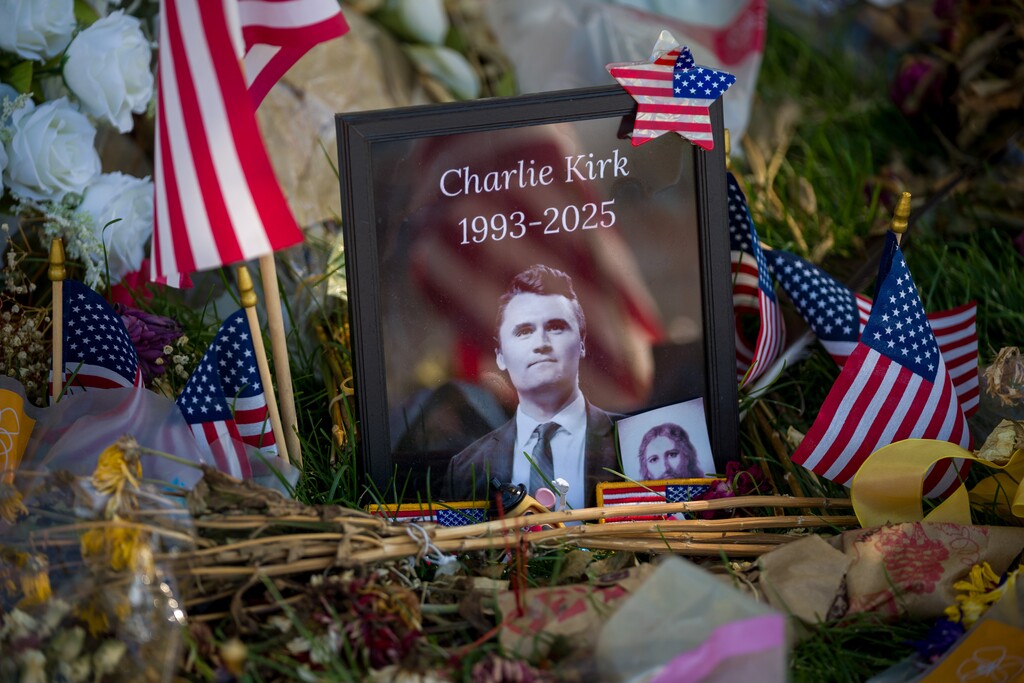
Charlie Kirk was shot and killed on Utah Valley University’s campus on Sept. 10, 2025. Two days later, suspect Tyler Robinson was taken into custody.
Here’s a timeline of significant events in the legal case against Robinson, and moments over the last 12 months where Kirk’s death affected other aspects of life in Utah and the U.S.
Timeline
Sept. 16, 2025 • Robinson made his first court appearance, over a video stream from the Utah County jail, to hear the seven charges filed against him — including a count of aggravated murder, which carries the potential of the death penalty if he’s convicted. Robinson only spoke once, to say his name.
(Utah State Courts) Tyler James Robinson appears virtually in 4th District Court Tuesday, Sept. 16, 2025 on charges, including aggravated murder, in the shooting death of Charlie Kirk.
Sept. 17, 2025 • Students at Utah Valley University returned to classes for the first time since Kirk’s death. Some took a moment to stop by the closed courtyard where he was killed.
Sept. 24, 2025 • Utah County officials announced the county had hired defense attorney Kathryn Nester as Robinson’s public defender. County officials estimated that hiring Nester would cost $750,000 over the following year. The county in February asked the Utah Legislature for $2 million to pay for Robinson’s defense.
(Bethany Baker | The Salt Lake Tribune) Tyler Robinson, left, accused in the fatal shooting of Charlie Kirk, sits beside defense attorney Kathryn Nester during a hearing in 4th District Court in Provo on Friday, Jan. 16, 2026.
Sept. 26, 2025 • After a nine-day hiatus, Utah viewers could watch “Jimmy Kimmel Live!” on ABC4 Utah again, when the station’s owner, Nexstar Media, brought the show back locally. ABC had suspended the show nationally Sept. 17 after Kimmel on Sept. 15 commented on Robinson’s arrest, saying that “the MAGA gang [is] desperately trying to characterize this kid … as anything other than one of them.”
Sept. 30, 2025 • Kirk’s organization, Turning Point USA, returned to Utah, bringing the “American Comeback Tour” to Utah State University in Logan. Security was tight for the event, where several speakers paid tribute to Kirk. The audience booed Gov. Spencer Cox when he spoke.
(Rick Egan | The Salt Lake Tribune) Gov. Spencer Cox says a few words at the Turning Point USA event Glen Smith Spectrum Arena, in Logan on Tuesday, Sept. 30, 2025.
Oct. 2, 2025 • Geoff Landward, Utah’s commissioner of higher education, said “the only appropriate response” to Kirk’s death was to commit more strongly to safeguarding free speech on campus.
Jan. 14, 2026 • Astrid Tuminez, then-president of Utah Valley University, announced she would step down at the end of the academic year. Jon Anderson, a Utah native, took over as UVU’s new president in July.
(Francisco Kjolseth | The Salt Lake Tribune) Former Utah Valley University president Astrid Tuminez speaks during a vigil on Friday, Sept. 19, 2025, at the UCCU Center following the killing of Charlie Kirk.
Jan. 29, 2026 • George Zinn, the 71-year-old man who added to the confusion in the moments after Kirk’s death by claiming he fired the shot, pleaded no contest to a charge of obstruction of justice, and guilty to two charges of sexual exploitation of a minor. (After his arrest, police found child sexual abuse material on Zinn’s phone.) Zinn was sentenced to up to 15 years in prison.
(Bethany Baker | The Salt Lake Tribune) George Zinn appears at an arraignment hearing in 4th District Court in Provo on Thursday, Jan. 29, 2026. Zinn pleaded no contest to an obstruction of justice charge amid the Charlie Kirk shooting, and pleaded guilty to two counts of sexual exploitation of a minor.
Feb. 6, 2026 • Utah Rep. Walt Brooks, a Republican from St. George, moved to ban open carry on the state’s public college campuses. Gov. Cox ultimately signed the bill into law.
(Francisco Kjolseth | The Salt Lake Tribune) Rep. Walt Brooks, R-St. George (seen here in 2022), switched positions during the 2026 Utah Legislature session, to support a ban on open carry of firearms at Utah public colleges.
Feb. 24, 2026 • Fourth District Judge Tony Graf ruled that he would not disqualify the Utah County attorney’s office from prosecuting Robinson, saying the fact that one prosecutor’s daughter attended the UVU event where Kirk was killed posed “no significant risk” of a conflict of interest in the case.
April 10, 2026 • According to a September search warrant unsealed in April, Robinson wrote in a handwritten letter to his romantic partner at the time that “I left the house this morning on a mission. I am likely dead, or facing a lengthy prison sentence. I had the opportunity to take out Charlie Kirk, and I took it.”
(Trent Nelson | The Salt Lake Tribune) Tyler Robinson and defense attorney Kathryn Nester in 4th District Court in Provo on Friday, April 17, 2026 during a hearing for Robinson, accused in the fatal shooting of Charlie Kirk.
April 16, 2026 • Utah Valley University canceled its planned commencement address from author and educator Sharon McMahon after conservatives including Utah Rep. Burgess Owens and Utah Sen. Mike Lee raised issue with some of her past social media comments, in which she wrote Kirk’s fans “might not realize why there is so much backlash to posts eulogizing his death.”
McMahon initially pushed back against the criticism; the university ultimately canceled because of “increased safety concerns.” In May, the Utah Board of Higher Education passed a rule requiring a more formal and open process for choosing commencement speakers at public colleges.
(Sharon McMahon) Author and educator Sharon McMahon was scheduled to be the commencement speaker at Utah Valley University in April 2026, but the speech was canceled after criticism of McMahon's social media comments after Charlie Kirk's death.
May 8, 2026 • Graf ruled that cameras would be allowed in the courtroom during Robinson’s hearings. Robinson’s attorneys had argued for months against cameras, citing rhetoric from elected officials and “sensational and misleading” news coverage as reasons to ban them. Kirk’s widow, Erika, and Utah news organizations (including The Salt Lake Tribune) had argued to have cameras capture the proceedings.
July 6, 2026 • Robinson’s preliminary hearing began, with Kirk’s parents and his widow, Erika, in attendance, along with Donald Trump Jr. The family left the courtroom before the judge watched surveillance footage that showed Kirk’s death. The preliminary hearing continued for a week, with an interview from Robinson’s roommate and romantic partner and discussions of DNA evidence.
(Marielle Scott | AP) Erika Kirk leaves the 4th District Courthouse, Monday, July 6, 2026, in Provo after a hearing for Tyler Robinson, accused in the fatal shooting of Charlie Kirk.
July 27, 2026 • Utah County prosecutors argued in a brief that Robinson targeted Kirk because the commentator represented a “political movement” opposed to gay marriage and transgender rights.
Sept. 1, 2026 • Graf ruled that Robinson could stand trial for aggravated murder and six other charges — meaning he could face the death penalty if convicted. A hearing was set for Oct. 23 to set a trial date.
(Francisco Kjolseth | The Salt Lake Tribune) Fourth District Court Judge Tony Graf listens during closing arguments for the preliminary hearing for Tyler Robinson at the 4th District Court in Provo on Tuesday, Sept. 1, 2026.