 Jose Davila IV
In a few years, you might be standing on a FrontRunner platform watching your train pull into the station and notice it has a completely different design.
If it all pans out the way Utah wants, that new train would have recently rolled out of a factory on Salt Lake City’s west side.
Beehive State transportation officials selected Stadler, the Swiss company that operates the plant, to build at least 10 diesel-powered trains for use on the commuter rail line, public records show. A committee determined Stadler’s bid provided “the best value to the state,” earning it a contract.
(Francisco Kjolseth | The Salt Lake Tribune) Stadler Rail celebrates the completion of an expansion of its west-side manufacturing plant in Salt Lake City on Wednesday, July 1, 2026.
FrontRunner, which whisks riders from Provo up to Ogden, is a key part of the Wasatch Front’s transportation system and keeps almost 14,000 cars off Utah’s highways each weekday. But it also is limited with 30-minute and hour-long waits for trains at peak and off-peak times, respectively.
Utah transportation officials have long planned to cut down on those extended headways by adding another track alongside the current one in some places so trains can pass each other more often along the route. The Utah Transit Authority also needs new FrontRunner vehicles to achieve those shorter waits. That’s where Stadler comes in.
According to public records, the train manufacturer proposed a price of $328.3 million for the vehicles. The Utah transportation committee evaluating the bid “determined that the submitted pricing was fair and reasonable.” Stadler was the only company that submitted a bid.
Utah Department of Transportation spokesperson Mitch Shaw said the contract with the train manufacturer “is not finalized” and that the agency doesn’t “speak about procurement contracts that are in process.”
Stadler spokesperson Charlotte Thalhammer said the two sides were still meeting “to figure out exactly the specifics of this project.” She indicated that Stadler won’t know what exact type of vehicles Utah officials will want until that process wraps up “in a couple of months.”
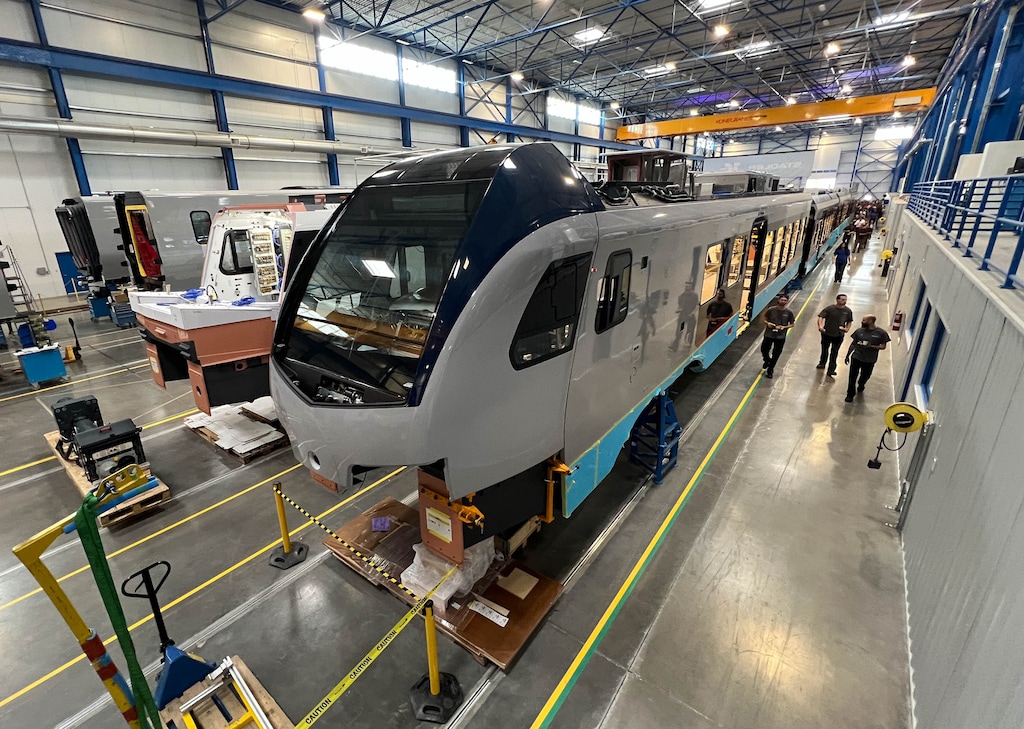
(Francisco Kjolseth | The Salt Lake Tribune) A diesel powered train bound for the Dallas area nears shipment at Stadler Rail's plant near Salt Lake City on Friday, Jan. 5, 2024. The diesel trains engine compartment is designed so it can be converted to battery powered system in the future.
Documents posted by UDOT offer some clues as to what the trains might look like, though. State transportation experts are looking to run multiple-car trains with diesel engines on-board instead of powering movement with a locomotive. Stadler only advertises one such vehicle on its website: the FLIRT model.
A document outlining the technical specifications of the hoped-for trains also leaves the door open to powering them with a rechargeable battery. The FLIRT model can be built for that hybrid setup, too. Two Dallas-area routes, Dallas Area Rapid Transit’s Silver Line and Trinity Metro’s TEXRail service, run FLIRT trains. So does the Arrow commuter system in San Bernardino County, California.
Utah transportation officials are looking for new trains that are an upgrade over the current ones, which have been in service since the line opened in 2008.
“The new units must provide improved performance and energy efficiency, higher reliability,” the technical specifications document says, “and provide a higher-quality passenger environment compared with that currently offered by existing trains on the UTA FrontRunner commuter rail system.”
A draft purchasing contract also shows that Utah transportation officials want to have the option of ordering an additional 40 trains, as well as a training simulator for drivers.
State officials are hoping to get federal funding to help complete the $3.2 billion double-tracking project. They don’t expect the new tracks and trains to begin service for at least another four years.