facebook-pixel

In Utah, here’s why some measles exposure sites never appear in public alerts

Health officials say the decision depends on the risk to the broader public.
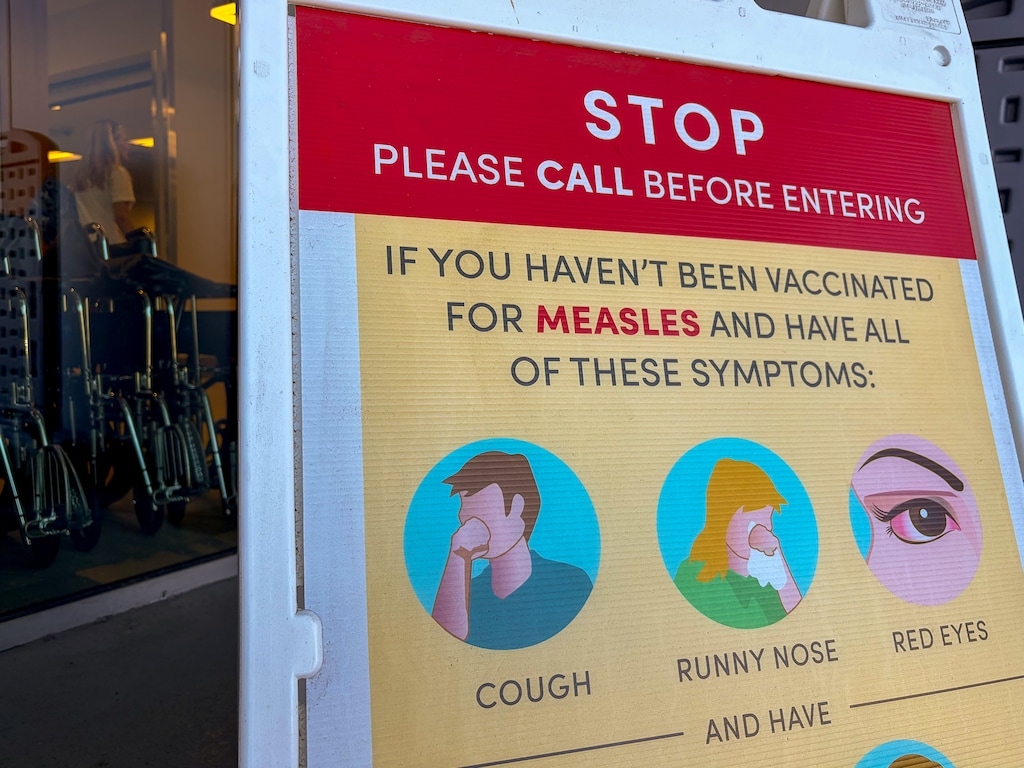
(Trent Nelson  |  The Salt Lake Tribune) A sign regarding measles at Sugar House Health Center in Salt Lake City on Friday, June 5, 2026.

(Trent Nelson | The Salt Lake Tribune) A sign regarding measles at Sugar House Health Center in Salt Lake City on Friday, June 5, 2026.

A person who doesn’t know they are infected with measles may enter a business in Utah and unknowingly expose people they pass by or sit near — yet that business may never appear in public health alerts.

County health departments across the state routinely publish lists of these potential exposure sites. But not every location is included.

That’s because, state health officials say, a public notification may not be as efficient as reaching people directly, when possible.

The Salt Lake Tribune reviewed more than 900 pages of email and text conversations among local and state health officials, including conversations about how to handle exposure notifications as case counts climbed in February and March. The Tribune received the documents through a public records request.

The conversations also included discussions about whether or not to name businesses. The highly contagious virus that was once considered eliminated is capable of lingering in the air for up to two hours after an infected person leaves a room, and exposure notifications are a key public health tool.

Utah’s measles outbreak is now nearing 700 cases. A single case can trigger a sprawling investigation as health officials work to determine where an infected person went, who may have been exposed and whether the public needs to be notified.

When are businesses named?

In Salt Lake County, emails indicate, officials didn’t always seek permission from a business before listing it as an exposure site.

Melanie Crossland, an epidemiologist for the Salt Lake County Health Department, said those decisions are made on a case-by-case basis. The department does not need permission before publicly identifying a business or organization, Crossland said, but it also does not have a rigid policy dictating when a location must be disclosed.

Instead, the decision often comes down to whether health officials can identify and directly contact the people who may have been exposed. If people were exposed in a setting where everyone can quickly be reached — such as a workplace, school event or private gathering — a public alert may not be necessary, she said.

But if an infected person visited a grocery store, restaurant or other public place where numerous people who can’t easily be identified could have been exposed, the health department is more likely to issue a public notification, Crossland said.

“If we deemed that there was a risk to the public and a business needed to be publicly identified, we would do it regardless if the business wanted us to or not,” Crossland said. “Our first and foremost responsibility is to public health.”

(Trent Nelson | The Salt Lake Tribune) Information about measles at Sugar House Health Center in Salt Lake City on Friday, June 5, 2026.

A daycare, Crossland said, is one example where county health officials may send a “targeted letter” to staff and families who may have been exposed instead of a issuing public alert.

Utah’s 13 different local health districts may handle exposure investigations somewhat differently, state epidemiologist Leisha Nolen said, but they share the same approach.

If everyone at risk can be contacted directly, a public notification isn’t necessary. If not, and there is a broader risk to the public, health officials will publicly identify the exposure site regardless of a business or organization’s preferences.

Part of that process, Nolen said, is ensuring businesses are not “blindsided” by an exposure while also balancing public health needs.

A public health system under strain

Crossland said the Salt Lake County Health Department has had to quickly respond to a virus many public health workers had never encountered in their careers.

“We have never seen anything like this before,” Crossland said. Typically, the department would see about one measles case every five years, she said, usually tied to international travel.

Once cases began to spike in early 2026, Utah health officials said it became increasingly difficult to contain the outbreak. Coupled with declining vaccination rates since the COVID-19 pandemic, the shift prompted officials to focus more on mitigation — informing people of the risks and encouraging vaccination — than on traditional containment efforts.

Although new cases have slowed significantly over the last two months, infections are still spreading, said Nolen, with the state. Crossland said smatterings of infections over the coming years may be the “new normal.”

So far, no deaths have been reported in Utah. But Nolen said it is something she has been “worried about for months.”

“Utah is getting lucky,” Nolen said, “... but if we continue to have an outbreak, we’re eventually going to have someone die, which is really tragic.”

(Francisco Kjolseth | The Salt Lake Tribune) State epidemiologist Dr. Leisha Nolen shares an update on the state's measles outbreak on Thursday, March 5, 2026.

The outbreak has also hit young children and pregnant patients, according to Andrew Pavia, a pediatric infectious disease specialist in Utah. Pavia spoke during a national news conference about measles in May.

In Utah, he said, 23 infants under age 1 have contracted the virus, along with 12 pregnant women. In one rare case, a newborn developed congenital measles after infection in the womb, Pavia said.

While the complication is often fatal, Pavia said the baby survived. Two babies in Canada with congenital measles, however, “were not so lucky,” he said.

“I’m afraid that until we can restore faith in vaccines, restore funding for our public health agencies and increase measles vaccine coverage,” Pavia said, “we have to anticipate that there will be many more outbreaks.”

Support free news for Utah

sltrib.com is now free to access — no subscription required. We made this decision because we believe access to trustworthy, independent news shouldn’t depend on what you can afford — especially as misinformation and AI-generated content continue to rise.

Free to read doesn’t mean free to produce. Our reporters show up every day to ask hard questions and hold powerful institutions to account. That work takes resources. As a nonprofit newsroom, we rely on support from people who believe it matters. Make a donation today to fund local news that serves Utah communities.

You can help us bring more local news to more communities today.