 Samantha Moilanen
Note to readers • The Salt Lake Tribune is making this story free to all.
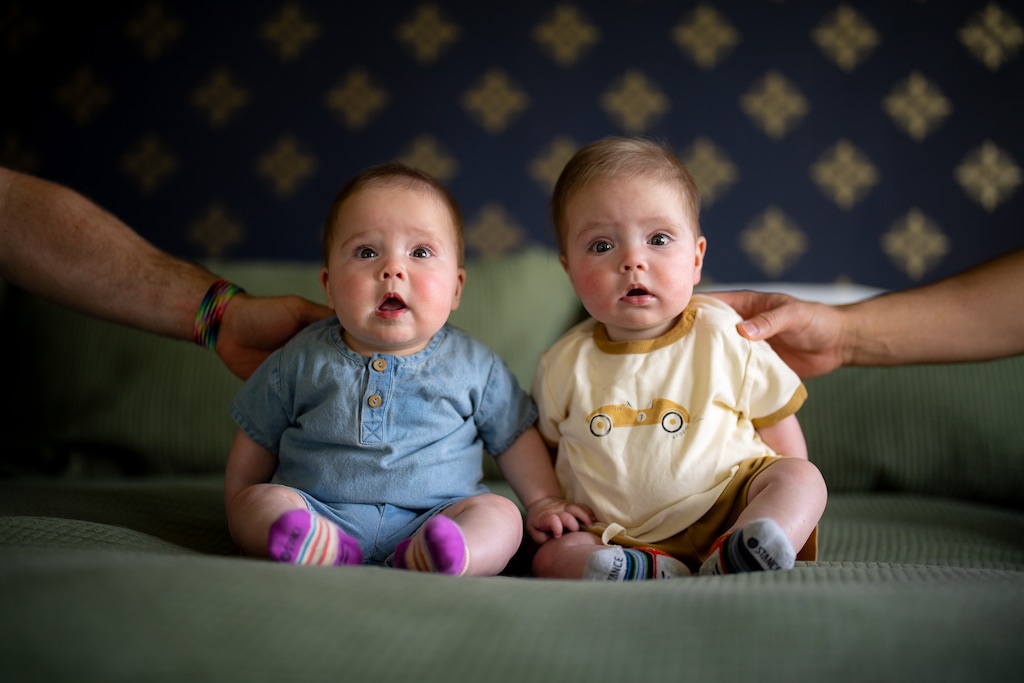
Michael Bangerter and Josh Valdez welcomed their twins into the world just as measles cases in Utah began to climb — and for months, the Riverton couple rarely took Lincoln and Lola out of their home.
“We’ve been actually not allowing even our closest friends and some of our family to meet the babies,” Bangerter said.
But by the time the twins were 5 months old, the parents’ constant vigilance had started to wear. Case numbers, they thought, seemed to be improving, and they “let their guard down,” Bangerter said.
The couple decided to take their babies to the Loveland Living Planet Aquarium in Draper on March 2.
But on the same day, around the same time, someone with measles had been there. The parents learned about the exposure about a week later, when state health officials announced the overlap.
“We’ve been very cautious,” he said. “And then the one time where we’re like, ‘Yeah, let’s take them to the aquarium today’ ... of course, that was one of the one days that it could have mattered.”
Their pediatrician instructed them to watch for symptoms: pink or red watery eyes, a cough, a runny nose, then a fever and eventually the rash commonly associated with virus.
But the doctor also confirmed something that surprised them: In a few short weeks, they could vaccinate the twins at just 6 months old — half a year sooner than they thought the babies would be eligible.
Bangerter took to social media to explain what he learned.
“If your baby is 6–12 months, talk to your pediatrician,“ he wrote on Instagram. ”Because the life you protect might not just be your own child’s — but the newborn next to you at the store."
Across the TikTok and Instagram accounts he shares with Valdez, Bangerter said the post drew comments from physicians, Utah residents and people outside the state — many saying they hadn’t realized the vaccine was available for infants that young.
“A lot of them were in Utah, and they said, ‘I had no idea my 7-month-old could get the vaccine,’” he recalled, “or, ‘I didn’t know my 8-month-old was eligible.’”
Utah health officials are encouraging parents to talk with doctors about giving infants between 6 and 12 months an early, extra dose of the MMR vaccine during Utah’s outbreak, even in cases without known exposure.
[Read more: Utah leads the nation in measles cases, but COVID made health officials cautious to encourage vaccines]
The extra shot is typically reserved for special circumstances, such as international travel, but state officials say broader use is now appropriate as cases rise.
Health departments in other outbreak states, such as South Carolina, have issued similar recommendations.
Children who receive an early dose would still need the standard two-dose series later in childhood, starting at 12–15 months and again at 4–6 years.
Children with measles are ‘very ill’
(Trent Nelson | The Salt Lake Tribune) Josh Valdez and Michael Bangerter with their twins, Lincoln and Lola, in Riverton on Monday, April 20, 2026.
While the highly contagious virus isn’t often fatal, it can pose serious health complications, especially in young children and infants, according to the Centers for Disease Control and Prevention.
Pregnant women and people who are immunocompromised are also more vulnerable to severe illness if infected.
At a news conference in early March, Amanda Jocelyn, who works in pediatric care in Hurricane, described the severity of cases she has seen firsthand.
Children with measles that come into her clinic are “very, very ill,” she said, with high fevers ranging from 103 to 105 degrees that last several days or even a week, along with severe coughing that has caused oxygen levels to drop low enough to require supplemental oxygen or hospitalization.
She said some patients have gone on to develop pneumonia and face prolonged recoveries, while others have experienced rare but serious complications, including aplastic crisis, a condition where bone marrow temporarily stops producing red blood cells, leading to anemia.
In another case, she said, a healthy young mother required hospitalization and intensive care after measles caused her to develop hepatitis, an inflammation of the liver.
Other complications include swelling of the brain that can lead to deafness or permanent brain damage in children, according to the CDC. And in rare cases, a fatal nervous system disease can develop years after a child recovers from measles.
(Francisco Kjolseth | The Salt Lake Tribune) Amanda Jocelyn, a nurse practitioner in southern Utah, talks about what it's been like treating patients with measles on March 5, 2026.
Many people, Jocelyn said, do not realize how severe measles can be. That, along with growing skepticism about vaccines in the Beehive State, has been an uphill battle for health officials working to control the virus.
She said it is important providers meet patients where they are.
“I‘m hoping that when we communicate about cases, we can make sure that we don’t come off accusatory, but we come off compassionate,” she said, “and we come off dedicated to providing care for our patients.”
Bangerter said he and Valdez chose to get their twins vaccinated on their 6-month birthday. Their decision brought the parents some peace of mind much earlier that expected.
“I think that the biggest thing we can do to educate,” he said, “is let them know you could get it earlier, to protect the vulnerable infant that’s not 12 months old yet.”