 Mark Eddington
This story is an excerpt from the Open Lands newsletter, delivered to inboxes every week. For a sneak peek from the environment team about what we’re working on and news we’re following, sign up to have Open Lands delivered to your inbox.
Cedar City • Martin and Susan Tyner’s children are long gone, but their home is anything but quiet.
Their modest house and nearby wildlife rescue shelter just outside Cedar City teems with life. On any given day, the properties host a revolving door of some of the West’s most vulnerable creatures — injured foxes and coyotes, orphaned roadrunners and fragile hummingbirds, and even massive, razor-taloned birds of prey.
Outside their home, custom shipping containers house some of the permanent residents. There is Belle, a sleek Harris hawk whom Martin Tyner uses for jackrabbit hunting. Helen, a visually impaired peregrine falcon, has educated thousands of schoolchildren and corporate executives about raptors.
And then there is Scout.
(Mark Eddington | The Salt Lake Tribune) Scout, a golden eagle who is Martin Tyner's hunting companion and doubles as an educational ambassador stares out a window in his enclosure on Tuesday, May 19, 2026.
Scout is a massive golden eagle. He is Tyner’s hunting partner, best buddy and a widely recognized educational ambassador throughout the West. He is also a bit of a comedian.
“Scout is mischievous during shows,” Tyner says. “He will reach into my pocket, steal my glasses, and throw them out into the audience. He thinks that is hilarious.”
But the work isn’t all lighthearted. Wildlife rehabilitation can be a fragile and fraught business.
The cost of rescue
(Mark Eddington | The Salt Lake Tribune) Whisper, a western screech owl that was struck by a car. The owl's eyes don't dilate properly so he is not a candidate for release. He is also used as an educational ambassador on Tuesday, May 19, 2026.
Weeks ago, Tyner notes, a great horned owl that was rushed to the center after being struck by a vehicle succumbed to its injuries overnight.
“About half the animals brought to us don’t make it because they are dying when they get here,” Tyner laments.
It is a heavy emotional toll, but Tyner — nicknamed the “Eagle Man” — has spent a lifetime preparing for it. Today, he is a nationally renowned, federally licensed eagle falconer, wildlife rehabilitator, and founder of the nonprofit Southwest Wildlife Foundation, popularly known as Enoch Wildlife Rescue.
Yet, his legendary bond with avians started with a childhood disaster.
As a toddler, Tyner remembers reaching out to pet his grandfather’s parakeet, only to get bitten. Shocked, he says he screamed, tumbled off the kitchen table, and brought the birdcage crashing down on top of himself.
“From that moment on, birds were evil and I wanted nothing to do with them,” Tyner says. “I’d see a sparrow fly overhead, scream, and run for the house.”
Refusing to let fear dictate her grandson’s life, Tyner’s grandmother bought him a pet pigeon. He said she assigned him the daily chores of feeding and watering it. Slowly, the terror faded, replaced by deep fascination.
A few years later, he continues, his grandmother stepped in again when he was struggling with undiagnosed dyslexia in the third grade.
After a teacher concluded he might never learn to read, his grandmother taught him herself and took Tyner to the library each week, where he devoured books on his favorite subjects: animals, dinosaurs and aviation.
The fledgling falconer
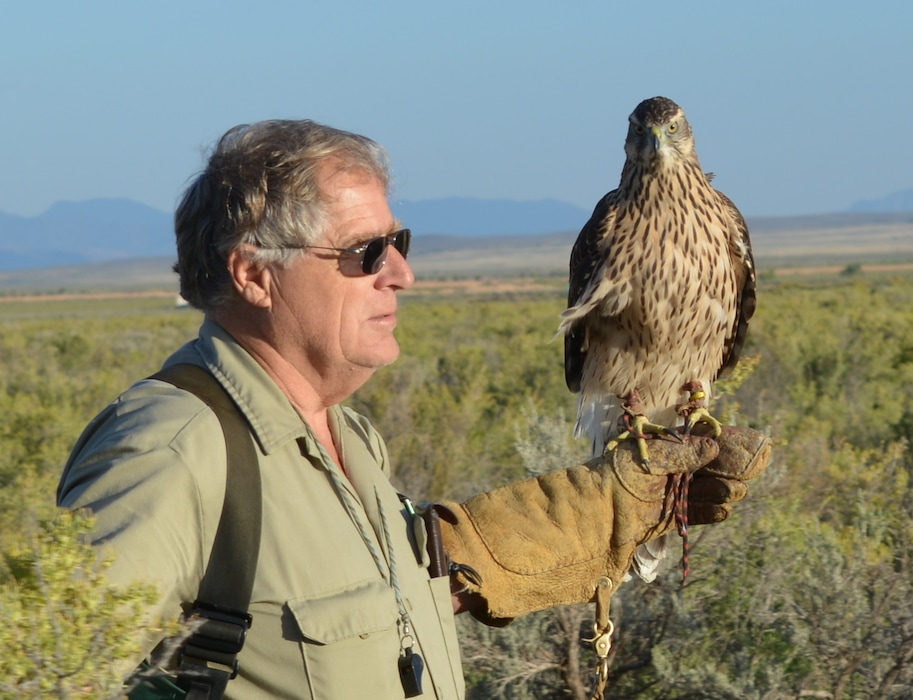
(Janet Tyner) Martin Tyner hunting with a goshawk named BG, Saturday, Sept. 10, 2016.
Tyner’s passion for birds and wildlife rescue took wing at age 9 when his family moved from Los Angeles to rural Simi Valley, California. By 16, he was working for Hubert Wells, a multi-generational Hungarian falconer and owner of Animal Actors of Hollywood. Wells became a father figure, teaching Martin the art of falconry.
At 19, Tyner became the curator of birds of prey at Busch Gardens in Van Nuys. The job came with unique perks: Singer John Denver would occasionally drop by before the park opened just to hang out and help him feed the eagles.
Forty-eight years ago, Tyner married his wife, Susan. In the late 1970s, they relocated to Enoch, Utah. While working full time, he devoted his spare hours conducting wildlife rescue and educational work. Susan, meanwhile, ran the couple’s pet store and dog-grooming business in Cedar City.
Alas, Tyner recalls, the profits from their business were not enough to offset the costs of his wildlife work, and he told Susan he would give it up rather than see the family suffer.
“I told him that I was not going to let him stop because the man I married cares for sick, injured and orphaned wildlife,” Susan Tyner said. “It’s part of why I fell in love with him.”
Instead, the Tyners cobbled together $6,000 to set up his rescue work as a federally recognized nonprofit, which allowed them to accept donations and put the family on more solid financial footing. He also took his falconry to a higher level.
Tyner dreamed of training a wild golden eagle to hunt, but he soon ran into roadblocks. A U.S. Fish and Wildlife official told him he would “never have an eagle for falconry, not in this lifetime or the next,” Tyner recalled.
After spending years navigating a labyrinth of state and federal permits, Tyner was given permission to trap his first golden eagle. Under strict official supervision, Tyner says he captured Bud, a “depredation” bird that posed a threat to livestock, on lambing grounds just west of Kanarraville.
“I was the first person in North America licensed to trap and train a wild golden eagle in falconry,” Tyner says.
‘I’m a good dog’
(Janet Tyner) Martin Tyner holds a prairie falcon at a school program during a school program on Thursday, Jan. 10, 2019.
Training Bud wasn’t easy. It required an ancient technique called a “falconer’s wake.” Tyner remembers sitting awake in his basement with the wild eagle on his glove for 72 straight hours until the bird lost its fear and accepted food. That was followed by “manning,” or making the raptor to familiar with humans so it could focus on hunting.
“I do not own the golden eagles and other birds that I fly,” Tyner emphasizes. “They fly free, and they can fly away. They come back because I’m a really easy way to get food. In our relationship, I’m the dog. I flush out the jackrabbits for them.”
But flying a wild eagle like Bud, which can dive at speeds of 150 mph or more, can be incredibly dangerous. Tyner recalls Bud getting confused during one hunt when he threw out the bird’s toy, sending the raptor into a steep dive. Unluckily, he says, his arm, not the toy, turned out to be the target.
Tyner remembers waking up face down in the dirt six feet away with the eagle standing over him. The impact dislocated his shoulder and severely injured his back and knees.
“That experience gave me knowledge,” Tyner says. “I now know exactly what is going through a jackrabbit’s mind just before an eagle kills it.”
Heartbreak and legacies
(Mark Eddington | The Salt Lake Tribune) Martin Tyner standing outside Enoch Wildlife Rescue, on Tuesday, May 19, 2026. Tyler founded the nonprofit in Enoch.
The pair’s 15-year partnership on hunts, Boy Scout Court of Honors and other events took a tragic turn in September 2005 when the mighty bird and beloved educational ambassador succumbed to West Nile Virus. Tyner says it was a “cruel and painful death.”
“The only thing that brought Bud any comfort was for him to lie in my lap, to feel my touch and to hear my voice,” Tyner wrote in “Healer of Angels,” a memoir he co-authored with Susan. “In all my years as a wildlife rehabilitator, I have rescued hundreds of eagles and returned them to the wild, but I couldn’t save Bud. This was the first time in my life that I ever heard an eagle cry.”
Tyner said he trapped Scout, another depredation golden eagle who is larger than Bud, in Wyoming the following year. The duo celebrated their 20th anniversary this year with a livestream on YouTube. Just like his predecessor, he says, Scout is an avid hunter and a celebrity at educational events.
The raptor, Tyner expounds, knows he is the star and will start making little noises if he thinks his partner is spending too much time with other birds at shows. Scout, he adds, also likes to lean toward him so he can pet and preen the eagle.
Each morning, Scout whistles for his longtime friend to come give him a hug. At 70, Tyner worries about how much longer he’ll be able to answer the call — not only from Scout, but from the injured and orphaned wildlife that still arrive at his door.