 Jordan Miller
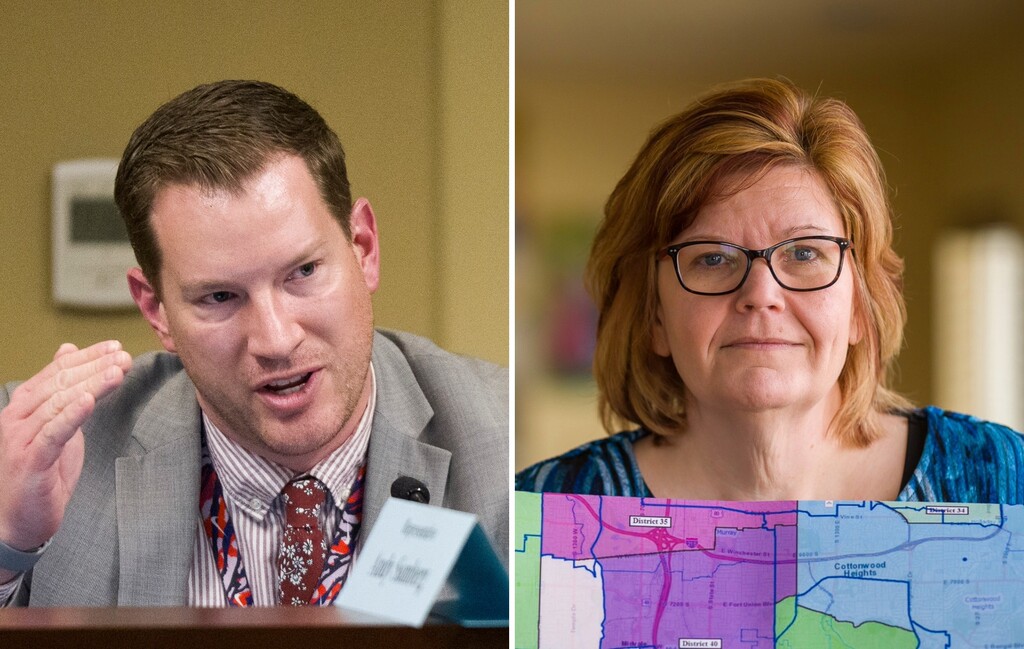
Democratic incumbent Andrew Stoddard will seek to fend off a challenger in House District 40’s primary.
Stoddard has represented the district — which encompasses Midvale and parts of Murray and Sandy — since 2019. His opponent in the Democratic primary, Wendy Davis, chairs the Sandy citizen committee and previously served as an officer for the district’s Democratic Party.
The Salt Lake Tribune posed the following questions, based on a reader survey about the issues Utahns felt were most important this election season, to each of the four candidates. Their answers — listed in alphabetical order — may have been edited slightly for length, style or grammar.
A plurality of voters, more than 30%, said elected official corruption is the primary issue driving who they’ll vote for, with another nearly 14% of voters saying it is their second-highest issue. Why are so many Utah voters concerned about corruption in politics? How will you build trust with Utahns?
Davis: Knocking on hundreds of doors, the number one issue voters raise is the data center in Box Elder County. This has galvanized voters because they believe politicians will receive personal gain for enabling this deal — that’s the definition of corruption.
How do you gain trust? I’m a political newcomer, not beholden to coalitions or political friendships. My sole focus is representing voters; showing up, listening, and advocating for them. I’ll build coalitions with community experts and municipal leaders. I’ll be transparent, honest and work hard. Trust must be earned. That’s where I’ll start.
Stoddard: Voters have watched legislators break their trust repeatedly by overriding voters’ best interests, focusing on petty politics rather than on real issues, and engaging in backroom dealmaking and dark funding. I’ve spent my career pushing for accountability, namely in laws requiring new ethical standards for the [attorney general], fair vacancy procedures, and transparent governing. Trust is built through consistent action over time, not empty promises. I’ll continue what I’ve always done in the Legislature: vote in the best interest of Utahns, and always remain accessible to my constituents.
After corruption, more than 16% of Utah voters said everyday affordability — like the cost of housing, groceries, gas, etc — is the first thing on their minds as they vote this year. Another 15% said it is their second-highest issue. What will you do to help make life more affordable for Utahns?
Davis: It is unconscionable that private companies and citizens hold fundraisers to reduce school lunch debt. I will advocate for free school lunch for all of Utah’s children. I went hungry because my mom couldn’t afford school lunch. We can solve this.
We can also relieve families by fully funding childcare. New Mexico did this last year, and Utah has similar options. We need brave lawmakers who care more about families than their own self-interest. Alleviating these burdens allows folks to redirect money to costs like rent, gas and groceries.
Stoddard: The core issue of housing affordability is supply; we need more units at more affordable price points. The state needs to partner with cities to reduce barriers to construction, focus on transit-oriented development, and find solutions beyond middle-density housing. On groceries and gas, the state government has limited tools, but we can stop making things worse. I opposed tariff policies that raise consumer costs, and I support keeping taxes low where cuts are justified. It’ll take work on multiple fronts and collaboration between local and state governments to achieve meaningful outcomes.
Utah has experienced drought for much of the last two decades. The availability of water is the third-most-pressing issue for voters this year. What can elected officials do to ensure Utahns have enough water for the future?
Davis: We need a comprehensive water plan involving every level of government: federal, state, and local. It must address commercial, residential, governmental and agricultural usage. We should incentivize conservation and penalize overuse. Structured pricing tiers with steep escalators for high consumers are necessary; I know that’s unpopular, but collective action is required.
We must also invest in agricultural water infrastructure to identify and fix what we’re losing to aging systems. We have options. We need the political will and collective action of the entire state to get this done.
Stoddard: I supported Great Salt Lake legislation this session that ensures conserved water reaches the lake. We can expand solutions to include tiered pricing that rewards conservation without punishing household usage, and create financial incentives for agricultural use to adopt efficient irrigation and transfer conserved water. The state should use every tool available across grants, technology and water markets because mandating conservation alone won’t address the dire state of the Great Salt Lake.
Should the state continue to pursue nuclear energy? What can be done to address Utah’s growing energy needs?
Davis: Yes. Utah needs a balanced energy portfolio. In a state facing ecological crisis; extreme drought, rising temperatures, and shifting seasons, the rules are being rewritten. We need progress, but not at any cost.
We need sustainable energy sources like wind and solar without eliminating alternatives like nuclear, which has operated safely in this country for decades. We must also make clean energy affordable for homeowners. That will take cooperation between public, private and nonprofit sectors.
Stoddard: Yes. Utah can already source solar and wind with the natural resources we have, and I believe nuclear energy is another potential solution to our energy needs. The scalable and safer designs that have evolved in nuclear energy are investments worth empirical study from the Legislature to understand what usages will maintain the sustainable energy infrastructure we need for the future. Understanding the best long-term investment is critical to ensure that what we’re prioritizing is actually reliable, affordable and clean.
In 2018, voters narrowly passed the Better Boundaries initiative, creating an independent redistricting commission and prohibiting partisan gerrymandering. The Legislature’s attempts to significantly weaken the Better Boundaries initiative spawned years of litigation, culminating in a court adopting new congressional boundaries. Who should be responsible for drawing Utah’s political boundaries? Why?
Davis: This is personal for me. After narrowly losing my 2020 legislative race, I was gerrymandered out of a rematch. I wrote about it in my memoir. I voted for Prop 4; it doesn’t matter how narrowly it passed. It passed.
Per the original intent of Proposition 4, an independent commission should draw and recommend maps; the Legislature can fulfill its constitutional obligation by selecting one. Self-interested politicians cannot objectively draw their own maps, nor should they.
Stoddard: The independent redistricting commission was the elected decision of voters, because we can’t rely on legislators to control the boundaries of their own seats. I’ve spoken out against every attempt to gut this initiative. Voters and voting data should indicate how our legislative districts are drawn. The transparent process and enforceable standards that Utahns asked for have been evident in the recent redistricting we’ve seen in the new congressional boundaries, and that’s thanks to the standards brought forth by the commission.
Is there an imbalance of power between the Legislature and the courts? If so, what should be done about it?
Davis: Respectfully, the executive branch is part of this problem, too. Checks and balances are misaligned because our governor won’t check the legislature; he agrees with them on most things. When the last check is the judiciary and the legislature seeks to dismantle their power, we are in a crisis. We may not know how deep, but we are squarely in it.
The judiciary must be treated as an independent branch. The other two must cease their power grabs, intimidation and legislative retribution. Litigation may be our only remaining tool to fight this imbalance.
Stoddard: There’s an imbalance, and our courts continue to be targeted. In this past session alone, there were at least 10 bills focused on the judiciary, including the new constitutional court, which allows the legislature to route cases as they see fit. Courts interpret the law; they’re not meant to deliver outcomes the legislature prefers. I’ve opposed every one of these measures because, as a prosecutor, I recognize the importance of reliable, unbiased courts. To restore balance, we need to end structural changes and allow courts to function as intended.
What do you believe is the most pressing issue before voters this year? What can be done to address it?
Davis: Voters in my district are talking about the data center and affordability; I’ve addressed both in the survey.
I’ll conclude with this: our leaders boast we are the best-run state with the best economy. I’d challenge any one of them to knock doors in the heart of the Salt Lake Valley and hear what working families say. We worship professional sports while kids go hungry. Utah is ranked as the worst state for women. Summit County has some of the most expensive homes in the country while others face homelessness. Let’s be honest about who we are. That self-reflection can lead to real change.
Stoddard: Democratic accountability is our most pressing issue. The corruption, gerrymandering, overriding of citizen initiatives, and restructuring of the courts are all sub-issues that fall within the accountability voters want. Every issue beyond these (water, housing, healthcare, etc.) is even harder to address when the people making the decisions aren’t being held accountable. I’ve spent eight sessions pushing for transparency and fair processes because good policy starts with accountable government.