 Sean P. Means
Lee este artículo en español aquí.
The planes seem to come through Salt Lake City International Airport on a fairly routine schedule — twice a week, on Monday and Thursday mornings, usually landing around 10 a.m. and taking off by noon.
People in handcuffs and ankle restraints boarded at least two of them in recent months, Salt Lake Tribune journalists have observed.
But U.S. Immigration and Customs Enforcement would not confirm any details about what it calls “removal flights,” citing “operational security concerns.”
Since the start of the year through April, 46 such “removal flights” have stopped at Salt Lake City’s airport — 12 in January, 13 in February, 12 in March plus nine in April, according to Human Rights First. The nonprofit compiles data on ICE flights to detention centers within the U.S. and deportation flights out of the country.
That’s down somewhat from a peak of 18 ICE flights moving through Salt Lake City’s airport last December, according to Savi Arvey, who runs the nonprofit’s ICE Flight Monitor.
The Monday-and-Thursday pattern emerged when The Salt Lake Tribune independently reviewed March, April and May flights through the flight-tracking website ADS-B Exchange.
How many people ICE is moving out of Salt Lake City is difficult to determine. For one recent flight, a Salt Lake Tribune journalist observed some 40 people, cuffed and shackled, being moved from windowless white vans and up the steps of a plane.
(Chris Samuels | The Salt Lake Tribune) A collage shows detainees believed to be in the custody of Immigration and Customs Enforcement board a plane at Salt Lake City International Airport, Monday, April 6, 2026.
Gloria Cardenas, a Taylorsville immigration attorney, said ICE flights have come through Salt Lake City for years, usually once a week.
What’s new, she said, “is the amount of flights will likely increase because of the use of ‘expedited removal’” under President Donald Trump.
When ICE moves a detained person, Cardenas said, the agency won’t tell anyone ahead of time, including family members and attorneys. ICE cites “security purposes” for that policy, she said.
“If I represent a client in Salt Lake City, I have to move quickly to keep them here,” Cardenas said. “If I don’t, then they are going to [get] their transfer somewhere else, and we won’t know until they get to that next location.”
The ICE flights through Salt Lake City that The Tribune reviewed mostly arrived from Mesa, Arizona. There have been four exceptions — one from Harlingen, Texas, on March 12; a late-night flight from Boston on April 16; and two from El Paso, Texas, on May 14 and 21.
The Monday flights have all left Salt Lake City for the Southern California Logistics Airport in Victorville, California. It’s a former U.S. Air Force base near Los Angeles, now used for business, military and freight aircraft, relieving pressure from the busy LAX.
From Victorville, the Monday flights then travel to El Paso, a border city on the Lone Star State’s far western tip, across the Rio Grande from Juarez. ICE maintains two facilities near El Paso and a neighboring U.S. Army base, Fort Bliss. One of those facilities is the massive Camp East Montana, where some 3,000 immigrants are detained and three have died, NPR reported in April.
The Thursday flights usually come from Mesa, then leave Salt Lake City for Harlingen, Texas, on the southern end of the state in the Lower Rio Grande Valley. ICE’s Harlingen field office oversees seven detention facilities in the valley, according to the agency’s website.
What we know about the planes
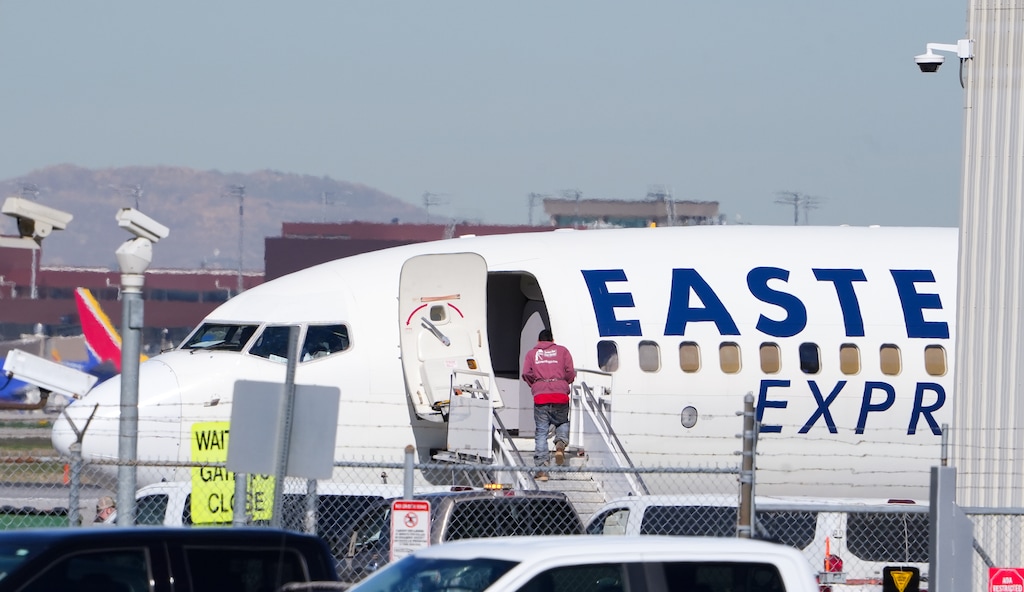
(Bethany Baker | The Salt Lake Tribune) Steps lead up an Eastern Air Express plane and U.S. Immigration and Customs Enforcement flight at Salt Lake City International Airport on Monday, March 23, 2026.
Many of the flights The Tribune reviewed were Eastern Air Express planes, though more from Global Crossing Airlines, or GlobalX, have been landing at and taking off for these flights out of Salt Lake City since mid-April.
According to ICE Flight Monitor’s April report, Eastern Air Express, a charter airline based in Kansas City, Missouri, had 10 of its planes flying ICE missions last month. In the last year, Eastern has received $43.5 million in a contract with the Department of Defense, according to a contract database. The contract is with the defense department’s U.S. Transportation Command.
GlobalX, based in Miami, had 13 planes running ICE flights in April, the ICE Flight Monitor report said. GlobalX is a subcontractor for CSI Aviation, which has a contract with the Department of Homeland Security worth $65 million a year, according to The Athletic. (GlobalX also provided flights for college basketball teams for the NCAA Final Four, The Athletic reported, sometimes putting players and coaches on the same planes that later carried detained people.)
Spokespeople for Eastern Air Express and GlobalX did not respond to requests for comment.
Arvey said the ICE flights moving through Salt Lake City mostly shuttle detained people to other U.S. locations. The alternative, deportation flights, usually take off from four airports, Arvey said: Mesa; El Paso; Harlingen; and Alexandria, Louisiana.
Since January 2025, when Trump returned to the White House, Arvey said the ICE Flight Monitor — launched in 2020 by retired journalist Tom Cartwright — has noticed an increase in both the number of ICE flights and the number of cities where flights are visiting.
The monitor first tracked ICE flights coming through Salt Lake City in March 2025, she said — tallying 99 flights from March through December. If ICE’s pace continues, based on the monitor’s figures, Salt Lake City could see around 140 ICE flights this year.
The monitor also spotted seven ICE flights going through St. George’s airport in April. Some of those, according to The Tribune’s review, made stops in Mesa, Seattle and Twin Falls, Idaho.
Arvey said it’s “hard to speculate” how many more ICE flights may come through Salt Lake City should a proposed detention center open in the large warehouse the agency quietly bought near the airport in March.
ICE flights are tiny part of airport traffic, official says
(Trent Nelson | The Salt Lake Tribune) The air traffic control tower at Salt Lake City International Airport on Thursday, Nov. 6, 2025.
The ICE flights that come and go through Salt Lake City represent a tiny fraction of the airport’s traffic, said Treber Andersen, the airport’s director of operations.
The airport typically handles between 300 and 350 commercial departures each day, according to its 2025 financial report.
The ICE flights are considered part of the airport’s general aviation service, and take off and land on the airport’s east side, away from the commercial travelers who use the airport’s terminals.
General aviation represents just a sliver of the airport’s total revenue. According to the airport’s fiscal 2025 financial report, general aviation brought in around $4.66 million, or just 0.7%.
Andersen said the airport leases its general aviation space to two companies, called fixed-base operators or FBOs, that provide ground services for planes outside of commercial travel. That covers charter airlines, small-engine aircraft, medical vehicles and the military, including the Utah Air National Guard.
The airport has little say over what happens in general aviation, as long as it’s legal.
“Generally speaking, if there’s an aviation activity that somebody wants to do, it’s really hard for airports to restrict it,” Andersen said.
An exception is made for actions that could affect airport operations. For example, skydiving excursions aren’t allowed near the airport, he said, because of the concentration of commercial flights nearby.
In a statement, an ICE spokesperson said that “removal management is a complex process that requires careful planning and coordination with a wide range of domestic and foreign partners, such as local government authorities, contract commercial air and charter service providers, and foreign embassies.”
“The Trump administration is committed to restoring the rule of law and common sense to our immigration system, and will continue to fight for the arrest, detention, and removal of illegal aliens who have no right to be in this country,” the statement concluded.
Arvey said monitoring ICE flights offers “transparency and an understanding of this administration’s detention and deportation campaign.”
“We provide information to attorneys, to family members, to people trying to find their loved ones on a daily basis,” she added.
Sean P. Means has been reporting and editing for The Salt Lake Tribune since 1991 — including 25 years as movie critic. Since 2018, he has reported on arts and culture reporter, and breaking news — and was part of The Tribune’s COVID-19 reporting team. He reviews movies for MovieCricket.net and X96’s “Radio From Hell” program.