 Tony Semerad
Ranchers in Box Elder County seem to be coming down on all sides of the massive data center project planned on 40,000 acres of Hansel Valley rangelands.
And in the starkest of contrasts, many of them point to elements of a frontier way of life that survives in the rural county today, only now, potentially juxtaposed with a huge and powerful symbol of the world’s technological future.
Utah House Speaker Mike Schultz, himself a rancher on acreage not far from the Hansel Valley site, voiced concerns last week about the potential environmental impact of the proposed hyperscale data center project, saying that, “like all the other ranchers in the area, I don’t love it.”
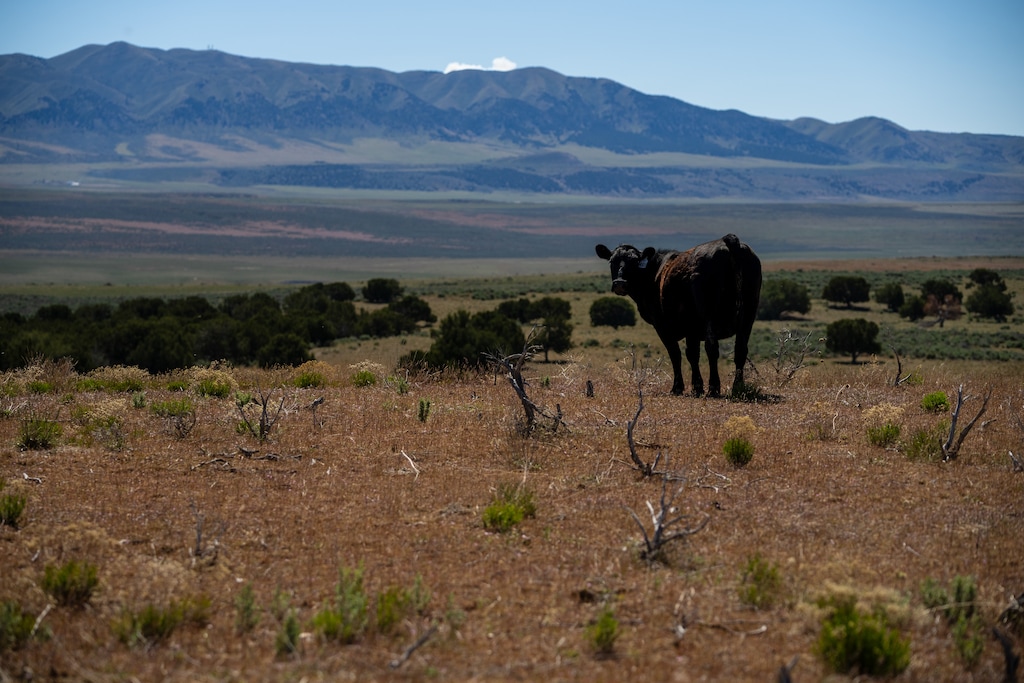
(Trent Nelson | The Salt Lake Tribune) Hansel Valley on Friday, May 1, 2026.
But some large private landowners in Box Elder County — from families that have run livestock over the area’s harsh and barren salt-desert ecosystems for more than a century — say they are part of the project out of a belief that it could help keep their ranching heritage alive.
That motivation, along with prospects of economic development and a strong patriotic nod to the mission of Utah’s Military Installation Development Authority, or MIDA, is among key reasons why they say they are contributing portions of their land to the project.
“Money isn’t the object,” multigenerational rancher Tim Munns told county commissioners in mid-April as the Stratos deal was first presented in an open hearing.
[Read more: Timeline: How the Kevin O’Leary data center plan came to be, and what’s happened since]
“We want to just continue doing what we’re doing. We’re happy with what we’re doing,” he said. “But like I said, change is inevitable. Progress is going to come.”
Munns, who has worked ranch lands in Hansel Valley for 49 years, now with two sons, said they’ll give up less than 5% of those acres toward the sprawling project, as a way to keep the rest going as it is. He said the U.S. military’s involvement through MIDA was a tipping point in favor. The project is expected to pay for modern buildings at Hill Air Force Base.
“We are on the team,” he said. “We are on board with the project.”
‘Not happy about it’
(Christopher Cherrington | The Salt Lake Tribune)
Interviews with adjacent landowners, meanwhile, reveal that many have been assured they will retain the ability to operate their ranches and hold onto key grazing rights even while Stratos ramps up its many proposed phases.
And as you might expect from folks who’ve driven cattle and sheep on desert scrublands, many are worried about the effects on water in the region.
“We’re not happy about it,” said Brett LaMont, who is not part of the project but whose family owns land right next to the 40,000 acres of private land MIDA is including. He said the water well serving his property is 680 feet deep.
“It doesn’t get much rainfall. There are no rivers out there, no creeks,” LaMont told The Salt Lake Tribune of his land, adding that he was concerned about a lack of transparency on where, exactly, water will come from for Stratos.
A devotion to ranching in Box Elder County has motivated other landowners to turn down offers to buy their land from celebrity investor Kevin O’Leary and his partners.
(Trent Nelson | The Salt Lake Tribune) Hansel Valley on Friday, May 1, 2026.
LuAnn Adams, whose family operates a historic ranch in the Salt Wells area and has younger generations ready to take the reins, said the money they were offered couldn’t buy adequate replacement range for wintering their livestock.
Adams is among a lot of ranchers and adjacent property owners who are raising questions about Stratos’ long-term effects on the area’s water tables and air quality, as well as on traffic along rural roads and potential noise.
Adams and others are also pointing to the potential impacts of up to 2,000 new data center employees traveling on existing roads that cut through the rangeland, including Salt Wells Road, which residents say has many dangerous blindspots.
“We’re not interested in selling our property this time,” Adams said at an April 22 meeting, “and we want to be protected for what we have in the future.”
‘Keep running our cows’
(O'Leary Digital) Renderings of a proposed data center project to be constructed in Box Elder County. The project is backed by celebrity investor Kevin O'Leary.
Some area property owners are similarly skeptical, warning that Stratos might ultimately push ranching and a traditional way of life to the margin. That includes Dustin Mills, a fourth generation rancher in Hansel Valley.
As Stratos moves into the county, Mills wondered, will longtime open rangelands have to be fenced to avoid road collisions with livestock? And what if the massive project drives up prevailing values on land that is only marginally supported by agriculture today?
“It’ll drive the next generation off the ranches because they can’t afford to stay there,” Mills predicted at the hearing in April. “As a county, as we look at our heritage and our culture, we need to consider that.”
Still, other nearby landowners welcome the regional economic lift Stratos could bring and say they are not opposed to a data center locating close by their spreads. And with MIDA’s involvement, they’re also supporting the data center’s perceived mission with a sense of patriotism on behalf of the U.S. military.
Randy Moulding, a landowner with 16,000 acres in the area, said that while much crucial information is still lacking on the project’s details, “it’s going to bring a lot of good-paying jobs and stuff like that. And if we really need it to stay ahead of China, I am all for it.”
A key point project backers are pitching is its potential to help keep the United States competitive with China in the artificial intelligence race.
(Trent Nelson | The Salt Lake Tribune) Hansel Valley on Friday, May 1, 2026.
Like many area residents, Moulding and fellow adjacent landowner Jay Stocking learned about the project only about a week before it steered toward public approval. Stocking, who ranches on about 7,500 acres in Box Elder County, some of it abutting the Stratos project zone, first caught wind of it on social media.
He said he does not share a sense of controversy that some do over the potentially immense campus.
“I own a piece of property out there that’s bigger than the city of Tremonton, and we’re not that concerned about it,” said Stocking, noting what he described as “a lot of misinformation” about Stratos and its goals.
Maybe it will bring better roads, Stocking said. Either way, “we’ll keep running our cows.”