 Paighten Harkins
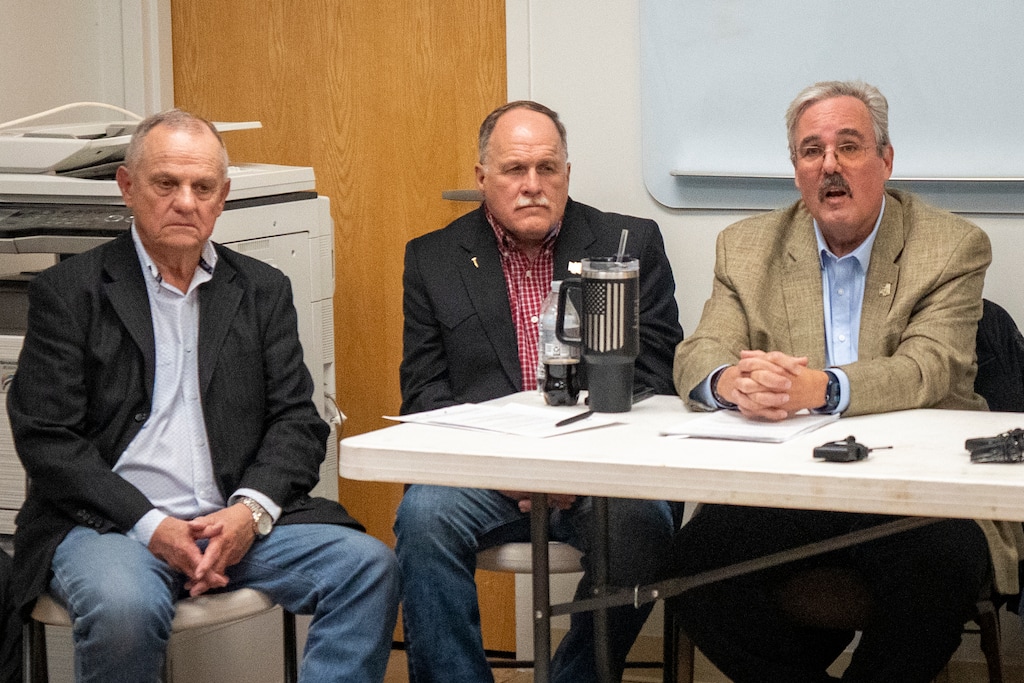
The controversial “hyperscale” data center project planned for Box Elder County has launched the sparsely populated county on the Idaho border into national consciousness — along with its trio of cowboy-hat-wearing commissioners.
The commissioners are in charge of county decision-making, including managing the budget, providing services and deciding land use and zoning and have faced much public scrutiny since approving the massive energy and data campus plan.
The group serving the county includes Boyd Bingham, a farmer and rancher with ties to various grazing and other related trade associations; Lee Perry, a former lawmaker now working at a multinational technology, infrastructure, engineering and defense firm; and Tyler Vincent, a longtime car shop owner and former city council member and mayor.
They voted earlier this month to give consent for the Military Installation Development Authority, or MIDA, to create the Stratos project area across 40,000 acres of unzoned land in the western part of the county. The developer, celebrity investor Kevin O’Leary, plans to build a massive data center campus that at full build-out would use more energy — powered through a nearby natural gas pipeline and perhaps other renewable sources — than the entire state and, scientists say and locals fear, could have disastrous consequences on the local environment.
(Rick Egan | The Salt Lake Tribune) An audience watches the Box Elder County Commission meeting on a video screen at the county fairgrounds in Tremonton on Tuesday, May 4, 2026.
Locals have starkly opposed the data center, with many citing environmental concerns.
While The Salt Lake Tribune sent the commissioners a set of questions about the project, any conflicts they may have and their approach to governing, they were not made available for interviews and did not respond to specific questions.
The group has gone dark, and the sheriff’s office has increased security around their homes in case of potential protests. Their photos, each of them sporting white cowboy hats in portraits hosted on the county’s website, have been taken down and, a spokesperson for the county told The Tribune, they “are no longer doing interviews” until the project “moves forward in a significant way.”
Instead, the county provided a written statement that echoed much of the information already publicly available on the county’s website.
The commissioners, the statement read, first heard “rumors and speculation” about the project from landowners and other stakeholders in March.
“[O]ur initial reaction was that a project of this scale seemed unlikely,” the statement read. Toward the end of March, a landowner contacted them directly about the data center project. The first formal confirmation came from MIDA on March 25, they said.
The statement indicated that the commissioners, like their constituents, had questions about “water resources, power infrastructure, landowners, and quality of life.” The commissioners assert they had limited developmental oversight of the “privately owned, unzoned land,” and, to avoid the project going forward through other means, tried to use their yes vote to establish “guardrails” to protect the county.
The statement also included a blanket denial of any conflicts:
“None of the commissioners or their families has any personal financial gain connected to the Stratos/MIDA project. Their businesses/employers are not participants in the Stratos/MIDA project. The commissioners’ decisions are not being made for personal benefit, but for what they believe is in the best interest of Box Elder County, its residents, and future generations.”
Here’s what we know about each commissioner, based on what the county has shared, their statements disclosing potential conflicts of interest, past news coverage and other sources:
Boyd Bingham
(Box Elder County) Boyd Bingham
Voters elected Bingham, a Republican, to County Commission seat A in 2022. He beat now-fellow commissioner Vincent in the primary election that year, and later handily beat his Democrat challenger with more than 80% of the vote. He previously served as Honeyville mayor for five years.
Bingham is a self-employed rancher and farmer, and serves on the board of directors for Western Ag Credit, an agricultural industry lender, according to his disclosure statement.
He owns Earl L. Bingham Ranch LLC. and 7/11 Ranch LLC and manages the sheep range land owned by B.A. Bingham & Sons LLC, as well as 7/11 Ranch Trucking LLC., which hauls livestock, according to the disclosure document.
His disclosure statement lists stocks or bonds worth more than $5,000 in the following associations: the Idaho-based Gentile Valley Cattle Company, the Eastern Idaho Grazing Association and the Springfield Cattle Co.
In a 2023 interview with Western Ag Credit’s trade magazine FenceLines, Bingham was quoted, describing his philosophy on land use and “preserving agriculture and rural living.”
“I feel like there’s a lot of pressure on the ag culture in the state of Utah to develop all this culinary water and put homes on this amazing farm ground,” he said. “The only reason I’m really involved in any of this is I’d like to see ag preserved. I think we’re crazy if we don’t. If we can’t provide for our own.”
He didn’t respond to The Tribune’s questions about how his views have or haven’t changed since he extolled preserving land for agriculture three years ago.
During the well-attended May 4 meeting where commissioners ultimately voted to support the Stratos project, despite overwhelming and vocal crowd disapproval, Bingham told attendees: “For hell’s sake, grow up.” The commissioners soon left the room and continued the meeting virtually, away from the raucous crowd.
When The Tribune asked additional questions about Bingham’s connections to grazing and agriculture associations, and whether any of those members have property within the Stratos project site, the county issued the following statement:
“The statement we sent on behalf of all the commissioners is the statement they shared, and until the project moves forward in a significant way, they are no longer doing interviews for now.”
Bingham has filed for re-election this year. Vance Smith, a Republican, has also filed to run.
Lee Perry
(Box Elder County) Lee Perry
Perry ran uncontested in the general election to secure County Commission seat B in 2022.
A Republican, he served in the Utah House from 2011 to 2020, representing parts of Box Elder. He served on various committees, including serving as chairman of the House Law Enforcement and Criminal Justice Committee.
He also worked for the Utah Highway Patrol for 31 years, stepping down in 2020, a few months before he announced his retirement from the Legislature. Many of the bills he sponsored focused on public safety.
When he left the Legislature, he started a job with Parsons Corp., a large defense and infrastructure contractor based in Virginia, but which has offices in Sandy.
Parsons boasts that it is “at the forefront of delivering mission-critical data center projects across various industries, such as telecoms, internet, insurance and financial institutions, energy and infrastructure.” Its website specifically mentions being able to cater to the “unique needs of hyperscale data centers.”
Perry still works there as a traffic incident management specialist and trainer, his disclosure form states. That unit works with law enforcement, tow providers and federal highway officials to more efficiently clear traffic incidents, according to its website.
Parsons also recently announced it had been selected as one of 10 firms that can bid on projects to renovate Hill Air Force Base as part of a $136-million design contract.
Stratos project supporters have said the data center could help fund updates at Hill Air Force Base.
Representatives for both MIDA and Hill Air Force Base said the design contract was unrelated to the Stratos project. No one from Parsons responded to The Tribune’s request.
The county did not directly respond to The Tribune’s follow-up questions about Perry’s connections to Parsons and sent the aforementioned statement noting commissioners “were no longer doing interviews.”
Perry had said previously: “There is no one on this commission or any other county elected official that is going to benefit from this project, financially or otherwise.”
Perry is also a board member on the Utah County Indemnity Pool and the Utah Association of Counties. He mentioned in the disclosure statement that a relative who works for the county but is overseen by another commissioner.
Perry has filed for re-election this year. Republican Nathan Tueller and Erin Zilinski, with the Constitution Party, have also both filed.
Tyler Vincent
(Box Elder County) Tyler Vincent
Vincent, a Republican, ran unopposed in his campaign for County Commission seat C in 2024, garnering more than 20,000 votes, despite write-in challenger Sam McMurdie securing more than 5,700 votes, election returns show.
Prior to working as a commissioner, Vincent was the Brigham City mayor from 2014 through 2021, and was on the City Council for three years prior.
He is the third-generation owner of Burt’s Autobody. He received $5,000 or more last year from the county for repairing vehicles, according to the disclosure document.
While Brigham City mayor, he served on the Bear River Association of Governments.
About the Stratos project, Vincent has said: “We need to realize and remember that everybody has property rights, and that they can do what they would like to do with their property.”
Paighten is an Enterprise reporter at The Salt Lake Tribune. She covers a variety of topics, including business, health, growth and the legal justice system — sometimes all at once. She is from southern Oklahoma, and lived and worked in the state, most recently at the Tulsa World, before starting at The Tribune in October 2017.