When George Matus Jr. was a high schooler in Sandy, he was already meeting with Department of Defense officials at Hill Air Force Base. His innovations had made drones capable of traveling unheard-of distances and caught the military’s attention.
Now 28, Matus has spent more than half his life thinking about drones. He has transformed from a kid obsessed with remote-controlled aircraft, who hoped to show the benefits of drones in everyday life, to one of Utah’s most prominent defense-tech founders.
His company’s signature drone can detect threats miles away, travel more than 10 miles through the air and hit a top speed of 100 mph. They cost about $2,000 — and can destroy a tank that costs millions.
Matus’ rise has aligned with a disruption in how wars are fought, a stark reality seen on battlefields in Ukraine and Iran. The U.S. military is now requesting tens of billions of dollars to quickly amass hundreds of thousands of drones to prepare for modern battlefields, where Matus predicts front lines will not be dominated by tanks, missiles or even soldiers, but swarms of these buzzing airborne assassins.
Some models are fast and nimble, made from cheap components because they are meant to crash into targets and explode. Others drop mines. Some are used for surveillance.
At Matus’ latest company, in Bluffdale, they are cranking out about 1,000 a month, and have secured contracts with the military, $61 million in venture funding and an additional $20 million loan to make more.
This moment in military technology, Matus said, is akin to the advent of muskets or rifles. “You’re not fighting with swords anymore,” he explained.
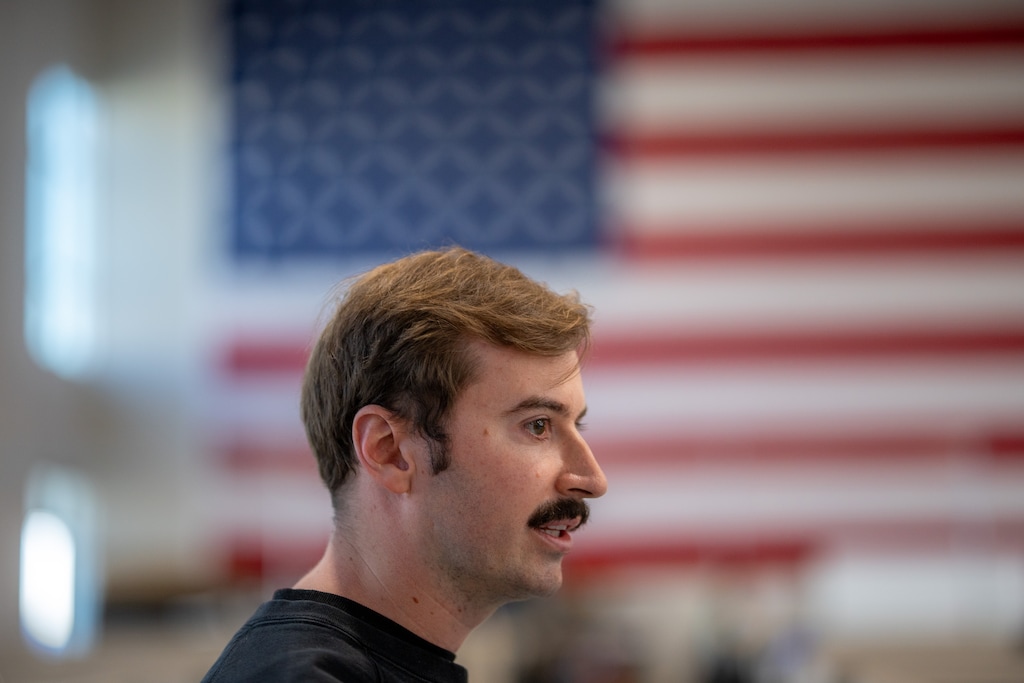
(Trent Nelson | The Salt Lake Tribune) George Matus at Vector Defense in Bluffdale on Thursday, April 30, 2026.
Critics argue that making warfare cheaper and more scalable can lower the threshold for conflict. The idea of mass-produced, expendable drones also raises ethical questions about how easily violence can be deployed when the cost drops.
But it’s also personal for Matus, whose family hails from Slovakia, which shares its eastern border with Ukraine. His first language wasn’t English but Slovak. That the war could creep across that border is front of mind, he said, as well as his fears about the U.S.’s dwindling stockpile of missiles and bombs — and the cost to replace them.
“I was raised being told America can fight two world wars and win both of them at the same time. The more I’ve learned about where we’re actually at, I don’t know that we could even win one,” he said.
“We’re trying to be in the business of helping to safeguard America’s freedom.”
Why drones?
Before the early 2000s, drones were largely associated with military use. A younger Matus hoped to change that.
He discovered his love for flying in the cockpit of planes, where his mother worked as a flight attendant, pre-9/11.
“She’d let me come in and join the pilots mid-flight, and I’d just be in awe at what I was seeing,” he recalled.
“I’ve always had a very obsessive personality,” Matus said. “When I would find interest in something, I would go really deep into it.”
For a while after his mom left that job, those interests shifted to Pokemon and tennis. But he found his way back flying remote-controlled planes. He got his first job, at age 12, as a test pilot for a prominent company.
(George Matus Jr.) At 12, George Matus Jr. poses with a remote-controlled plane in Slovakia.
He called it his “dream job.”
Then his dreams got bigger.
“I just started seeing gaps of what didn’t exist, and realized that maybe I can start building my own thing,” he said.
That led to him creating his own drones, and, eventually, his own company, in 2014, at age 17.
Matus’ vision
Matus first launched that company, Teal Drones — named for the small, agile ducks — with a consumer model.
As a junior in high school, he was accepted into tech-entrepreneur Peter Thiel’s prestigious fellowship that dissuades creators with ideas that “can’t wait” from going to college by funding and supporting their pursuits.
At the time, Pelion Venture Partner investor Ben Lambert was also early in his career, looking for Utah’s next great entrepreneur. Matus’ name kept coming up.
He remembers being impressed with the teen’s vision — and how well he could articulate it.
“When you meet somebody that’s 17 years old, that’s doing that, it just makes you confident in who they can become,” Lambert said.
Indeed, as he built that company, Matus was making headlines in the local and trade press, trying to turn everyday people into drone believers.
(Trent Nelson | The Salt Lake Tribune) Utah Sen. Mitt Romney holds a Teal 2 drone during a tour of Teal Drones in Salt Lake City on Tuesday, Aug. 22, 2023. At left is George Matus.
Nancy Woller, Matus’ senior-year calculus teacher, remembers him well. His senior project featured beautiful aerial shots of the region in Slovakia where his family is from. He saw a larger purpose in those machines even then, she said: “It was to introduce people to his family’s country.”
In 2018, two years after he graduated from Waterford School, he made Forbes’ 30 under 30 list, which noted his “belief is that drones can be much more than flying cameras and should be accessible to everyone.”
In a Q&A that same year, someone asked about the “common misconceptions” people have about drones.
He said they can be “perceived as these intrusive, privacy-infringing, annoying devices.”
“Drones also have the disadvantage of having the military use of them tied to the name,” he wrote.
But this was about the time, he said, that the “trough of disillusionment” hit. Chinese manufacturers were creating drones so cheaply that American companies like Matus’ couldn’t keep up.
Despite his optimism, Teal was “close to the brink” at times, Matus said.
But, in 2017, the U.S. Army announced a ban on Chinese-made drones. Matus soon saw an opening.
He pivoted to building drones for the military, around the same time the Army started searching for suppliers that could build portable, lightweight drones able to conduct critical short-range reconnaissance.
Matus spent the next five years working toward that goal, and in 2024, the Army announced it had selected Teal’s Black Widow. The speedy quad-copter can fit into a soldier’s rucksack and quickly launch when needed.
(Rick Egan | The Salt Lake Tribune) A Teal Black Widow drone at the Red Cat ribbon-cutting ceremony on Friday, April 24, 2026.
During that time, he also made business moves, selling Teal to then-Puerto Rico-based Red Cat Holdings in 2021. He stayed on as Teal’s CEO and was eventually promoted to Red Cat’s chief technology officer.
But, by the time of the Army’s Black Widow announcement, Matus was experiencing some disillusionment of his own, having spent so much time producing drones to the military’s unrelenting standards, many of which he thought were unnecessary.
He wanted to work on something faster paced, something responsive to the real-time needs of service members. Something new.
Matus announced he was leaving Red Cat and Teal for Vector Defense, a startup led by CEO Andy Yakulis.
Yakulis said bringing in Matus was a no-brainer. Despite his age, Yakulis considers him one of the country’s “top experts,” and he had experience building a company to meet defense demands.
“He’s got this very unique, rare sort of blend of going from zero to one, and then one to 10,” Yakulis said.
“I call him the boy wonder,” he joked.
Allegations of ‘lies, sabotage, and subterfuge’
(Trent Nelson | The Salt Lake Tribune) George Matus at Vector Defense in Bluffdale on Thursday, April 30, 2026.
The move from Red Cat to Vector wasn’t, however, smooth. A federal lawsuit followed.
Red Cat alleged Matus was helping build a drone for Vector, called the Hammer, while still employed at Teal and Red Cat, asserting that he and Vector misled Red Cat executives about Vector’s intentions as he prepared to leave.
At the time, while Matus was still Red Cat’s chief technology officer, the company was developing a low-cost, first-person view drone called FANG. They alleged that drone, which was never produced, would have competed with the Hammer.
Red Cat also alleged Matus helped derail a key partnership with a Croatian manufacturing company, and later illegally recruited engineers away from Teal who had been subject to noncompete agreements.
“Matus implemented this plan with calculated precision, believing that through lies, sabotage, and subterfuge, he and his co-founders at Vector could outmaneuver Red Cat/Teal,” the lawsuit alleges.
Matus declined to discuss the lawsuit with The Tribune. In responses filed in court, he denies the allegations. Regarding the FANG, he said Red Cat planned to have a third-party develop that drone, meaning “there would be no Red Cat confidential or trade secret information involved in the design.”
He also points out that the Black Widow, the drone he helped design at Red Cat, and the Hammer are two separate drones — one for reconnaissance and one meant to kill.
“And they compete for different types of contracts,” Matus said in a court filing.
The case is ongoing, but Vector received an early victory in November when U.S. District Judge Ted Stewart ruled against an injunction, citing “significant factual disputes” and a lack of clear evidence as to the damages Red Cat was alleging.
Red Cat officials declined to comment on the lawsuit or Matus, but the company still acknowledges Matus’ role in its story.
In April, when Red Cat announced its new headquarters in South Salt Lake, adjoined to Teal’s existing warehouse, they alluded to Teal’s 17-year-old founder and his “scrappy little startup.”
(Rick Egan | The Salt Lake Tribune) Celeste Maloy, and Christian Morrison Chief Financial Officer at Red Cat Holdings Inc. join Christian Ericson for the Red Cat ribbon-cutting ceremony on Friday, April 24, 2026.
Now that company is the “core product and the core center of who Red Cat is today,” said Chief Operating Officer Chris Ericson to a group gathered outside for Red Cat’s ribbon-cutting.
Stan Nowak, the company’s vice president of marketing, doesn’t shy away, either. Matus is still listed on Teal’s website. Nowak compared it to a superhero’s origin story.
“It was just the perfect foundation for us to get to where we are today,” he said.
Matus told The Tribune in late April that he doesn’t think about the lawsuit much.
“I’m excited for that to be over,” he said, “and be able to get on with building useful things for the country.”
What Vector is building
(Trent Nelson | The Salt Lake Tribune) Vector Defense in Bluffdale on Thursday, April 30, 2026.
As Matus walked through Vector Defense’s massive, 35,000-square-foot warehouse in late April, he wore a big smile on his face, competing for real estate below his thick, lampshade mustache, and a black sweatshirt that he got during the Thiel Fellowship. It read in black font on the front: DROPOUT.
This sprawling, open-floor plan facility dwarfs Teal’s warehouse in South Salt Lake, but there’s some symmetry.
Both feature giant American flags hung from the ceiling. Workers at both build new drones in assembly-line fashion at tidy workspaces.
Vector’s warehouse and its 125 employees produce about 1,000 drones per month.
(Trent Nelson | The Salt Lake Tribune) Vector Defense in Bluffdale on Thursday, April 30, 2026.
Vector has plans to scale up its drone manufacturing capacity to more than 6,000 units per month, Matus said. The plan is to help deliver the weapons at a pace similar to “[a]dversaries like China, Iran, and North Korea,” Vector said in a statement.
But Vector isn’t just building drones. They are building a new way to get them to soldiers quicker through its “warfare-as-a-service” model, supplying not only the aircraft, but also training for how to use them with the ability to quickly modify units as needed.
In the defense-tech industry, Matus sees a three-tiered pyramid of companies. At the top are “defense primes,” like Lockheed Martin and Northrop Grumman, which also have a Utah footprint. They make expensive fighter jets and missiles that are, he said, becoming less relevant.
The second are companies, like his former employer Red Cat, that are “building more relevant and interesting things,” he said, but which are still “quite expensive.”
Then there’s what he and his other co-founders are trying to build at Vector, what the Pentagon refers to as “attritable” systems: Expendable, cheap drones that can be deployed by the thousands and shot down or otherwise destroyed while in the course of duty.
“None of those companies are responsive enough or accommodating enough,” Matus said.
Walking through the warehouse, Matus passed an indoor drone testing area as he headed outside.
There, for now, a large patch of dirt is used as an outdoor testing site. Vector eventually expects to build it out into a 120,000-square-foot facility, where they can produce thousands more drones each month.
As Matus opened a door to show it off, two employees were outside, zipping a Hammer drone across the sky.
A long way from ‘the fun of flying’
(Trent Nelson | The Salt Lake Tribune) George Matus at Vector Defense in Bluffdale on Thursday, April 30, 2026.
Pivoting to the defense industry may not have been Matus’ plan, but his early investor, Lambert, recalls it wasn’t a hard choice.
“You just had to let go of maybe an initial dream,” Lambert said.
James Harris, Matus’ high school robotics coach, has seen the transformation. He remembers a teenage Matus for how “meticulous” he was at “assembling components,” like a bot’s electronics board.
“George was captivated by drones for the fun of flying and for the engineering challenge. He was not a kid with particular military interests,” Harris recalled.
“But that is where the opportunity is,” he continued.
Although Matus does still envision a future where drones have more consumer applications, he said his business ethos are currently grounded in deterrence, patriotism and technological urgency.
Many companies, he said, start out with a military application before offering products to civilians. Think Jeep, or Ray-Ban sunglasses.
One of Matus’ first business pitches was to use drones to deliver packages, he said.
He can picture them becoming as “ubiquitous as your phone” — an “aerial companion” that could one day pick up your groceries, he said, or check on your kids at the playground.
He may one day pivot back.
For now, he is focused on rising to today’s needs, which means scaling up to build battle drones by the millions.
“I think if we don’t do it,” he said, “China will.”
(Trent Nelson | The Salt Lake Tribune) George Matus at Vector Defense in Bluffdale on Thursday, April 30, 2026.