 Jose Davila IV
Ever since the high-profile Glendale Regional Park opened in Salt Lake City late last year, pedestrian safety around the new green space has been a top concern for west-side residents.
Those concerns were realized last month when a 6-year-old was hospitalized after being hit by a truck while riding his bike across 1700 South toward the park.
The collision has resulted in a renewed push to upgrade an existing crossing at 1300 West, build a new crosswalk near Concord Street (about 1250 West) and 1700 South, and reduce the number of lanes on the east-west road.
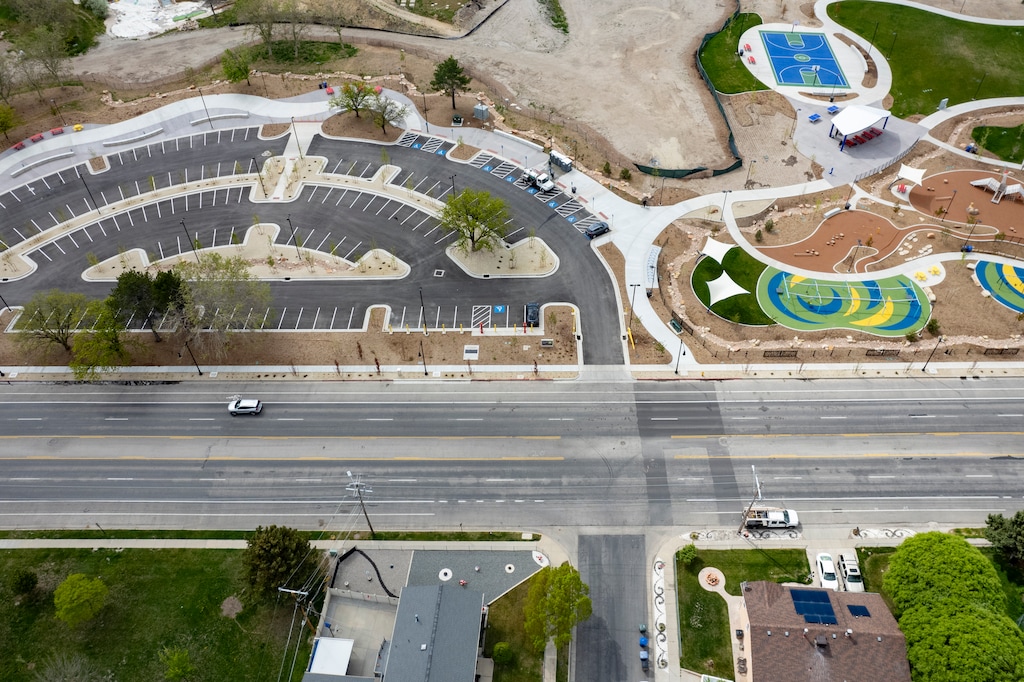
(Rick Egan | The Salt Lake Tribune) Glendale Regional Park and the intersection of Concord Street and 1700 South on Thursday, April 16, 2026.
While the Utah Department of Transportation is supportive of crosswalk improvements, Glendale Neighborhood Council Chair Jennifer Madrigal said a new law that gives the agency veto power over traffic control projects in Salt Lake City could make it more challenging to realize upgrades.
“We would love to take 1700 South down to three lanes total with the center lane. We’ll see if that happens; that’s going to be a lot more difficult to do,” Madrigal said during a neighborhood council meeting last week. “It sounds like UDOT is OK with putting in the [signal at the existing crosswalk], and they’re also very aware that we have that issue with crossing at Concord directly into the park where the playground is.”
UDOT administrator Lisa Zundel said the state agency was “supportive” of adding a new crosswalk and wants to advance both crossing projects “as quickly as we can.”
(Rick Egan | The Salt Lake Tribune) Glendale Regional Park on Thursday, April 16, 2026.
Although only the first phase of amenities is open, the new park has proved to be a big draw for west-side families. However, it sits across the busy 1700 South from the homes and apartments that make up its eponymous neighborhood, making crossing the street sometimes dangerous.
The intersection of the Jordan River Trail and 1700 South, to the east of and across the river from the unimproved portion of the park, has a traffic signal triggered by pedestrians and bikers. Farther west, at 1300 West, another crosswalk exists, but is marked only by flashing yellow lights. Drivers traveling west on 1700 South sometimes blow through that crossing when the sun is low in the afternoon, washing out the signals, residents say.
The city is already working to upgrade that crosswalk with a traffic signal that will display red lights if pedestrians are looking to cross the road.
“[City officials] are working on a shock signal where the current crosswalk is, with the rapid flashing beacon, which will be really nice because it’ll stop traffic … once that’s installed,” the park’s project manager, Jon Ruedas, told attendees at the neighborhood meeting Wednesday.
(Rick Egan | The Salt Lake Tribune) Families play at Glendale Regional Park on Thursday, April 16, 2026.
The most popular destination on the south side of 1700 South, the park’s shiny new playground, is in the middle of those two crossings but is more accessible from the east side. That means some visitors have taken to jaywalking closer to Concord Street and 17th South River Park.
The 2022 master plan for the new green space included “road narrowing” on 1700 South and adding a new crosswalk where jaywalking is most prominent. That crossing could come at one of two locations: the intersection of Concord and 1700 South or between the two parks.
(Christopher Cherrington | The Salt Lake Tribune)
That plan became harder to realize after Gov. Spencer Cox signed SB242 this year, making a host of changes to how and when Salt Lake City can alter its streets. Even though the bill has yet to take effect, city Transportation Division spokesperson Sofia Jeremias said officials are operating as if it’s in place because it will be by the time design and construction happen. So, a new crosswalk and any possible changes to the road’s lanes would likely need UDOT sign-off.
Under a yet-to-be-signed agreement between UDOT and the city required by the new law, the entities will have to place most of the city’s roads into a tiered system that will determine what traffic control tools can be used and what level of oversight each street project will receive. In a 2018 city map, 1700 South was marked as an “arterial,” which could mean the street is more likely to receive the restrictive “Tier 1” designation, which would take lane reductions off the table and place limits on narrowings.
Zundel, the UDOT official, indicated that any lane reductions or narrowings would be subject to increased scrutiny by the agency and further community engagement efforts under the law, though she didn’t rule out such changes.
“This is the exact situation that city residents feared: state legislation preventing or slowing response to real safety issues that should be overseen by city officials in coordination with community members,” city Parks, Natural Lands, Urban Forestry & Trails Advisory Board Chair Kerri Nakamura wrote in a letter about the project to Mayor Erin Mendenhall. “The PNUT Board urges the city to communicate to the Utah Department of Transportation that immediate approvals are necessary.”
(Rick Egan | The Salt Lake Tribune) Glendale Regional Park on Thursday, April 16, 2026.
City officials at last week’s neighborhood meeting vowed to keep looking for solutions at the new regional park.
“It’s sort of an all-hands-on-deck for us in Salt Lake City with [the Public Lands Department] and Transportation and the mayor’s office,” transportation planner Susan Lundmark told neighbors, “in terms of seeing what we can do in the short term and in the long term to help improve safety.”