 Leia Larsen
Note to readers • This story is made possible through a partnership between The Salt Lake Tribune and Grist, a nonprofit environmental media organization.
Environmental groups are suing the federal government over plans to blast a “hydrocarbon highway” through a Utah canyon full of cultural, archaeological and historical resources.
The Trump administration resurrected the project in Nine Mile Canyon in eastern Utah after it stalled out during President Joe Biden’s term. Environmental and historic preservation groups say approvals for the highway bypassed the normal public comment and ecological review processes. The Nine Mile Canyon Coalition, Southern Utah Wilderness Alliance and Center for Biological Diversity filed a lawsuit against the Department of Interior and Bureau of Land Management on Oct. 6 to stop the project.
“It’s like constructing a highway through the Louvre Museum,” J. Michael Hansen, president of the Nine Mile Canyon Coalition, said in a statement.
(Southern Utah Wilderness Alliance) A Native American rock art panel in Nine Mile Canyon near Price.
The BLM’s website refers to Nine Mile as the “world’s longest art gallery” due to its extensive ancient petroglyphs, Native American panels and Pioneer-era axle-grease inscriptions. Nine Mile Canyon covers about 46 miles, and Gate Canyon has 47 historic sites with 43 eligible for the National Register of Historic Places, according to BLM documentation from 2015.
A BLM spokesperson declined to comment on the lawsuit.
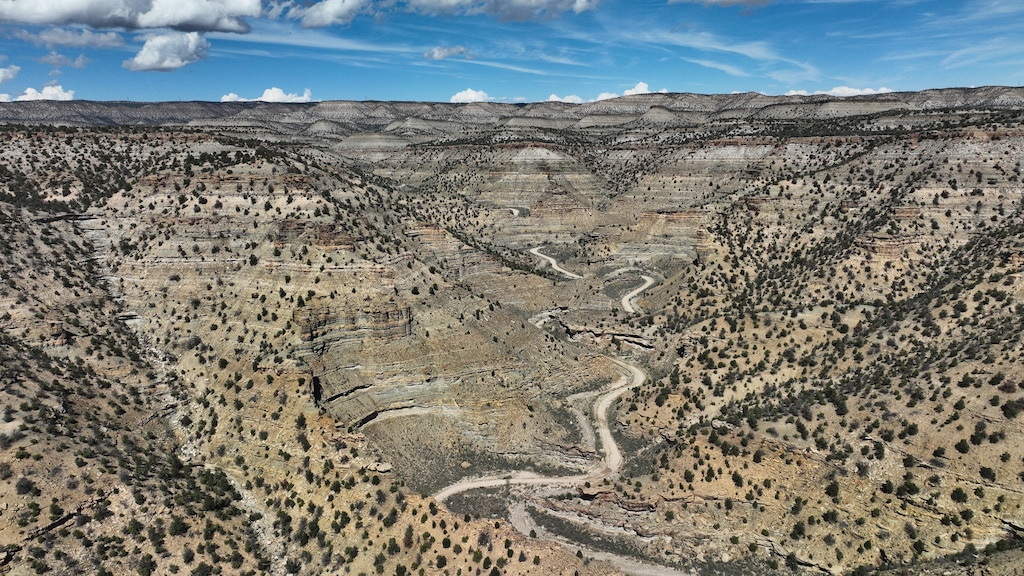
The federal agency began considering plans to realign Gate Canyon’s winding dirt Wells Draw Road in 2015. Duchesne County sought a more direct route from the oil fields in the Uinta Basin to the rail facilities of Carbon County. The project could bring up to 500 heavy trucks through Nine Mile Canyon per day. Duchesne County has also said straightening the old county road would provide for safer travel.
In 2016, the BLM received nearly 700 public comments sharing concerns about impacts to Nine Mile Canyon from the increased traffic, the agency noted in its latest assessment.
The proposed highway would run 5.3 miles through lands owned by both the Bureau of Land Management and Utah’s Trust Lands Administration, although most of the switchbacks the highway project would straighten occur on state land.
(Bureau of Land Management) A proposed realignment of Wells Draw Road that would create a "hydrocarbon highway" between the oilfields of the Uinta Basin and the rail facilities of Carbon County.
The BLM paused its earlier environmental assessment of the project, the lawsuit claims, but it solicited public comments again in 2023 after reviewing an amended right-of-way that covers 2.8 miles running through federal lands. The highway proposal was again hit by a round of opposition. The plan was scrapped, with BLM citing the need for further cultural surveys and reports.
But a Duchesne County special service district submitted a new development plan in September 2025, which they finalized on April 13 of this year. The BLM approved it on April 28 after determining the highway “will not significantly affect” the environment, recreation, wildlife or quality of life.
In their lawsuit, the environmental groups disagreed with that assessment.
“The road construction will facilitate increased traffic through Gate Canyon and the adjoining Nine Mile Canyon, threatening some of the state’s most important cultural and scenic values in the larger Nine Mile Canyon region,” the lawsuit said.
Although the BLM issued a final environmental assessment in April, the environmental groups said the agency violated several federal laws, including the Endangered Species Act, the National Environmental Policy Act, the Federal Land Policy and Management Act and the National Historic Preservation Act.
The Gate Canyon project area potentially includes habitat for the threatened Mexican spotted owl, according to the agency’s own 2015 draft environmental assessment, environmental groups argued.
And despite that previous draft assessment identifying dozens of sites within Gate Canyon that are eligible for the National Register, including 11 “within feet” of the existing dirt road, the parties say the BLM signed off on the project without identifying any historical or archaeological resources.
The plaintiffs said they asked for public comment periods and to participate in the NEPA process after learning of the highway’s new development plan in March, but that the BLM either did not respond or denied those requests.
“This lawsuit challenges the Trump administration’s disgraceful plan to transform a quiet backcountry road into a highway clogged with speeding oil tanker trucks,” said Deeda Seed, senior Utah campaigner at the Center for Biological Diversity. “We’re going to court to protect this irreplaceable cultural treasure and the animals calling it home.”
The federal government has not yet filed a response with the Utah District Court.