 Gordon Monson
Notable it is that whenever Notre Dame takes the field in the fall, there are two religions that hold mighty sway over millions of Americans converging there in a big green cathedral: Catholicism and football.
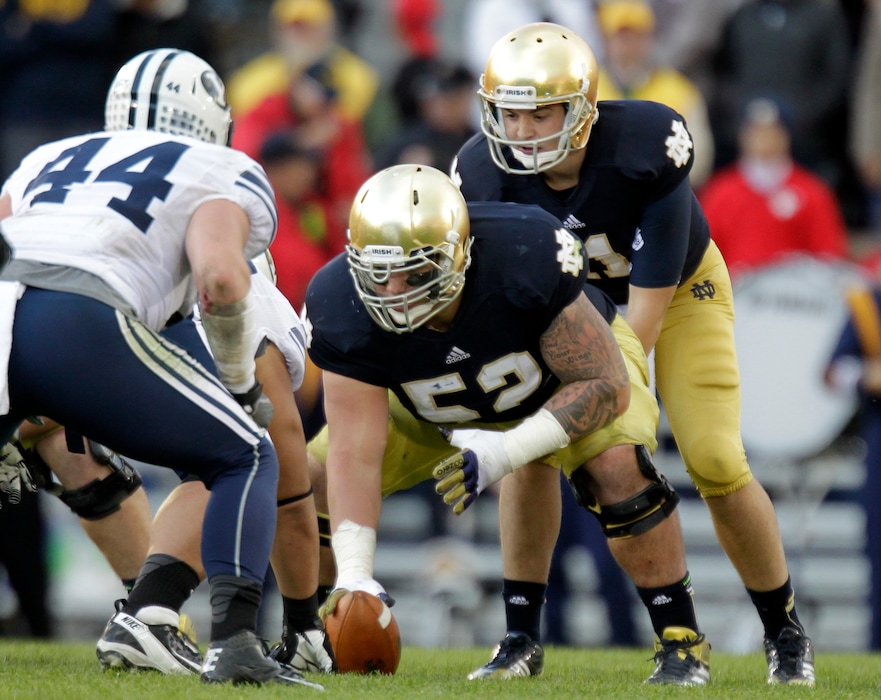
On Saturday, at LaVell Edwards Stadium, when and where the Irish face BYU, a matchup of two undefeated Top 10 teams, there will be three.
Worship what and how you will, but the mix is intriguing enough to draw primetime national television attention and maybe even the focus of a pope and a prophet.
And while I prefer, in a general sense, to separate matters of faith from matters of football, when these two teams play — which they’ve done now nine times, coming up on 10 — it’s hard to completely dodge the notion. For those who insist on vigorously blending faith and football, then God must favor Catholics over Latter-day Saints, seeing that Notre Dame, the school founded by a young priest in 1842, now holds a 7-2 advantage over the school owned and operated by The Church of Jesus Christ of Latter-day Saints.
I don’t figure the Almighty keeps score, though. Not on the gridiron. Not past tracking the good, honest, charitable deeds humans do in day-to-day living and those that humans undo.
It might just mean that Notre Dame has had better football players than BYU, and many of them, on both sides, aren’t even followers of these particular denominations.
BYU quarterback Bear Bachmeier was raised Catholic. And maybe you already know this, but Rudy Ruettiger of “Rudy” film fame is a Latter-day Saint. One of the most significant plays in BYU football history, the famous game-winning bomb from Jim McMahon to Clay Brown in the 1980 Holiday Bowl — the “Miracle Bowl” — was a Catholic-to-Catholic connection.
Anyone who’s visited the campuses in South Bend and Provo knows they are impressive places, quality schools where faculty and students, coaches and players might not be perfect, but they, many of them, anyway, seem to have good intentions.
Most folks around here are familiar with BYU. If you’ve never been to Notre Dame, it’s worth the trip. A lot of college football fans don’t like Notre Dame, or think they don’t, mostly because the Irish win so much and because they often are gifted certain advantages and attention that other schools do not get. But if you go there, it might soften those hard feelings.
The first time I visited the storied campus of Our Lady, the Virgin Mary, and saw its setting, its buildings, its halls, its stadium, its basilica, its lawns, its shrines inside and out of sports, its bookstore, I was impressed. When I walked across the field on game day, the place oozed history. Yeah, they lay it on pretty thick back there, but it’s cool. The only uncool thing I saw was a trail of rat droppings in the old stadium’s press box.
Prior to the start of the game I was covering on that occasion — and games on other occasions — I remember walking across the campus, taking in the sights, kicking up colorful leaves that had fallen from still-colorful maple and oak trees on an autumn day under what Grantland Rice had decades earlier described as a blue-gray October sky.
I can’t remember spotting the Four Horsemen. I do recall interviewing Knute Rockne … no, not the famous Irish coach who won big at the school and died in a plane crash in 1931, but rather Knute Rockne III, the grandson of the original coach, who played football at Utah State and who was a coach and teacher at Brighton High School in Sandy. True story. He said he remembered sitting in his granddad’s house when he was a kid, watching as Notre Dame legends — quarterback Harry Stuhldreher, halfback Jim Crowley, halfback Don Miller and fullback Elmer Layden — walked through the living room minus their mounts.
I strolled past the aforementioned church — the Basilica of the Sacred Heart — located at the center of campus, the cathedral where Rockne’s funeral was held. As I passed by, a football being thrown back and forth on an adjacent lawn by two 10-year-old kids dressed out in Notre Dame jerseys hit a priest standing outside the door straight in the forehead. The priest grinned and granted the boys forgiveness.
God and football, football and God are everywhere on game day. Or they seem to be.
Near the stadium, on the outer wall of a library, there was the large mosaic of Christ, alongside his ancient apostles, with his hands raised in the air, famously known as “Touchdown Jesus.” Other monuments dot the campus, too.
There’s “First-down Moses,” a statue of the Old Testament prophet with a finger pointing forward, and there’s an image of “Fair-catch Corby,” Father Corby being a past school president who is captured in this representation with a raised hand in the air. Neither overshadows Notre Dame’s Sports Heritage Hall, where football memories and memorabilia are displayed, including plaques and pictures of so many Irish All-Americans and past coaching greats, trophies showcasing Heisman winners and national championships, a bronze bust of Rockne and a piece of the plane in which the coach was riding when he died in a Kansas crash.
The football stadium is kind of a stadium inside a stadium, with the old low-slung brick building — naked the first time I saw it — embellished now with new renovations that did their best to add seats and modernize while keeping intact the historical structure.
If you love college football, you’d love that place.
Many of the people there were and are gracious. I was told that students go to Mass on Saturday mornings before home games, ahead of walking to the stadium. I remember asking students at that time for a column I was writing how they felt about the connection between sports and the spiritual. A few of their replies, one coming from within the shadow of the stadium, went like this:
— “Some students really think God cares [about football]. They pray about it, you know, they pray to win. Football and religion go hand in hand here.”
— “I’ve always felt this is a sacred, blessed place to be and I’m not even Catholic. I’m Lutheran. Football, you could say, adds to that atmosphere.”
— During one game that ended in a tight Notre Dame victory, a student said: “We were all in the stands holding hands, hoping, praying I guess. You could sure feel something special in the air.”
In Provo, when I asked around years later, posing the same question at a BYU home game, the expressed sentiments were quite similar, a handful maybe even a bit more fervent.
“I think God’s involved in the details in football and everything else,” one student said.
An infamous quote from a BYU player once proclaimed (uh-huh, wait for it), “When you’re doing what’s right on and off the field, the Lord steps in and plays a part. Magic happens.”
Who’s on the Lord’s side, who? Whose side is the Lord on?
Hmm.
The way I see and saw it, magic can happen on a verdant football field anywhere for anyone, if they make it happen. That’s the beauty, the justice of the college game, whether God is watching or God is busy working so many wonders elsewhere.