 Brooke Larsen
La versión en español de este artículo está disponible aquí.
St. George • On a 90-degree March day, Annette Graf and Jorge Pineda sorted cans of beans, pouches of applesauce and boxes of pasta at the back of Graf’s smoothie shop in St. George. Pop music blasted from speakers as customers ordered cool, fruity drinks at the counter.
Just two months earlier, Graf had been one of roughly 35 people who crammed into a packed Manos Amigas Utah meeting, wondering what she could do to help families affected by the surge in immigrant arrests in Washington County.
Since then, Graf had converted a corner of her Orange Peel smoothie shops into grocery drop-off points.
“I can offer a free space for donations, and that might turn some people away, but I don’t know of anyone else in the area doing anything to raise awareness for this cause,” she said.
About once a week, Pineda and other Manos Amigas volunteers transfer donated food and diapers into plastic totes and reusable bags, load up their car trunks and deliver items to families that have had a loved one and income provider arrested by ICE or county officers.
Arrests by U.S. Immigration and Customs Enforcement, or ICE, increased by about 550% from 2024 to 2025 in southwest Utah, according to the latest data obtained by the Deportation Data Project through Freedom of Information Act litigation.
The surge in immigrant arrests has been supported by local law enforcement in Washington County. The sheriff’s office has two agreements with ICE and aids its efforts with bed space and an office at the Purgatory Correctional Facility in Hurricane, as well as over a dozen officers who are credentialed to enforce immigration laws, former Sheriff Nate Brooksby said at a luncheon in February.
“Every single week we have a new heartbreaking story of someone who’s afraid, someone who’s hiding, someone whose children are hungry, someone whose baby doesn’t have formula or diapers,” Pineda said, “because their loved one who put that food on the table, who bought those diapers for them, is being detained or has been sent to sent back to another country.”
Many of the families are single moms with three or four kids. “That’s the most common story, and that’s my story as well,” Pineda, who’s a son of immigrants, added. His dad was deported last year, and he said it breaks his heart that other families have been separated from their father like he and his siblings have.
Pineda and others started Manos Amigas Utah last fall as they saw neighbors arrested and families struggle to feed their kids. “Manos amigas” means “helping hands” in Spanish, and the volunteer-run group provides immigrant families with groceries, family preparedness plans and communication with those who are detained.
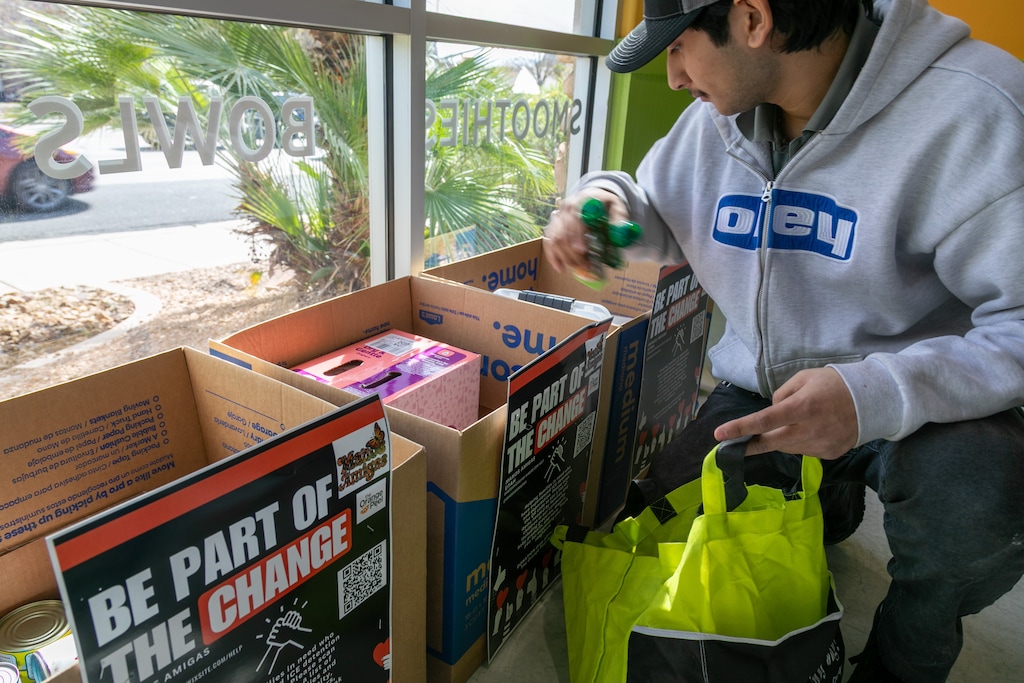
(Jud Burkett | Special to The Tribune) Volunteer Jorge Pineda picks up food and other household items donated to Manos Amigas Utah at the Orange Peel in St. George, Monday, March 16, 2026.
Manos Amigas is currently helping 14 immigrant families in Washington County. Pineda, Graf and about a dozen volunteers are trying to support more families each week.
Sharing her space — and her story
Like Pineda, Graf sees herself in the families who are struggling, she told The Tribune during a morning at her shop. Blenders roared in the background and bright images of strawberries, limes and oranges lined the walls.
Graf was only five years old when her family immigrated to the U.S. “I was trying to remember … why we came in the first place. Obviously, I didn’t get to choose,” she said as she began pulling a document from one of her four boxes of immigration paperwork.
“I found the paperwork that my dad had filed,” she continued, “and you can see somewhere on here, it’s filing for asylum because there was a civil war.”
Her family fled El Salvador during the early ’90s after the country had been embroiled in violent conflict for over a decade. They landed in California, and after a brief stint there, they moved to St. George. A friend of her parents told them it was safe and quiet — just what they were looking for in the U.S.
“There’s a lot of red dirt here,” Graf remembers her parents saying, “but we can make this work.”
When they first arrived, she said her family picked up food boxes from the Dixie Care & Share, a homeless shelter and food bank that has since been absorbed into Switchpoint.
“That’s what we had to do, because we had nothing,” she said. Now she wants to “pay it forward” to the families in similar situations, she added.
(Jud Burkett | Special to The Tribune) Orange Peel owner Annette Graf, right, and volunteer Jorge Pineda pick up food and other household items donated to Manos Amigas Utah at the Orange Peel in St. George, Monday, March 16, 2026.
In the years following, she learned how to navigate the complex immigration system as she and her family sought citizenship.
“[It’s] a lot of time, a lot of details, a lot of charges, a lot of fees, a lot of paperwork,” Graf said. And as soon as they’d get the hang of one policy, a new administration would change things up, she added.
Despite having to navigate this, Graf quickly became “Americanized” as a kid, she said. She played soccer, ran track, worked hard in school and listened to pop, punk and heavy metal music from the U.S. She even joined the Future Farmers of America and won second place in a national agriculture debate competition.
“I was the only brown girl, I wish I had a photo to show you,” she said as she laughed. “It’s like a bunch of red-headed, cute cowboys and me.”
She then went on to start Orange Peel with her husband while in college. “I needed to succeed,” she said. “There was no other option.”
Until recently, “no one, not a soul” knew her immigration story except for her mother’s best friend, who drove Graf to the El Salvador consulate office in Las Vegas for immigration appointments. It was the only time she missed class, she said.
She didn’t think her friends would understand: While she was working two or three jobs and filing and paying for citizenship paperwork, her friends were struggling to get their driver’s license.
“It’s just such a different mode of having to adult very young,” she said.
She recently started sharing her story, though, in hopes that others would understand what some immigrant families in Washington County are going through today and why it’s so hard to become a citizen.
“Less judgement and more kindness,” she said repeatedly, like a mantra she hoped to spread through her community.
A challenge unlike any other
A lot of the people who have donated food and volunteered with Manos Amigas are also immigrants or relatives of immigrants, Graf told The Tribune.
“We know what it felt like,” she said. “We’ve been in those shoes.”
(Jud Burkett | Special to The Tribune) Boxes with Manos Amigas Utah posters sit filled with donations of food and other household items at the Orange Peel in St. George, Monday, March 16, 2026.
Adrian, a volunteer who recently started delivering groceries to a family each week, also immigrated to the U.S. as a young kid. He wasn’t yet 2-years-old when his family left Mexico and landed in California. Like Graf’s family, his parents eventually chose to live in St. George because it was safe.
He has also felt the effect of increased immigration enforcement over the past year: his uncle was arrested by ICE after he lived and worked “sun up to sun down” in the construction industry locally for years, Adrian said.
When Adrian learned about Manos Amigas from Pineda, a friend and former soccer teammate, he immediately said, “Sign me up.”
“I’ve been blown away from all things they’ve been able to do,” he told The Tribune.
In March, Adrian began delivering groceries to Claudia, a mother whose husband and oldest son are currently detained in an immigration detention facility.
Manos Amigas protects the identities of its volunteers and the families it supports. Claudia and Adrian agreed to speak with The Tribune on the condition that their last names be withheld over fears of being targeted by immigration authorities.
On one of the deliveries the Tribune joined, Claudia didn’t arrive home until nearly 7:00 p.m. She had just finished her daily twelve-hour shift cleaning homes. “I’m getting really tired,” she said in Spanish.
Three years ago, Claudia and her family fled Mexico after gang members killed several of her family members, including uncles, aunts, grandparents and her husband’s brother.
“We were fleeing organized crime, which is deeply infiltrated within the judicial, legislative, and executive branches,” she said.
She worries her husband and son will be killed in Mexico if they are deported. “Am I even going to be able to bury them if they go back?” she added. “What am I going to do? I wish I could see them and hug them.”
Her next oldest son, who recently turned 18, has also been working nonstop, she said. Two days after his birthday this year, Claudia signed over custody of her two youngest sons to him in case she is detained too.
All the stress has made him sick recently, she said, and she took him to the hospital after he fainted and experienced worsening headaches, migraines and mental health challenges.
She has noticed her own health struggling from the stress too, including swollen eyes and thinning hair.
“This separation is a challenge unlike any I’ve dealt with in my entire life,” she said. “It’s very difficult.”
She and Manos Amigas have been trying to find a lawyer to represent her family pro bono because she can’t afford legal fees. But so far they have not found one who will take on her husband’s case.
“All I want is for my family to be back,” she said. “My husband’s an excellent father and spouse, a good provider, the head of our household. I don’t see my family without a father. I had a sad childhood because of my absent father.”
“I ask God for strength because there’s no other way,” she added.
(Jud Burkett | Special to The Tribune) A Manos Amigas volunteer picks up food and other household items donated at the Orange Peel in St. George, Monday, March 16, 2026.
If more people imagined themselves in the situation of immigrant families, “trying to survive in a new place with a new language, with new government barriers that they have to learn,” the community and country would become kinder, Graf said.
She hopes more people will help.
“It’ll come back to them someday. It always does,” she said as she smiled and looked at the bright walls of her smoothie shop. “It did for me.”